


Fibroblast growth factor (FGF) signaling in development and skeletal diseases
- PMID: 25679016
- PMCID: PMC4323088
- DOI: 10.1016/j.gendis.2014.09.005
Fibroblast growth factor (FGF) signaling in development and skeletal diseases
Abstract
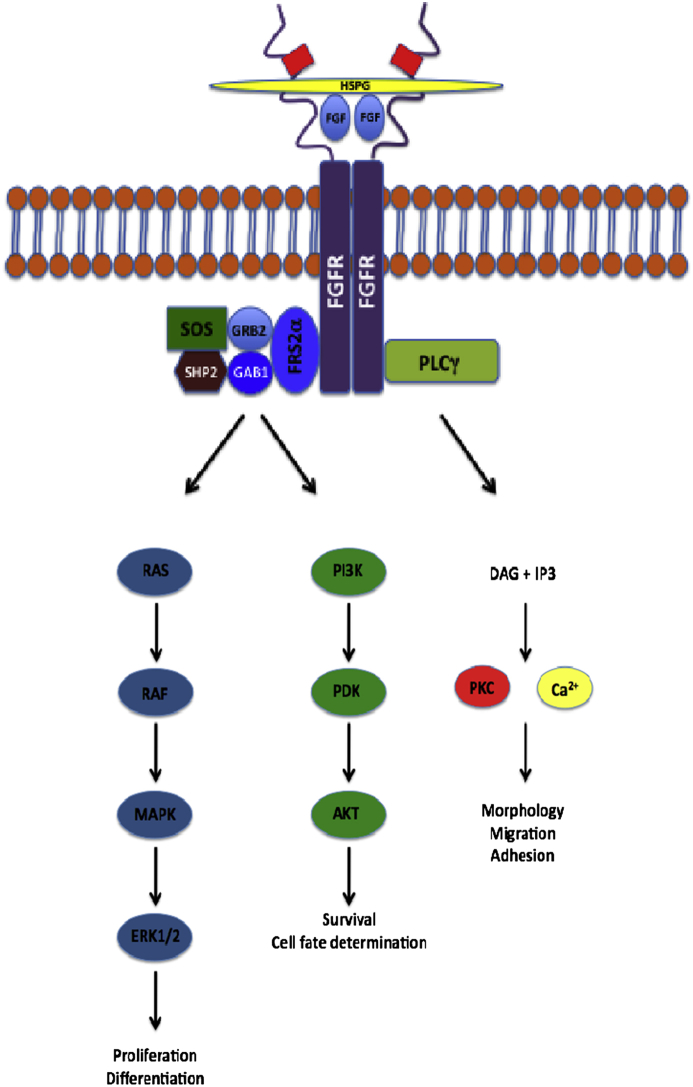
Fibroblast growth factors (FGF) and their receptors serve many functions in both the developing and adult organism. Humans contain 18 FGF ligands and four FGF receptors (FGFR). FGF ligands are polypeptide growth factors that regulate several developmental processes including cellular proliferation, differentiation, and migration, morphogenesis, and patterning. FGF-FGFR signaling is also critical to the developing axial and craniofacial skeleton. In particular, the signaling cascade has been implicated in intramembranous ossification of cranial bones as well as cranial suture homeostasis. In the adult, FGFs and FGFRs are crucial for tissue repair. FGF signaling generally follows one of three transduction pathways: RAS/MAP kinase, PI3/AKT, or PLCγ. Each pathway likely regulates specific cellular behaviors. Inappropriate expression of FGF and improper activation of FGFRs are associated with various pathologic conditions, unregulated cell growth, and tumorigenesis. Additionally, aberrant signaling has been implicated in many skeletal abnormalities including achondroplasia and craniosynostosis. The biology and mechanisms of the FGF family have been the subject of significant research over the past 30 years. Recently, work has focused on the therapeutic targeting and potential of FGF ligands and their associated receptors. The majority of FGF-related therapy is aimed at age-related disorders. Increased understanding of FGF signaling and biology may reveal additional therapeutic roles, both in utero and postnatally. This review discusses the role of FGF signaling in general physiologic and pathologic embryogenesis and further explores it within the context of skeletal development.
Keywords: Craniosynostosis; FGF signaling; Fibroblast growth factor; Fibroblast growth factor receptor; Genetics; Pathogenesis; Signal transduction; Skeletal development.
Figures
References
-
- Seitz I.A., Teven C.M., Reid R.R., editors; Neligan P.C., Gurtner G.C., editors. Repair and Grafting of Bone. vol. 1. Elsevier Saunders; Philadelphia, PA: 2012. (Plastic Surgery). [Priciples]
-
- Thisse B., Thisse C. Functions and regulations of fibroblast growth factor signaling during embryonic development. Dev Biol. Nov 15 2005;287:390–402. - PubMed
-
- Itoh N., Ornitz D.M. Evolution of the Fgf and Fgfr gene families. Trends Genet. Nov 2004;20:563–569. - PubMed
Grants and funding
LinkOut - more resources
Full Text Sources
Other Literature Sources
Miscellaneous