


Effectiveness of a universal parental support programme to promote healthy dietary habits and physical activity and to prevent overweight and obesity in 6-year-old children: the Healthy School Start Study, a cluster-randomised controlled trial
- PMID: 25680096
- PMCID: PMC4332680
- DOI: 10.1371/journal.pone.0116876
Effectiveness of a universal parental support programme to promote healthy dietary habits and physical activity and to prevent overweight and obesity in 6-year-old children: the Healthy School Start Study, a cluster-randomised controlled trial
Abstract
Objective: To develop and evaluate the effectiveness of a parental support programme to promote healthy dietary and physical activity habits and to prevent overweight and obesity in Swedish children.
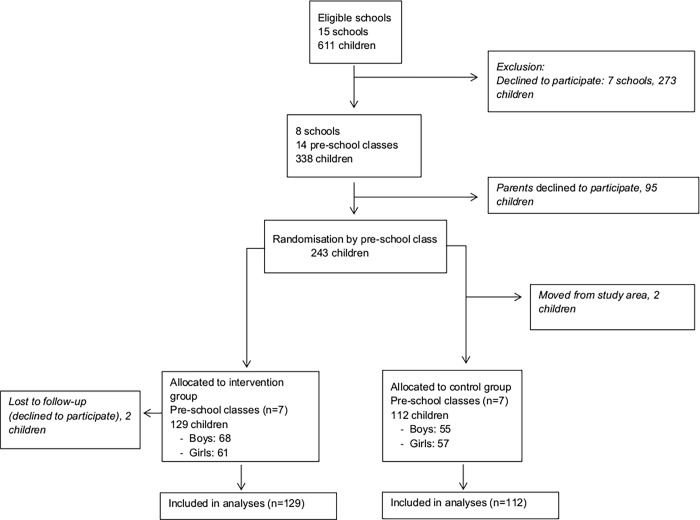
Methods: A cluster-randomised controlled trial was carried out in areas with low to medium socio-economic status. Participants were six-year-old children (n = 243) and their parents. Fourteen pre-school classes were randomly assigned to intervention (n = 7) and control groups (n = 7). The intervention lasted for 6 months and included: 1) Health information for parents, 2) Motivational Interviewing with parents and 3) Teacher-led classroom activities with children. Physical activity was measured by accelerometry, dietary and physical activity habits and parental self-efficacy through a questionnaire. Body weight and height were measured and BMI standard deviation score was calculated. Measurements were conducted at baseline, post-intervention and at 6-months follow-up. Group differences were examined using analysis of covariance and Poisson regression, adjusted for gender and baseline values.
Results: There was no significant intervention effect in the primary outcome physical activity. Sub-group analyses showed a significant gender-group interaction in total physical activity (TPA), with girls in the intervention group demonstrating higher TPA during weekends (p = 0.04), as well as in sedentary time, with boys showing more sedentary time in the intervention group (p = 0.03). There was a significantly higher vegetable intake (0.26 servings) in the intervention group compared to the control group (p = 0.003). At follow-up, sub-group analyses showed a sustained effect for boys. The intervention did not affect the prevalence of overweight or obesity.
Conclusions: It is possible to influence vegetable intake in children and girls' physical activity through a parental support programme. The programme needs to be intensified in order to increase effectiveness and sustain the effects long-term. These findings are an important contribution to the further development of evidence-based parental support programmes to prevent overweight and obesity in children.
Trial registration: Controlled-trials.com ISRCTN32750699.
Conflict of interest statement
References
-
- Lim SS, Vos T, Flaxman AD, Danaei G, Shibuya K, et al. (2013) A comparative risk assessment of burden of disease and injury attributable to 67 risk factors and risk factor clusters in 21 regions, 1990–2010: a systematic analysis for the Global Burden of Disease Study 2010. Lancet 380: 2224–2260. - PMC - PubMed
Publication types
MeSH terms
Associated data
LinkOut - more resources
Full Text Sources
Other Literature Sources
Medical
