


Minimally invasive aortic valve replacement provides equivalent outcomes at reduced cost compared with conventional aortic valve replacement: A real-world multi-institutional analysis
- PMID: 25680751
- PMCID: PMC4409485
- DOI: 10.1016/j.jtcvs.2015.01.014
Minimally invasive aortic valve replacement provides equivalent outcomes at reduced cost compared with conventional aortic valve replacement: A real-world multi-institutional analysis
Abstract
Background: Several single-center studies have reported excellent outcomes with minimally invasive aortic valve replacement (mini-AVR). Although criticized as requiring more operative time and complexity, mini-AVR is increasingly performed. We compared contemporary outcomes and cost of mini-AVR versus conventional AVR in a multi-institutional regional cohort. We hypothesized that mini-AVR provides equivalent outcomes to conventional AVR without increased cost.
Methods: Patient records for primary isolated AVR (2011-2013) were extracted from a regional, multi-institutional Society of Thoracic Surgeons database and stratified by conventional versus mini-AVR, performed by either partial sternotomy or right thoracotomy. To compare similar patients, a 1:1 propensity-matched cohort was performed after adjusting for surgeon; operative year; and Society of Thoracic Surgeons risk score, including age and risk factors (n = 289 in each group). Differences in outcomes and cost were analyzed.
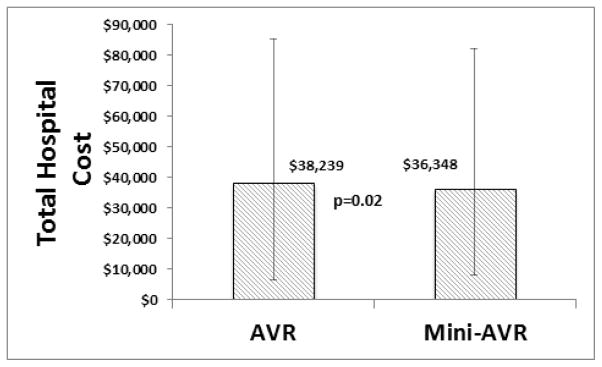
Results: A total of 1341 patients underwent primary isolated AVR, of which 442 (33%) underwent mini-AVR at 17 hospitals. Mortality, stroke, renal failure, and other major complications were equivalent between groups. Mini-AVR was associated with decreased ventilator time (5 vs 6 hours; P = .04) and decreased blood product transfusion (25% vs 32%; P = .04). A greater percentage of mini-AVR patients were discharged within 4 days of the operation (15.2% vs 4.8%; P < .001). Consequently, total hospital costs were lower in the mini-AVR group ($36,348 vs $38,239; P = .02).
Conclusions: Mortality and morbidity outcomes of mini-AVR are equivalent to conventional AVR. Mini-AVR is associated with decreased ventilator time, blood product use, early discharge, and reduced total hospital cost. In contemporary clinical practice, mini-AVR is safe and cost-effective.
Copyright © 2015 The American Association for Thoracic Surgery. Published by Elsevier Inc. All rights reserved.
Conflict of interest statement
Conflicts of Interest Statement: The authors have no conflict of interest that would impact this study’s design, data collection, analysis, and interpretation.
Figures
Comment in
-
The value of measuring value.J Thorac Cardiovasc Surg. 2015 Apr;149(4):1066. doi: 10.1016/j.jtcvs.2015.01.049. Epub 2015 Feb 7. J Thorac Cardiovasc Surg. 2015. PMID: 25749143 No abstract available.
References
-
- Brown JM, O’Brien SM, Wu C, Sikora JA, Griffith BP, Gammie JS. Isolated aortic valve replacement in North America comprising 108,687 patients in 10 years: changes in risks, valve types, and outcomes in the Society of Thoracic Surgeons National Database. The Journal of thoracic and cardiovascular surgery. 2009;137:82–90. - PubMed
-
- Cosgrove DM, 3rd, Sabik JF. Minimally invasive approach for aortic valve operations. The Annals of thoracic surgery. 1996;62:596–7. - PubMed
-
- Tabata M, Umakanthan R, Cohn LH, Bolman RM, 3rd, Shekar PS, Chen FY, et al. Early and late outcomes of 1000 minimally invasive aortic valve operations. European journal of cardio-thoracic surgery: official journal of the European Association for Cardio-thoracic Surgery. 2008;33:537–41. - PubMed
-
- Johnston DR, Atik FA, Rajeswaran J, Blackstone EH, Nowicki ER, Sabik JF, 3rd, et al. Outcomes of less invasive J-incision approach to aortic valve surgery. The Journal of thoracic and cardiovascular surgery. 2012;144:852–8. e3. - PubMed
Publication types
MeSH terms
Grants and funding
LinkOut - more resources
Full Text Sources
Other Literature Sources
