


Moderators of the effects of group-based physical exercise on cancer survivors' quality of life
- PMID: 25680762
- PMCID: PMC4519631
- DOI: 10.1007/s00520-015-2622-z
Moderators of the effects of group-based physical exercise on cancer survivors' quality of life
Abstract
Purpose: This study explored demographic, clinical, and psychological moderators of the effect of a group-based physical exercise intervention on global quality of life (QoL) among cancer survivors who completed treatment.
Methods: Cancer survivors were assigned to a 12-week physical exercise (n = 147) or a wait-list control group (n = 62). The main outcome measure was global QoL, assessed with the EORTC QLQ-C30 at baseline and 12 weeks later. Potential moderators were age, gender, education level, marital status, employment status, type of treatment, time since treatment, the presence of comorbidities, fatigue, general self-efficacy, depression, and anxiety. Linear regression analyses were used to test effect modification of the intervention by each moderator variable using interaction tests (p ≤ 0.10).
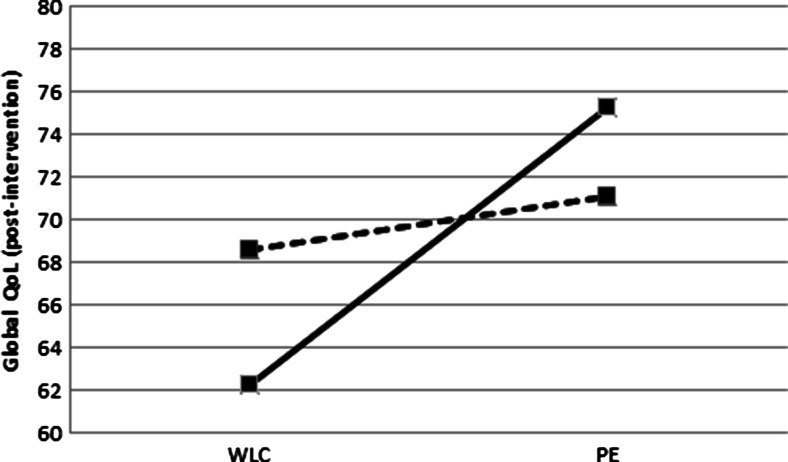
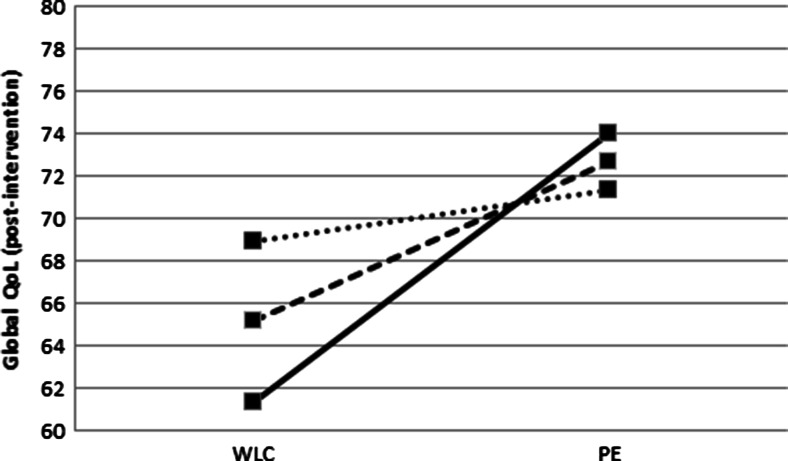
Results: The physical exercise intervention effect on global QoL was larger for cancer survivors who received radiotherapy (β = 10.3, 95 % confidence interval (CI) = 4.4; 16.2) than for cancer survivors who did not receive radiotherapy (β = 1.8, 95 % CI = -5.9; 9.5, p interaction = 0.10), larger for cancer survivors who received a combination of chemoradiotherapy (β = 13.0, 95 % CI = 6.0; 20.1) than for those who did not receive this combination of treatments (β = 2.5, 95 % CI = -3.7; 8.7, p interaction = 0.02), and larger for cancer survivors with higher baseline levels of fatigue (β = 12.6, 95 % CI = 5.7; 19.6) than for those with lower levels (β = 2.4, 95 % CI = -3.9; 8.7, p interaction = 0.03). No other moderating effects were found.
Conclusions: This study suggests that cancer treatment modality and baseline fatigue levels moderate the effect of a physical exercise program on cancer survivors'global QoL.
Figures
References
-
- Rowland JH, Kent EE, Forsythe LP, Loge JH, Hjorth L, Glaser A, Mattioli V, Fossa SD. Cancer survivorship research in Europe and the United States: where have we been, where are we going, and what can we learn from each other? Cancer. 2013;119(Suppl 11):2094–2108. doi: 10.1002/cncr.28060. - DOI - PMC - PubMed
-
- International Agency for Research on Cancer. GLOBOCAN 2012: estimated cancer incidence, mortality and prevalence worldwide in 2012. (2014). http://globocan.iarc.fr/Pages/fact_sheets_cancer.aspx. Accessed 24 Feb 2014
-
- Curt GA, Breitbart W, Cella D, Groopman JE, Horning SJ, Itri LM, Johnson DH, Miaskowski C, Scherr SL, Portenoy RK, Vogelzang NJ. Impact of cancer-related fatigue on the lives of patients: new findings from the Fatigue Coalition. Oncologist. 2000;5:353–360. doi: 10.1634/theoncologist.5-5-353. - DOI - PubMed
Publication types
MeSH terms
LinkOut - more resources
Full Text Sources
Other Literature Sources
Medical
