


Infection in home health care: Results from national Outcome and Assessment Information Set data
- PMID: 25681302
- PMCID: PMC4437508
- DOI: 10.1016/j.ajic.2014.12.017
Infection in home health care: Results from national Outcome and Assessment Information Set data
Abstract
Background: Patients in home health care (HHC), the fastest growing health care sector, are at risk for infection. The existing research on infection in HHC is often limited by small sample sizes, local scope of inquiry, and a lack of current data. There is no national study examining agency-level infection rates.
Methods: This secondary data analysis used a 20% random sample of the 2010 national Outcome and Assessment Information Set (OASIS) data. An infection case was identified when the HHC patient was hospitalized or received emergency care for respiratory infection, urinary tract infection, intravenous catheter-related infection, wound infection, or deterioration. Proportions of infection cases out of the total number of patients were calculated for the whole sample and for each HHC agency.
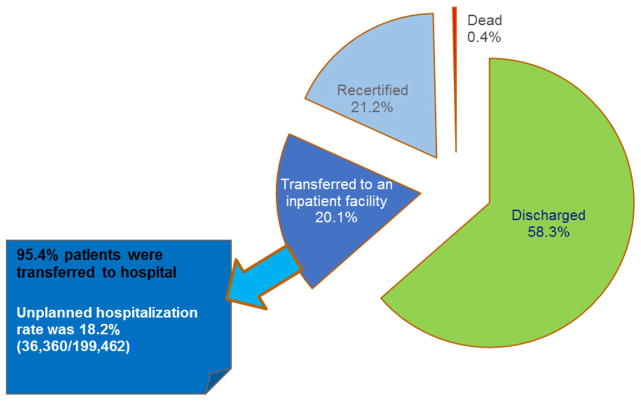
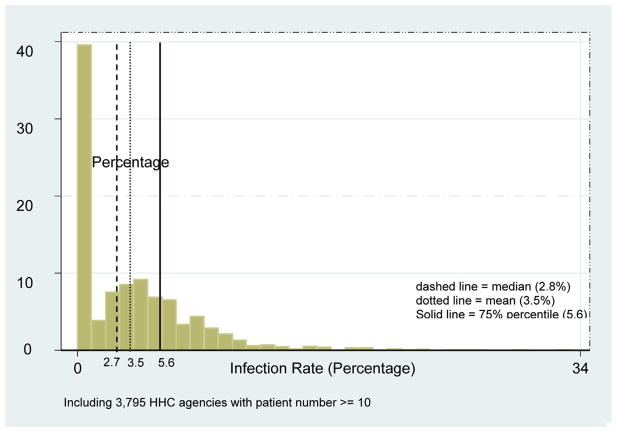
Results: The final analysis included 199,462 patients from 8,255 HHC agencies. Approximately 3.5% of patients developed infections during their HHC stay, leading to emergency care treatment or hospitalization. Seventeen percent of unplanned hospitalizations among HHC patients were caused by infections. The agency-level infection rate ranged from 0%-34%, with an average of 3.5%.
Conclusion: To our knowledge, this is the first study to examine the proportion of hospitalizations or emergency care treatment caused by infection in HHC and the agency-level infection rate at a national level by using OASIS data. These data demonstrate that infection is a serious problem in HHC, and infection rates varied between agencies. The variance in agency level rates may be caused by differences in infection control policies and practices. Better infection surveillance system in HHC is needed to benchmark quality of care.
Keywords: Home health care; Infection; Outcome and Assessment Information Set.
Copyright © 2015. Published by Elsevier Inc.
Conflict of interest statement
Conflicts of interest: None to report.
Figures
References
-
- Clark P. Emergence of infection control surveillance in alternative health care settings. J Infus Nurs. 2010;33:363–70. - PubMed
-
- Sheldon P, Bender M. High-technology in home care. An overview of intravenous therapy. Nurs Clin North Am. 1994;29:507–19. - PubMed
-
- National Association for Home Care & Hospice. [Accessed January 21st, 2015];Basic statistics about home care. 2010 Available from: http://www.nahc.org/assets/1/7/10HC_Stats.pdf.
Publication types
MeSH terms
Grants and funding
LinkOut - more resources
Full Text Sources
Other Literature Sources
Medical
