. 2015 Apr;66(7):1977-85.
doi: 10.1093/jxb/eru545. Epub 2015 Feb 14.

Multiple steps control immunity during the intracellular accommodation of rhizobia

Affiliations

Multiple steps control immunity during the intracellular accommodation of rhizobia

Fathi Berrabah et al. J Exp Bot. 2015 Apr.

Abstract

Medicago truncatula belongs to the legume family and forms symbiotic associations with nitrogen fixing bacteria, the rhizobia. During these interactions, the plants develop root nodules in which bacteria invade the plant cells and fix nitrogen for the benefit of the plant. Despite massive infection, legume nodules do not develop visible defence reactions, suggesting a special immune status of these organs. Some factors influencing rhizobium maintenance within the plant cells have been previously identified, such as the M. truncatula NCR peptides whose toxic effects are reduced by the bacterial protein BacA. In addition, DNF2, SymCRK, and RSD are M. truncatula genes required to avoid rhizobial death within the symbiotic cells. DNF2 and SymCRK are essential to prevent defence-like reactions in nodules after bacteria internalization into the symbiotic cells. Herein, we used a combination of genetics, histology and molecular biology approaches to investigate the relationship between the factors preventing bacterial death in the nodule cells. We show that the RSD gene is also required to repress plant defences in nodules. Upon inoculation with the bacA mutant, defence responses are observed only in the dnf2 mutant and not in the symCRK and rsd mutants. In addition, our data suggest that lack of nitrogen fixation by the bacterial partner triggers bacterial death in nodule cells after bacteroid differentiation. Together our data indicate that, after internalization, at least four independent mechanisms prevent bacterial death in the plant cell. These mechanisms involve successively: DNF2, BacA, SymCRK/RSD and bacterial ability to fix nitrogen.

Keywords: CRK; DNF2; bacA; innate immunity; nifA; nifH; nitrogen fixation..


Figures

Fig. 1.
Fig. 1.
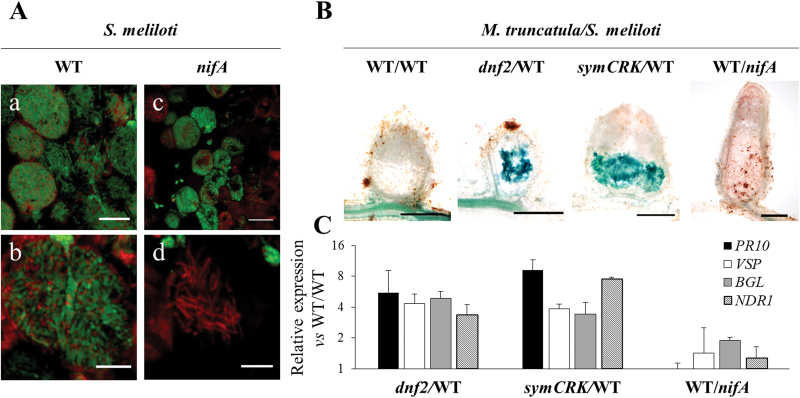
Mutation in nifA elicits early bacterial death that is not mediated by symCRK/dnf2-dependant defence reactions. (A): a–d: On these sections of 26dpi nodules imaged using a confocal microscope after live/dead staining assay, the early death of the nifA mutant within the plant cell is observable. Green and red stain alive and dead bacteria respectively. a and b represent WT bacteria induced nodules, c and d: nifA induced nodules, note that like the WT bacteria, the nifA mutant undergoes terminal differentiation, scale bars correspond to, 20µm (a, c) and 10µm (b, d). (B): nifA mutant does not elicit the accumulation of phenolics in nodules. Sections of WT plant nodules induced by WT bacteria or by nifA mutant as well as dnf2 and symCRK nodules induced by WT bacteria were stained with methylene blue to reveal phenolics in blue. Scale bars correspond to 500 µm. (C): PR10, VSP, BGL and NDR1 defence-related genes are not induced in nifA-triggered nodules. In contrast these defence-related genes are induced in dnf2 and symCRK nodules as revealed by RT-qPCR analysis. Results are expressed as induction fold vs R108 nodules induced by WT bacteria after normalization using Mtactin2 constitutive gene as an internal standard.
Fig. 2.
Fig. 2.
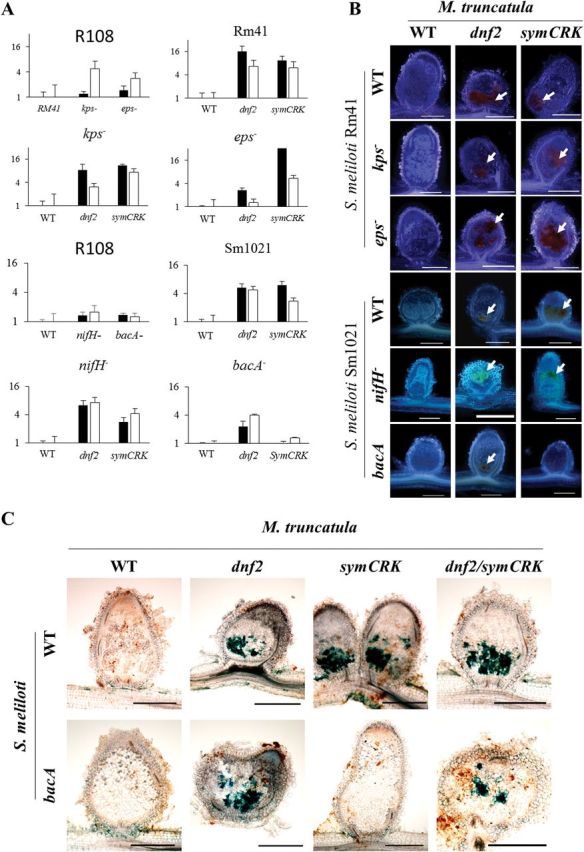
DNF2, bacA and SymCRK act successively during the symbiotic process. (A) Development of defence reactions was investigated in nodules by evaluating the expression of defence-related genes PR10 and NDR1. The four top sub-panels correspond to plants inoculated with Rm41 WT or the corresponding mutant strains. The four bottom sub-panels correspond to plants inoculated with Sm1021 WT or the corresponding mutant strains. The top left sub-panel of each four sub-panels corresponds to gene expression in the R108 WT plants inoculated by the WT bacteria or its mutant derivatives. The three other sub-panels correspond to gene expression in the R108 WT or dnf2 or symCRK mutants inoculated by different bacteria. (B) The development of defence reactions was investigated in nodules by examination of necrotic zone in nodule section. Columns represent the plant genotypes and rows the bacterial genotypes. Arrows in (B) point to the necrotic zones. (C) Accumulation of phenolic compounds is revealed by the blue color on nodule sections stained with methylene blue. B, C: scale bars correspond to 500 µm.
Fig. 3.
Fig. 3.
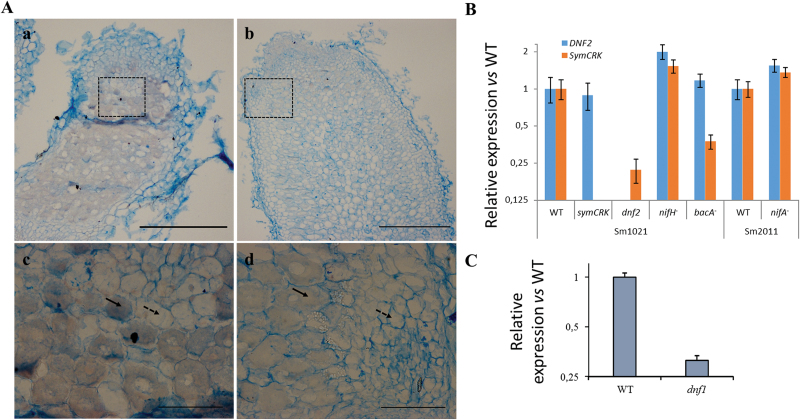
SymCRK is expressed in infected cells. (A) Expression of SymCRK was investigated using in situ hybridization and (B, C) RT-qPCR. Using antisense probe (a, c), signal was detected in infected cells (indicated with plain arrows) of the nitrogen fixation zone and not in uninfected cells (indicated with dashed arrows); sense probe was used as a control of specificity (b, d). c, d represent magnification of the zones delimited by a dashed rectangle in a and b. Scale bars represent 300 and 30 µm in whole nodule sections and in enlargement respectively. (B) RT-qPCR analyses revealed that SymCRK expression is strongly reduced in nodules of the dnf2 mutant. In contrast, the expression of DNF2 is not altered in the symCRK nodules. Also, expression of SymCRK was strongly reduced in the bacA induced nodules (B) as well as in the 14dpi nodules of the dnf1 mutant (C). B, C: error bars represent standard errors of three biological experiments with two technical replicates.
Fig. 4.
Fig. 4.
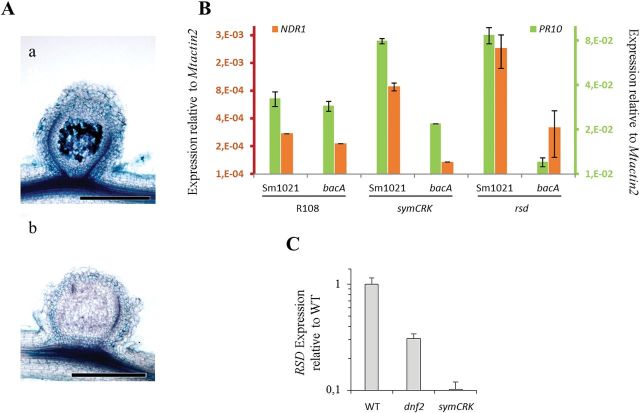
RSD is required to suppress immunity in nodules and act downstream of bacA. (Aa) Upon inoculation with the WT Sinorhizobium meliloti, the rsd-1 mutant nodules (32dpi) accumulate phenolics as revealed by methylene blue staining of nodules sections. (Ab) In contrast, bacA triggered nodules do not accumulate phenolics; scale bars represent 500 µm. (B) In agreement, RT-qPCR analyses indicate that defences are activated in rsd nodules induced by the WT bacteria but not in those triggered by the bacA mutant. (C) RSD expression is strongly reduced in dnf2 and symCRK mutant nodules. B, C: error bars represent standard errors.
Fig. 5.
Fig. 5.
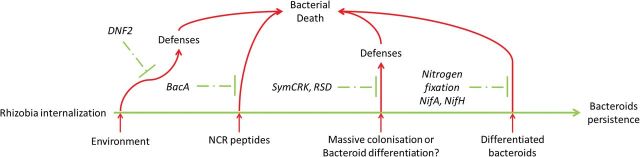
Bacteroid death is prevented by multiple actors acting successively. DNF2 is the earliest actor identified as required for symbiotic suppression of immunity at the intracellular stage of the symbiosis. Its requirement is determined by environmental conditions that influence the development of defence-like reactions in nodules (Berrabah et al., 2014a ). After DNF2, the bacA bacterial gene prevents the NCR triggered bacteroid death (Haag et al., 2011). Later, SymCRK and RSD prevent defence-like reactions possibly triggered by massive intracellular invasion or initiation of bacteroid differentiation. Finally, nitrogen fixation is required to prevent the death of elongated bacteroids.

References

    1. Alunni B, Kevei Z, Redondo-Nieto M, Kondorosi A, Mergaert P, Kondorosi E. 2007. Genomic organization and evolutionary insights on GRP and NCR genes, two large nodule-specific gene families in Medicago truncatula . Molecular Plant Microbe Interactions 20, 1138–1148. - PubMed
    1. Becquart-de Kozak I, Reuhs BL, Buffard D, Breda C, Kim JS, Esnault R, Kondorosi A. 1997. Role of the K-Antigen Subgroup of Capsular Polysaccharides in the Early Recognition Process Between Rhizobium meliloti and Alfalfa Leaves. Molecular Plant-Microbe Interactions 10, 114–123.
    1. Berrabah F, Bourcy M, Eschstruth A, et al. 2014. a A nonRD receptor-like kinase prevents nodule early senescence and defense-like reactions during symbiosis. New Phytologist 203, 1305–1314. - PubMed
    1. Berrabah F, Bourcy M, Cayrel A, Eschstruth A, Mondy S, Ratet P, Gourion B. 2014. b Growth conditions determine the DNF2 requirement for symbiosis. PLoS One 9, e91866. - PMC - PubMed
    1. Bobik C, Meilhoc E, Batut J. 2006. FixJ: a major regulator of the oxygen limitation response and late symbiotic functions of Sinorhizobium meliloti . Journal of Bacteriology 188, 4890–4902. - PMC - PubMed

Publication types

MeSH terms