


Review
doi: 10.1038/cmi.2015.10.
Epub 2015 Feb 16.
FOXP3+ regulatory T cells and their functional regulation
Affiliations
- PMID: 25683611
- PMCID: PMC4579651
- DOI: 10.1038/cmi.2015.10
Item in Clipboard
Review
FOXP3+ regulatory T cells and their functional regulation
Cell Mol Immunol.
2015 Sep.
Abstract
FOXP3(+) regulatory T (Treg) cells are critical in maintaining immune tolerance and homeostasis of the immune system. The molecular mechanisms underlying the stability, plasticity and functional activity of Treg cells have been much studied in recent years. Here, we summarize these intriguing findings, and provide insight into their potential use or manipulation during Treg cell therapy for the treatment of autoimmune diseases, graft-versus-host disease (GVHD) and cancer.
Figures
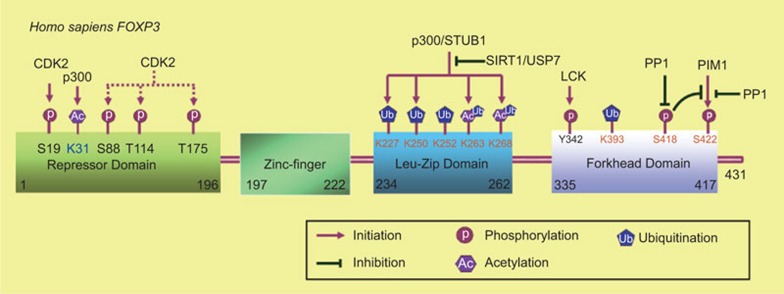
Identified enzymes that are responsible for the post-translational modifications of FOXP3 and their corresponding modified residues in human FOXP3. Acetylation of FOXP3 at K263 and K268 by the acetyltransferase p300 stabilizes FOXP3 and promote its activity, while SIRT1 modulates the reciprocal modification. The E3 ligase STUB1 promotes the ubiquitination of FOXP3 at its leucine-zipper domain (K227, K250, K252, K263 and K268) and leads to its degradation, while the deubiquitinase USP7 prevents the ubiquitination process and stabilizes FOXP3. Acetylation and ubiquitination may compete for the same lysine residues in the leucine-zipper domain of FOXP3 to affect its stability and activity. FOXP3 is highly phosphorylated at Ser418 and dephosphorylation at the residue mediated by the phosphotase PP1 downregulates its repressive activity; The kinase PIM1 phosphorylates FOXP3 at Ser422 and negatively regulates FOXP3 activity, while the phosphatase PP1 works oppositely. Furthermore, phosphorylation at Ser418 prevents PIM1-mediated phosphorylation at Ser422. CDK2 phosphorylates FOXP3 at Ser88, Thr144 and Thr175 and promotes FOXP3 degradation. LCK phosphorylates FOXP3 at Tyr342 and enhances the repressive activity of FOXP3. CDK2, cyclin-dependent kinase 2; LCK, lymphocyte-specific protein kinase; PP1, protein phosphatase 1.
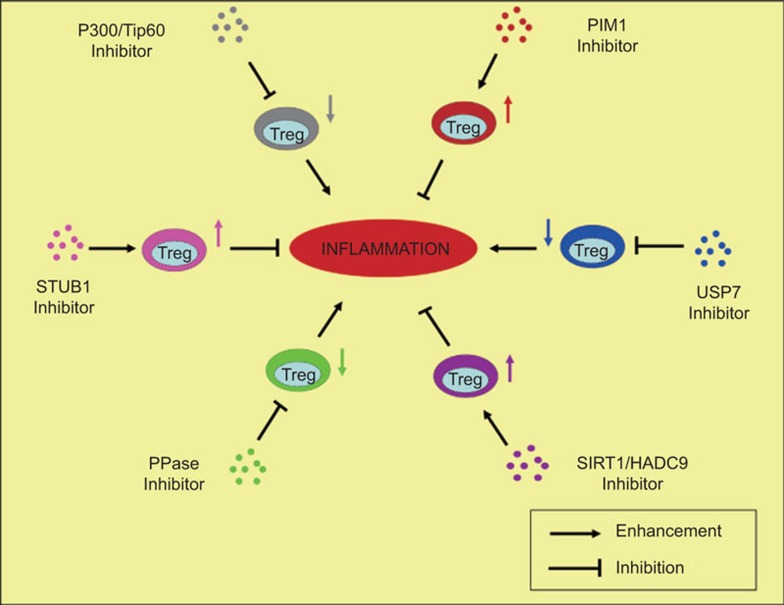
Enzymes responsible for post-translational modification of FOXP3 are potential therapeutic targets for inflammation. Inhibitors of FOXP3 positive regulators, including P300/TIP60, USP7 and PPase, could be used to activate immune system through downregulating the immunosuppressive activity of Treg cells; inhibitors of FOXP3 negative regulators, including SIRT1/HDAC9, STUB1 and PIM1, could be used to put a brake on immune responses through upregulating the immunosuppressive function of Treg cells. Treg, regulatory T.
References
-
- 1Sakaguchi S, Sakaguchi N, Asano M, Itoh M, Toda M. Immunologic self-tolerance maintained by activated T cells expressing IL-2 receptor alpha-chains (CD25). Breakdown of a single mechanism of self-tolerance causes various autoimmune diseases. J Immunol 1995; 155: 1151–1164. - PubMed
-
- 2Wing K, Sakaguchi S. Regulatory T cells exert checks and balances on self tolerance and autoimmunity. Nat Immunol 2010; 11: 7–13. - PubMed
-
- 3Littman DR, Rudensky AY. Th17 and regulatory T cells in mediating and restraining inflammation. Cell 2010; 140: 845–858. - PubMed
-
- 5Feuerer M, Hill JA, Mathis D, Benoist C. Foxp3+ regulatory T cells: differentiation, specification, subphenotypes. Nat Immunol 2009; 10: 689–695. - PubMed
Publication types
MeSH terms
Substances
LinkOut - more resources
Full Text Sources
Other Literature Sources
