. 2015 Jun;172(12):3099-111.
doi: 10.1111/bph.13114. Epub 2015 Apr 23.

Inhibiting endocannabinoid biosynthesis: a novel approach to the treatment of constipation

Affiliations

Inhibiting endocannabinoid biosynthesis: a novel approach to the treatment of constipation

M Bashashati et al. Br J Pharmacol. 2015 Jun.

Abstract

Background and purpose: Endocannabinoids are a family of lipid mediators involved in the regulation of gastrointestinal (GI) motility. The expression, localization and function of their biosynthetic enzymes in the GI tract are not well understood. Here, we examined the expression, localization and function of the enzyme diacylglycerol lipase-α (DAGLα), which is involved in biosynthesis of the endocannabinoid 2-arachidonoylglycerol (2-AG).

Experimental approach: Cannabinoid CB1 receptor-deficient, wild-type control and C3H/HeJ mice, a genetically constipated strain, were used. The distribution of DAGLα in the enteric nervous system was examined by immunohistochemistry. Effects of the DAGL inhibitors, orlistat and OMDM-188 on pharmacologically induced GI hypomotility were assessed by measuring intestinal contractility in vitro and whole gut transit or faecal output in vivo. Endocannabinoid levels were measured by mass spectrometry.

Key results: DAGLα was expressed throughout the GI tract. In the intestine, unlike DAGLβ, DAGLα immunoreactivity was prominently expressed in the enteric nervous system. In the myenteric plexus, it was colocalized with the vesicular acetylcholine transporter in cholinergic nerves. In normal mice, inhibiting DAGL reversed both pharmacologically reduced intestinal contractility and pharmacologically prolonged whole gut transit. Moreover, inhibiting DAGL normalized faecal output in constipated C3H/HeJ mice. In colons incubated with scopolamine, 2-AG was elevated while inhibiting DAGL normalized 2-AG levels.

Conclusions and implications: DAGLα was expressed in the enteric nervous system of mice and its inhibition reversed slowed GI motility, intestinal contractility and constipation through 2-AG and CB1 receptor-mediated mechanisms. Our data suggest that DAGLα inhibitors may be promising candidates for the treatment of constipation.


Figures

Figure 1
Figure 1
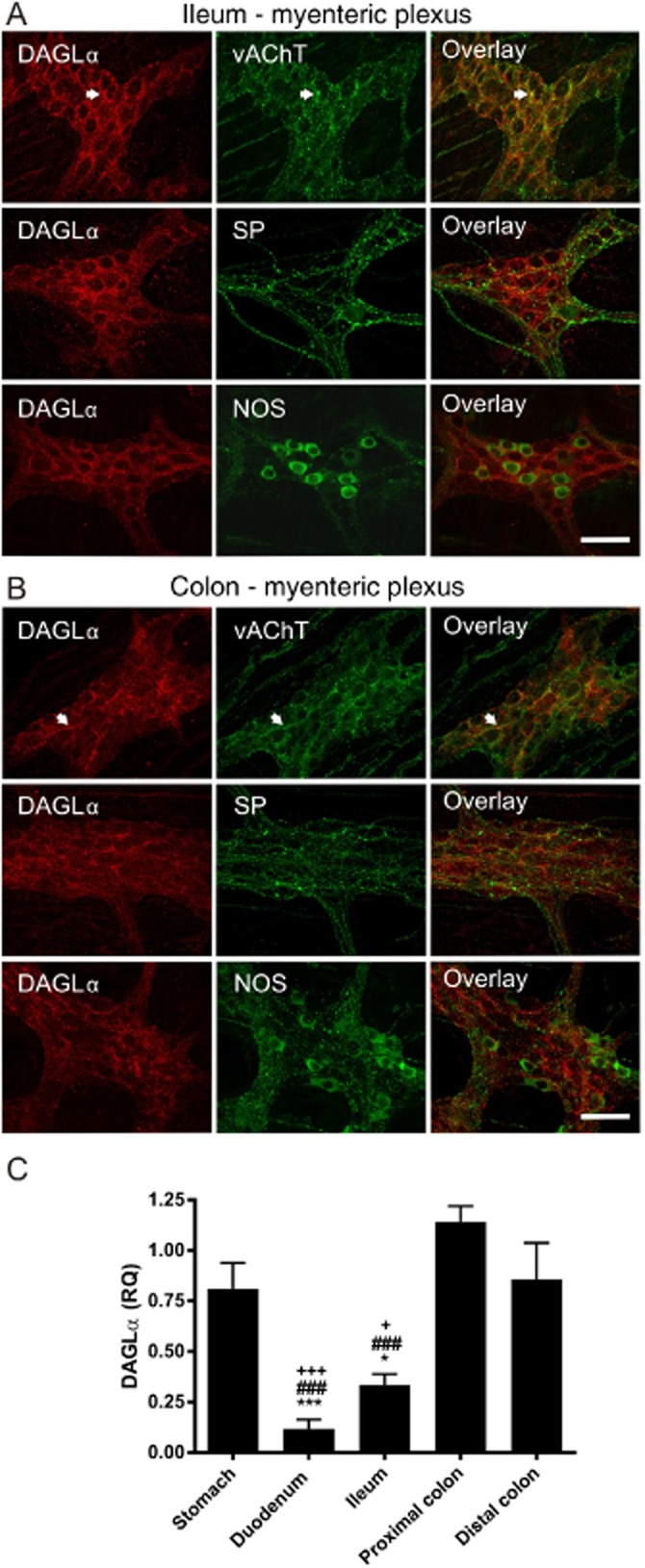
DAGLα immunoreactvity and mRNA expression in the mouse GI tract. DAGLα immunoreactvity is present in punctate terminals and nerve processes surrounding enteric neurons in the myenteric plexus of the ileum (A) and colon (B). DAGLα colocalizes with the vAChT in the myenteric plexus (arrowheads) but only to a minimal extent with either substance P (SP) or NOS immunoreactivity in both ileum and colon. Scale bars: 50 μM. DAGLα mRNA is expressed throughout the GI tract (C). The relative expression is significantly lower in the duodenum and ileum compared with the colon and stomach. n = 3–5 mice per group. F (degrees of freedom): F (4,15) = 20.34, P < 0.001; one-way anova: Bonferroni post hoc test. *P < 0.05, ***P < 0.001, compared with stomach; ###P < 0.001, compared with proximal colon; +P < 0.05, +++P < 0.001, compared with distal colon.
Figure 2
Figure 2
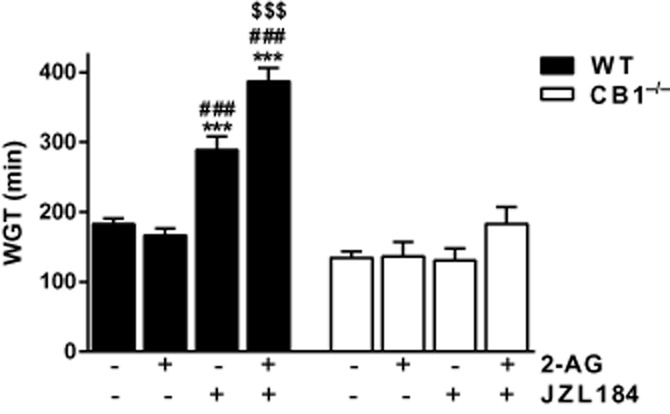
Effects of 2-AG and the MAGL inhibitor JZL184 on whole gut transit (WGT) in mice. 2-AG (10 mg·kg−1, i.p.) did not change WGT in WT or CB1−/− mice. However, JZL184 (18 mg·kg−1, i.p.) prolonged WGT and enhanced the effect of 2-AG in the WT but not the CB1−/− mice. n = 4–14 mice per group; F (degrees of freedom) for interaction: F (3,56) = 13.62, P < 0.001; two-way anova; Bonferroni post hoc test. ***P < 0.001, compared with WT vehicle; ###P < 0.001, compared with WT 2-AG alone; $$$P < 0.001, compared with WT JZL184 alone.
Figure 3
Figure 3
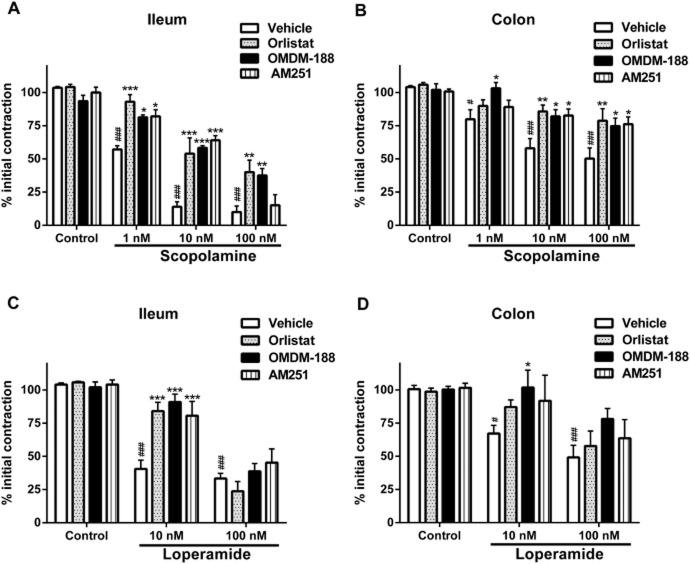
Effects of DAGL inhibitors on pharmacologically inhibited EFS contractility of the mouse ileum (A and C) and colon (B and D). Scopolamine (A and B) or loperamide (C and D) were used at the doses indicated to reduce contractility. Inhibiting DAGL with either orlistat (5 μM) or OMDM-188 (1 μM) reversed the effects of scopolamine or loperamide on the EFS contractility. The CB1 inverse agonist, AM251 (100 nM), also reversed the inhibitory effect of scopolamine and loperamide on the EFS contractility. n = 3–8 mice per group; # and ###P < 0.05 and P < 0.001, respectively, control vehicle compared with scopolamine vehicle or loperamide vehicle; F (degrees of freedom) for interaction of panel A: F (9,40) = 4.63, P < 0.001; panel B: F (9,48) = 1.61, P > 0.05 [scopolamine treatment: F (3,48) = 25.16, P < 0.001, DAGL inhibitors F(3,48) = 7.81, P < 0.001]; panel C: F (6,33) = 3.88, P < 0.01 and panel D: F(6,30) = 0.74, P > 0.05 [loperamide treatment: F (2,30) = 17.32, P < 0.001, DAGL inhibitors: F (3,30) = 2.70, P = 0.06). two-way anova; Bonferroni post hoc test. *P < 0.05, **P < 0.01, ***P < 0.001, compared with respective vehicle at each concentration.
Figure 4
Figure 4
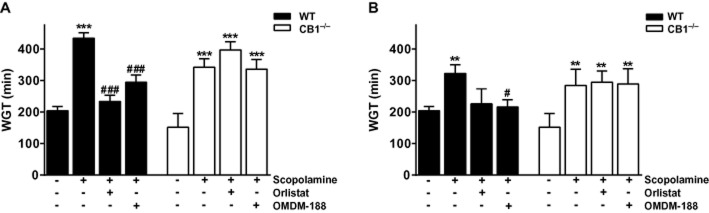
Effects of DAGL inhibitors on whole gut transit (WGT). Mice were treated with scopolamine (A, 0.5 mg·kg−1, i.p.) or loperamide (B, 0.5 mg·kg−1, i.p.) that significantly reduced WGT (increasing the transit time) in the WT or the CB1−/− mice. Orlistat (1 mg·kg−1, i.p.) or OMDM-188 (1 mg·kg−1, i.p.) reversed the effect of scopolamine and loperamide on WGT in the WT but not the CB1−/− mice. Note that neither orlistat nor OMDM-188 had any effect on transit when given alone in untreated animals. n = 4–12 mice per group; F (degrees of freedom) for interaction of panel A: F (3,55) = 11.15, P < 0.001 and panel B: F (3,36) = 4.32, P < 0.05); two-way anova; Bonferroni post hoc test. **P < 0.01, ***P < 0.001 compared with vehicle in WT or CB1−/− mice; #P < 0.05, ###P < 0.001, compared with scopolamine or loperamide in WT mice.
Figure 5
Figure 5
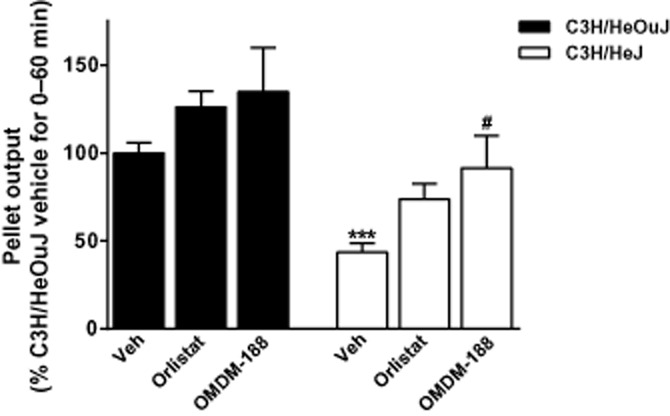
Effects of DAGL inhibitors on faecal output of C3H/HeJ and the background C3H/HeOuJ mice. Monitoring the faecal output for 1 h revealed that C3H/HeJ mice had significantly less output compared with the background strain mice. ***P < 0.001; two-way anova; Bonferroni post hoc test. OMDM-188 (1 mg·kg−1, i.p.) but not orlistat (1 mg·kg−1, i.p.) significantly enhanced faecal output of the constipated C3H/HeJ mice; n = 8–19 mice per group. #P < 0.05, compared with faecal output of vehicle-treated C3H/HeJ mice; two-way anova; Bonferroni post hoc test; (F (degrees of freedom) for interaction: F (2,86) = 0.19, P > 0.05 [genotype: F (1,86) = 33.79, P < 0.001, treatment: F (2,86) = 7.83, P < 0.001]).
Figure 6
Figure 6
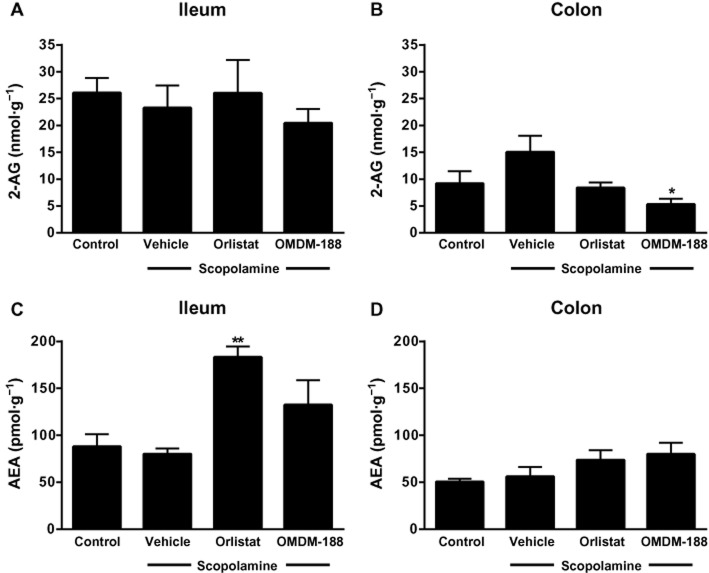
Effects of DAGL inhibitors on intestinal endocannabinoid levels in WT mice. Pre-incubation of the colon with scopolamine (1–100 nM) induced a tendency towards an increase in 2-AG levels and the DAGL inhibitors orlistat (5 μM) and OMDM-188 (1 μM) reversed this effect. Inhibiting DAGL increased anandamide (AEA) levels in the ileum. n = 3–5 mice per group; F (degrees of freedom) for panel A: F(3,13) = 0.43, P > 0.05; panel B: F (3,9) = 4.23, P < 0.05; panel C: F (3,11) = 9.73, P < 0.01 and panel D: F (3,9) = 1.36, P > 0.05; one-way anova; Bonferroni post hoc test. *P < 0.05. **P < 0.01, compared with vehicle.
Figure 7
Figure 7
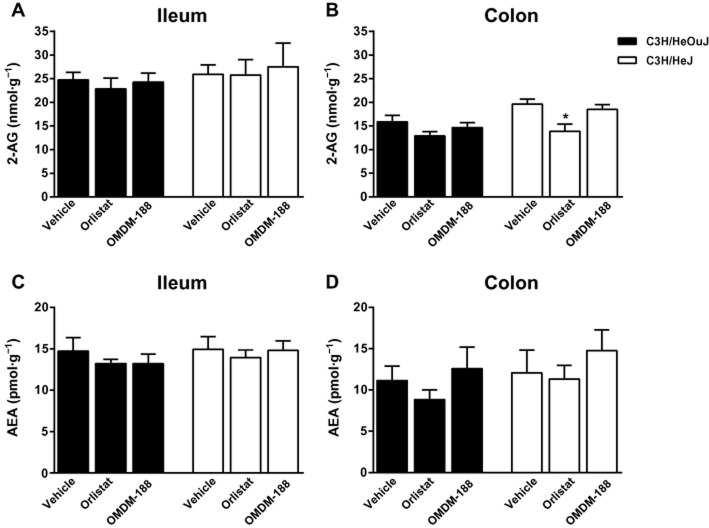
Effects of DAGL inhibitors on the intestinal endocannabinoid levels in C3H/HeOuJ and C3H/HeJ mice. 2-AG tended to be higher in the colon of C3H/HeJ compared with C3H/HeOuJ mice. P = 0.06. Orlistat significantly decreased 2-AG levels in the colon of C3H/HeJ mice. *P < 0.05 compared with vehicle in the C3H/HeJ group. The dose of orlistat and OMDM-188 was 1 mg·kg−1 i.p. n = 6–7 mice per group. F (degrees of freedom) for treatment (panel B): F(2,34) = 7.55, P < 0.01; two-way anova; Bonferroni post hoc test.

References

    1. Abalo R, Vera G, López-Pérez AE, Martinez-Villaluenga M, Martín-Fontelles MI. The gastrointestinal pharmacology of cannabinoids: focus on motility. Pharmacology. 2012;90:1–10. - PubMed
    1. Alexander SPH, Benson HE, Faccenda E, Pawson AJ, Sharman JL, Spedding M, et al. The Concise Guide to PHARMACOLOGY 2013/14: Enzymes. Br J Pharmacol. 2013a;170:1797–1867. - PMC - PubMed
    1. Alexander SPH, Benson HE, Faccenda E, Pawson AJ, Sharman JL, Spedding M, et al. The Concise Guide to PHARMACOLOGY 2013/14: G Protein-Coupled Receptors. Br J Pharmacol. 2013b;170:1459–1581. - PMC - PubMed
    1. Alexander SPH, Benson HE, Faccenda E, Pawson AJ, Sharman JL, Catterall WA, et al. The Concise Guide to PHARMACOLOGY 2013/14: Ion Channels. Br J Pharmacol. 2013c;170:1607–1651. - PMC - PubMed
    1. Alexander SPH, Benson HE, Faccenda E, Pawson AJ, Sharman JL, Spedding M, et al. The Concise Guide to PHARMACOLOGY 2013/14: Transporters. Br J Pharmacol. 2013d;170:1706–1796. - PMC - PubMed

Publication types

MeSH terms