. 2015 Jul;145(3):391-403.
doi: 10.1111/imm.12453.

Proteinase activated receptor-2-mediated dual oxidase-2 up-regulation is involved in enhanced airway reactivity and inflammation in a mouse model of allergic asthma

Affiliations

Proteinase activated receptor-2-mediated dual oxidase-2 up-regulation is involved in enhanced airway reactivity and inflammation in a mouse model of allergic asthma

Ahmed Nadeem et al. Immunology. 2015 Jul.

Abstract

Airway epithelial cells (AECs) express a variety of receptors, which sense danger signals from various aeroallergens/pathogens being inhaled constantly. Proteinase-activated receptor 2 (PAR-2) is one such receptor and is activated by cockroach allergens, which have intrinsic serine proteinase activity. Recently, dual oxidases (DUOX), especially DUOX-2, have been shown to be involved in airway inflammation in response to Toll-like receptor activation. However, the association between PAR-2 and DUOX-2 has not been explored in airways of allergic mice. Therefore, this study investigated the contribution of DUOX-2/reactive oxygen species (ROS) signalling in airway reactivity and inflammation after PAR-2 activation. Mice were sensitized intraperitoneally with intact cockroach allergen extract (CE) in the presence of aluminium hydroxide followed by intranasal challenge with CE. Mice were then assessed for airway reactivity, inflammation, oxidative stress (DUOX-2, ROS, inducible nitric oxide synthase, nitrite, nitrotyrosine and protein carbonyls) and apoptosis (Bax, Bcl-2, caspase-3). Challenge with CE led to up-regulation of DUOX-2 and ROS in AECs with concomitant increases in airway reactivity/inflammation and parameters of oxidative stress, and apoptosis. All of these changes were significantly inhibited by intranasal administration of ENMD-1068, a small molecule antagonist of PAR-2 in allergic mice. Administration of diphenyliodonium to allergic mice also led to improvement of allergic airway responses via inhibition of the DUOX-2/ROS pathway; however, these effects were less pronounced than PAR-2 antagonism. The current study suggests that PAR-2 activation leads to up-regulation of the DUOX-2/ROS pathway in AECs, which is involved in regulation of airway reactivity and inflammation via oxidative stress and apoptosis.

Keywords: airway epithelium; allergic asthma; cockroach extract allergens; dual oxidase-2; proteinase-activated receptor-2; reactive oxygen species.


Figures

Figure 1
Figure 1
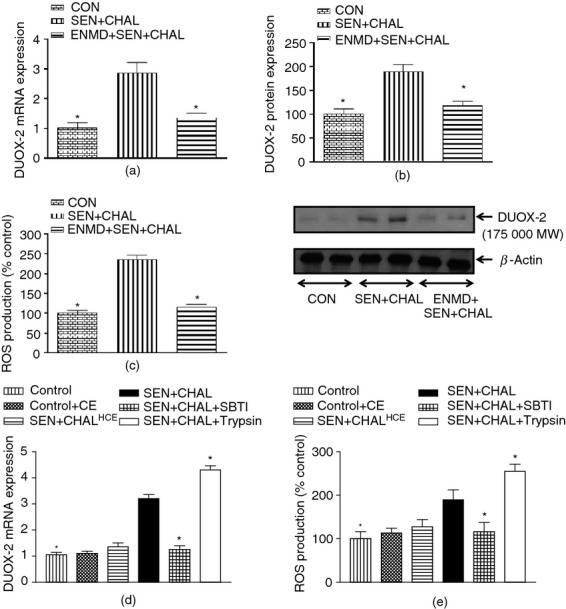
Effect of intact (a–c)/heat-inactivated cockroach extract allergen challenge and proteinase activated receptor-2 (PAR-2) activity modulators (d–e) on dual oxidase 2–reactive oxygen species (DUOX-2–ROS) signalling in airway epithelial cells (AECs) of different groups. (a) DUOX-2 mRNA expression, (b) DUOX-2 protein expression, (c) ROS generation, (d) DUOX-2 mRNA expression, and (e) ROS generation. Expression of DUOX-2 in all the groups was assessed by real-time PCR. For mRNA expression by comparative CT method using real=time PCR, first column was made as the calibrator against which the other groups were compared. ROS generation was assessed biochemically. Values are expressed as mean ± SE, n = 4 to 8/group and derived from two independent experiments. *< 0·05, versus SEN + CHAL group.
Figure 2
Figure 2
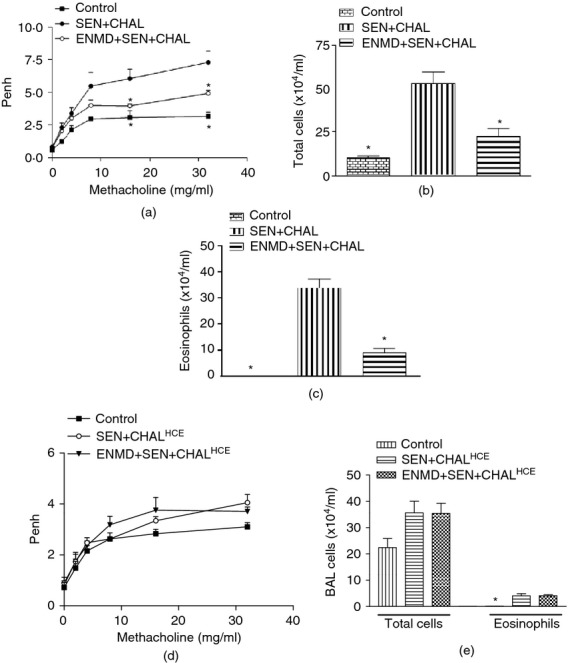
Effect of intact (a–c) and heat-inactivated (d, e) cockroach extract allergen challenge on airway reactivity and inflammation. (a) Enhanced pause (Penh), (b) total leucocyte count, (c) eosinophil count, (d) Penh, and (e) total leucocyte and eosinophil counts. Airway reactivity to methacholine was measured as Penh, 24 hr after the final allergen challenge using a Buxco system for whole body plethysmography in which mice were exposed to increasing concentrations of methacholine (0–32 mg/ml). Airway inflammation in bronchoalveolar lavage was assessed 48 hr after the final allergen challenge through total cell and eosinophil cell counts. Values are expressed as mean ± SE, n = 6 to 8/group and derived from two to three independent experiments. *< 0·05, versus SEN + CHAL/SEN + CHALHCE group.
Figure 3
Figure 3
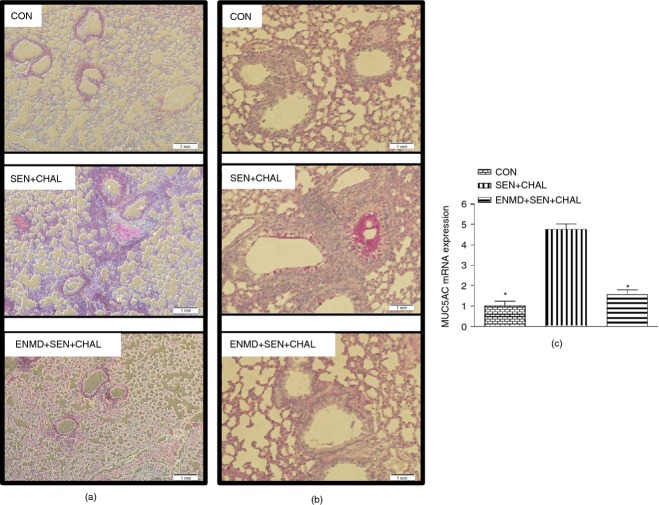
Effect of cockroach extract allergen challenge on histological parameters in allergic mice. (a) Haematoxylin & eosin (H&E) staining of lung sections, (b) periodic acid Schiff (PAS) staining of lung sections, and (c) MUC5AC expression. Expression of MUC5AC in all the groups was assessed by real-time PCR. For mRNA expression by comparative CT method using real-time PCR, first column was made as the calibrator against which the other groups were compared. Values are expressed as mean ± SE, n = 6 to 8/group and derived from two independent experiments. *< 0·05, versus SEN + CHAL group. Each photomicrograph is a representative image from every group (n = 5 or 6/group; magnification, 100× and 200× for H&E and PAS staining, respectively).
Figure 4
Figure 4
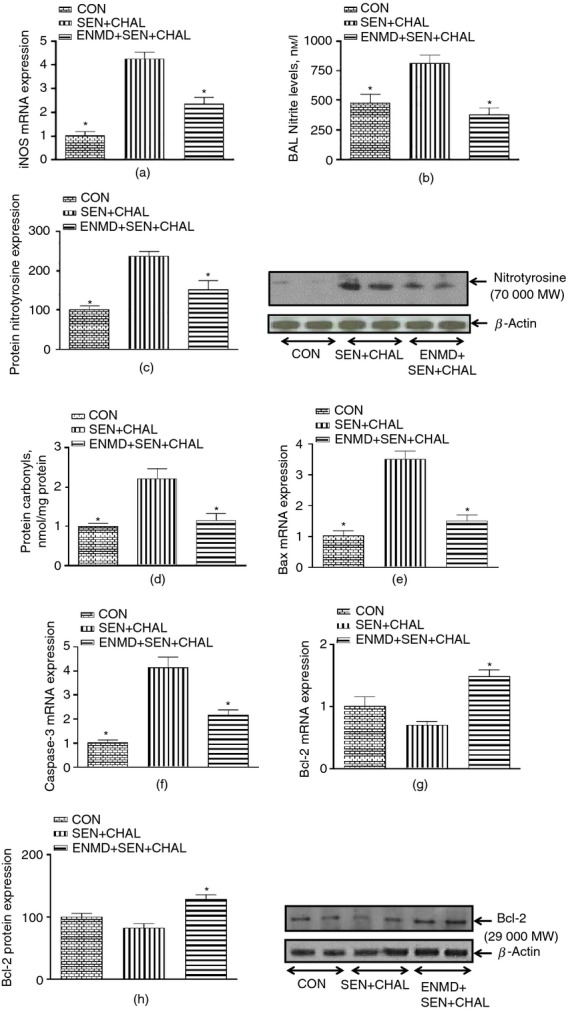
Effect of cockroach extract allergen challenge on parameters of oxidative stress and apoptotic markers in airway epithelial cells (AECs)/trachea of allergic mice. (a) Inducible nitric oxide synthase (iNOS) expression, (b) nitrite levels, (c) 3-NT, (d) protein carbonyls, (e) Bax, (f) caspase-3, and (g, h) Bcl-2. Expression of iNOS and pro-/anti-apoptotic genes in all the groups was assessed by real-time PCR. For mRNA expression by comparative CT method using real-time PCR, the first column was made as the calibrator against which the other groups were compared. 3-NT and Bcl-2 levels were assessed by Western blot whereas nitrite and protein carbonyls were assessed biochemically. Values are expressed as mean ± SE, n = 4 to 8/group and derived from two independent experiments. *< 0·05, versus SEN + CHAL group.
Figure 5
Figure 5
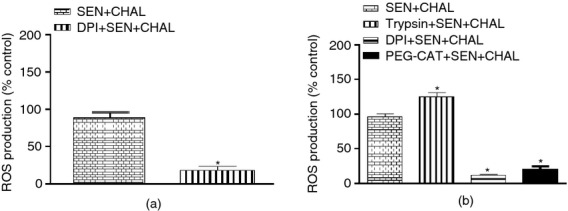
Effect of the dual oxidase (DUOX) inhibitor, diphenyl iodonium (DPI); proteinase activated receptor-2 (PAR-2) agonist, trypsin; and scavenger of hydrogen peroxide, polyethylene glycol (PEG-CAT) on reactive oxygen species (ROS) generation from airway epithelial cells (AECs) of allergic mice. (a) ROS generation after in vivo DPI treatment, and (b) ROS generation after in vitro treatment of PEG-CAT, DPI and trypsin. ROS generation was assessed biochemically. Values are expressed as mean ± SE, n = 3 or 4/group and derived from two independent experiments. *< 0·05, versus SEN + CHAL group.
Figure 6
Figure 6
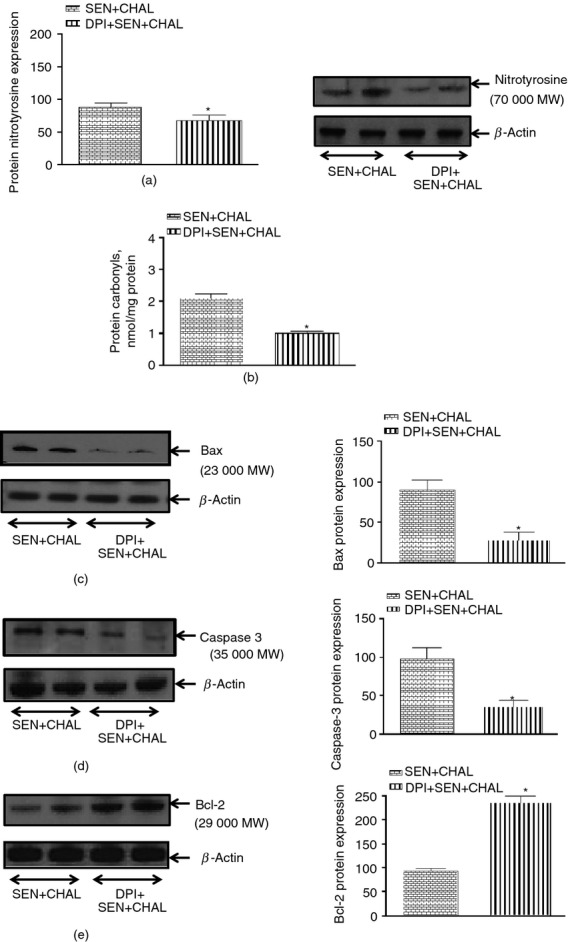
Effect of dual oxidase (DUOX) inhibitor, diphenyl iodonium (DPI) on cockroach extract allergen-induced changes in markers of oxidative stress and apoptosis in airway epithelial cells (AECs) of allergic mice. (a) 3-NT, (b) protein carbonyls, (c) Bax, (d) caspase-3 and (e) Bcl-2. Expression of pro-/anti-apoptotic markers was assessed by Western blot whereas protein carbonyls were measured biochemically. Values are expressed as mean ± SE, n = 5 or 6/group and derived from two independent experiments. *< 0·05, versus SEN + CHAL group.
Figure 7
Figure 7
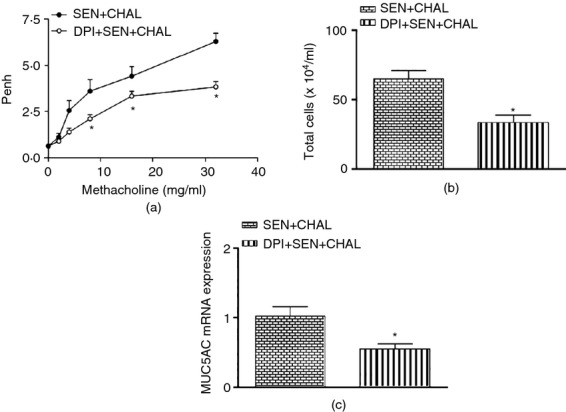
Effect of dual oxidase (DUOX) inhibitor, diphenyl iodonium (DPI) on cockroach extract allergen-induced changes characteristic of allergic asthma. (a) Enhanced pause (Penh), (b) airway inflammation, and (c) MUC5AC expression. Airway reactivity to methacholine was measured as Penh, 24 hr after the final allergen challenge using a Buxco system for whole body plethysmography in which mice were exposed to increasing concentrations of methacholine (0–32 mg/ml). Airway inflammation in bronchalveolar lavage was assessed 48 hr after the final allergen challenge through total cell and eosinophil cell counts. Expression of MUC5AC in all the groups was assessed by real-time PCR. For mRNA expression by comparative CT method using real-time PCR, the first column was made as the calibrator against which the other groups were compared. Values are expressed as mean ± SE, n = 5 or 6/group and derived from two independent experiments. *< 0·05, versus SEN + CHAL group.

References

    1. Janssen-Heininger YM, Poynter ME, Aesif SW, et al. Nuclear factor κB, airway epithelium, and asthma: avenues for redox control. Proc Am Thorac Soc. 2009;6:249–55. - PMC - PubMed
    1. Zhang H, Zeng X, He S. Evaluation on potential contributions of protease activated receptors related mediators in allergic inflammation. Mediators Inflamm. 2014:829068. . doi: . - DOI - PMC - PubMed
    1. Knight DA, Lim S, Scaffidi AK, Roche N, Chung KF, Stewart GA, Thompson PJ. Protease-activated receptors in human airways: upregulation of PAR-2 in respiratory epithelium from patients with asthma. J Allergy Clin Immunol. 2001;108:797–803. - PubMed
    1. Comhair SA, Erzurum SC. Redox control of asthma: molecular mechanisms and therapeutic opportunities. Antioxid Redox Signal. 2010;12:93–124. - PMC - PubMed
    1. Nadeem A, Siddiqui N, Alharbi NO, Alharbi MM. Airway and systemic oxidant-antioxidant dysregulation in asthma: a possible scenario of oxidants spill over from lung into blood. Pulm Pharmacol Ther. 2014;29:31–40. - PubMed

Publication types

MeSH terms