


Neuroimaging findings in treatment-resistant schizophrenia: A systematic review: Lack of neuroimaging correlates of treatment-resistant schizophrenia
- PMID: 25684554
- PMCID: PMC4409508
- DOI: 10.1016/j.schres.2015.01.043
Neuroimaging findings in treatment-resistant schizophrenia: A systematic review: Lack of neuroimaging correlates of treatment-resistant schizophrenia
Abstract
Background: Recent developments in neuroimaging have advanced the understanding of biological mechanisms underlying schizophrenia. However, neuroimaging correlates of treatment-resistant schizophrenia (TRS) and superior effects of clozapine on TRS remain unclear.
Methods: Systematic search was performed to identify neuroimaging characteristics unique to TRS and ultra-resistant schizophrenia (i.e. clozapine-resistant [URS]), and clozapine's efficacy in TRS using Embase, Medline, and PsychInfo. Search terms included (schizophreni*) and (resistan* OR refractory OR clozapine) and (ASL OR CT OR DTI OR FMRI OR MRI OR MRS OR NIRS OR PET OR SPECT).
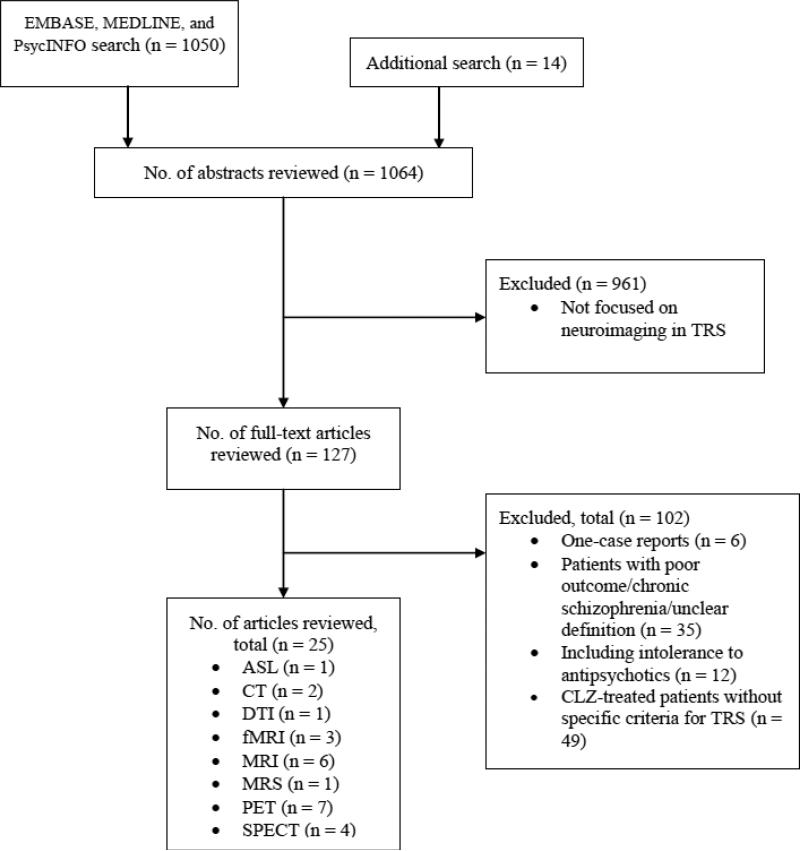
Results: 25 neuroimaging studies have investigated TRS and effects of clozapine. Only 5 studies have compared TRS and non-TRS, collectively providing no replicated neuroimaging finding specific to TRS. Studies comparing TRS and healthy controls suggest that hypometabolism in the prefrontal cortex, hypermetabolism in the basal ganglia, and structural anomalies in the corpus callosum contribute to TRS. Clozapine may increase prefrontal hypoactivation in TRS although this was not related to clinical improvement; in contrast, evidence has suggested a link between clozapine efficacy and decreased metabolism in the basal ganglia and thalamus.
Conclusion: Existing literature does not elucidate neuroimaging correlates specific to TRS or URS, which, if present, might also shed light on clozapine's efficacy in TRS. This said, leads from other lines of investigation, including the glutamatergic system can prove useful in guiding future neuroimaging studies focused on, in particular, the frontocortical-basal ganglia-thalamic circuits. Critical to the success of this work will be precise subtyping of study subjects based on treatment response/nonresponse and the use of multimodal neuroimaging.
Keywords: Clozapine; Glutamate; Neuroimaging; Schizophrenia; Treatment-resistance.
Copyright © 2015 Elsevier B.V. All rights reserved.
Figures
References
-
- Abbott C, Bustillo J. What have we learned from proton magnetic resonance spectroscopy about schizophrenia? A critical update. Curr Opin Psychiatry. 2006;19(2):135–139. - PubMed
-
- Abdul-Monim Z, Reynolds GP, Neill JC. The effect of atypical and classical antipsychotics on sub-chronic PCP-induced cognitive deficits in a reversal-learning paradigm. Behav Brain Res. 2006;169(2):263–273. - PubMed
-
- Abekawa T, Ito K, Koyama T. Role of the simultaneous enhancement of NMDA and dopamine D1 receptor-mediated neurotransmission in the effects of clozapine on phencyclidine-induced acute increases in glutamate levels in the rat medial prefrontal cortex. Naunyn Schmiedebergs Arch Pharmacol. 2006;374(3):177–193. - PubMed
-
- Abekawa T, Ito K, Koyama T. Different effects of a single and repeated administration of clozapine on phencyclidine-induced hyperlocomotion and glutamate releases in the rat medial prefrontal cortex at short- and long-term withdrawal from this antipsychotic. Naunyn Schmiedebergs Arch Pharmacol. 2007;375(4):261–271. - PubMed
-
- Abi-Dargham A, Gil R, Krystal J, Baldwin RM, Seibyl JP, Bowers M, van Dyck CH, Charney DS, Innis RB, Laruelle M. Increased striatal dopamine transmission in schizophrenia: confirmation in a second cohort. Am J Psychiatry. 1998;155(6):761–767. - PubMed
Publication types
MeSH terms
Substances
Grants and funding
LinkOut - more resources
Full Text Sources
Other Literature Sources
Medical
