


Surgical management of moderate adolescent idiopathic scoliosis with ApiFix®: a short peri- apical fixation followed by post-operative curve reduction with exercises
- PMID: 25685175
- PMCID: PMC4328564
- DOI: 10.1186/s13013-015-0028-9
Surgical management of moderate adolescent idiopathic scoliosis with ApiFix®: a short peri- apical fixation followed by post-operative curve reduction with exercises
Abstract
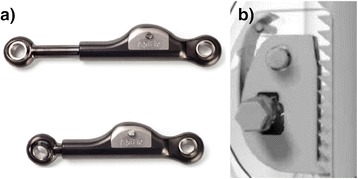
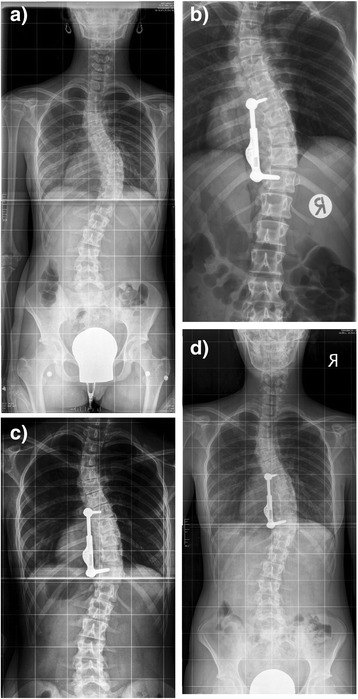
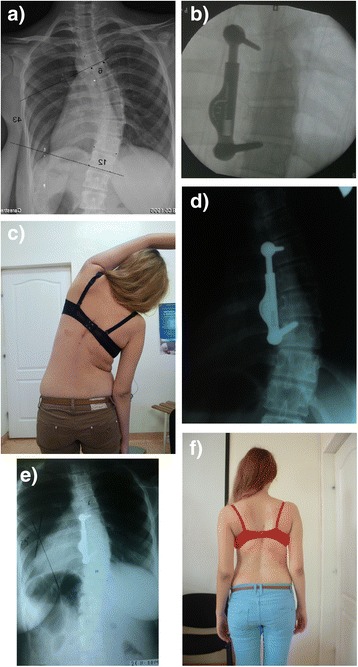
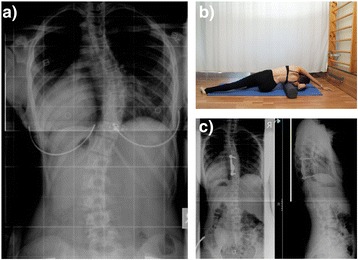
Surgery in adolescent idiopathic scoliosis (AIS) is a major operative intervention where 10-12 vertebrae are instrumented and fused. A smaller motion preserving surgery would be more desirable for these otherwise healthy adolescents. The ApiFix® system is a novel less invasive short segment pedicle screw based instrumentation inserted around the apex of the main curve. The system has a ratchet mechanism that enables gradual postoperative device elongation and curve correction. The ratchet is activated by performing specific spinal exercises. The unique features of the device allow curve correction without fusion. The system which has a CE approval was employed in adolescents with main thoracic curves. More than a dozen of ApiFix surgeries have been performed so far. The preoperative Cobb angle was 45° ± 8, and 25° ± 8 at final follow up. The following is a report on three adolescent females aged 13-16 years with curves between 43°-53° and Risser sign of 1-4 who underwent surgery with ApiFix®. Two pedicle screws were inserted around the curve apex and the ratchet based device with polyaxial ring connectors was attached to the screws. No fusion attempt was made. Operative time was around one hour. Two weeks after surgery the patients were instructed to perform Schroth like daily exercises with the aim of rod elongation and gradual curve correction. Patients were followed between 6 months to 2 years. Curves were reduced and maintained between 22- 33°. Patients were pain free and were able to perform their spinal exercises. Postoperative gradual elongation of the device was observed. No screw loosening or rod breakage were observed. No adding on or curve progression was seen. Three factors may contribute to the ApiFix® success: polyaxial connections that prevent mechanical failure, gradual curve correction by spinal motion and spinal growth modulation. The ApiFix® system allows managing moderate AIS with a simple and minor surgical intervention. Recovery is rapid with negligible motion loss. It allows gradual and safe curve correction with high patient satisfaction. It may also serve as an internal brace for AIS.
Keywords: Correction with exercises; Main thoracic curve; Moderate AIS; Short fixation.
Figures
References
LinkOut - more resources
Full Text Sources
Other Literature Sources
Miscellaneous
