The Western Africa ebola virus disease epidemic exhibits both global exponential and local polynomial growth rates
- PMID: 25685633
- PMCID: PMC4322058
- DOI: 10.1371/currents.outbreaks.8b55f4bad99ac5c5db3663e916803261
The Western Africa ebola virus disease epidemic exhibits both global exponential and local polynomial growth rates
Abstract
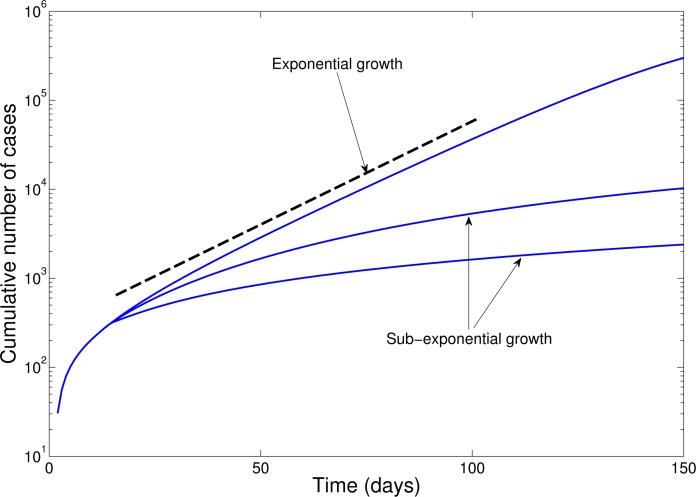
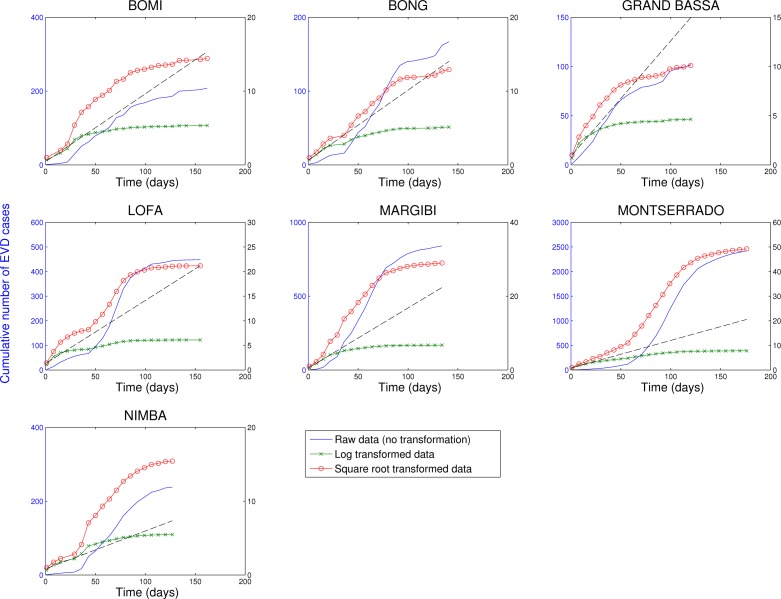
Background: While many infectious disease epidemics are initially characterized by an exponential growth in time, we show that district-level Ebola virus disease (EVD) outbreaks in West Africa follow slower polynomial-based growth kinetics over several generations of the disease.
Methods: We analyzed epidemic growth patterns at three different spatial scales (regional, national, and subnational) of the Ebola virus disease epidemic in Guinea, Sierra Leone and Liberia by compiling publicly available weekly time series of reported EVD case numbers from the patient database available from the World Health Organization website for the period 05-Jan to 17-Dec 2014.
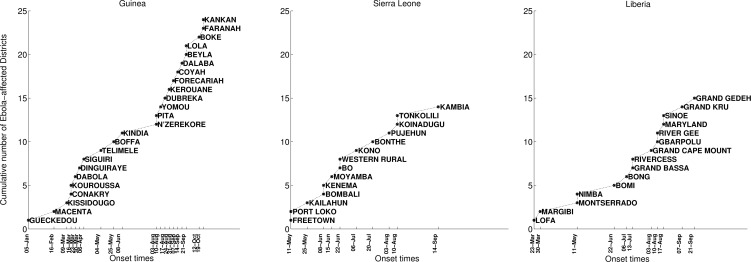
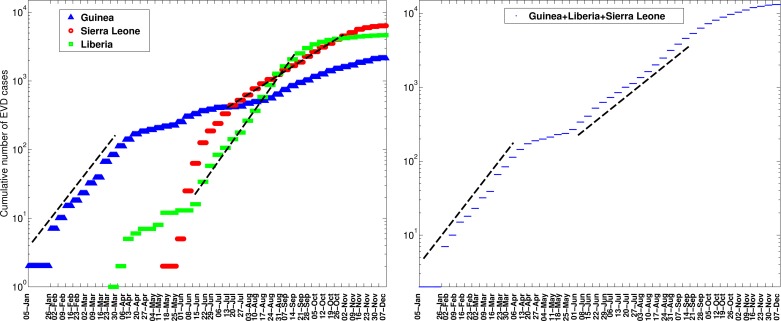
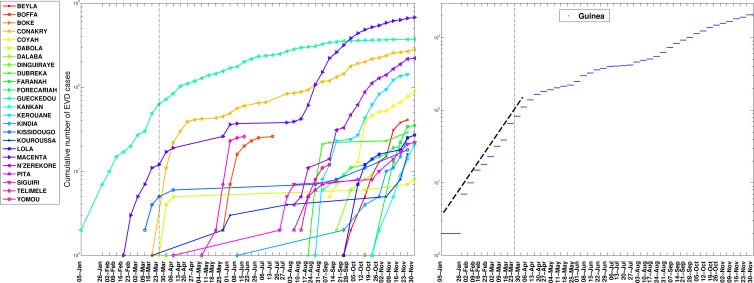
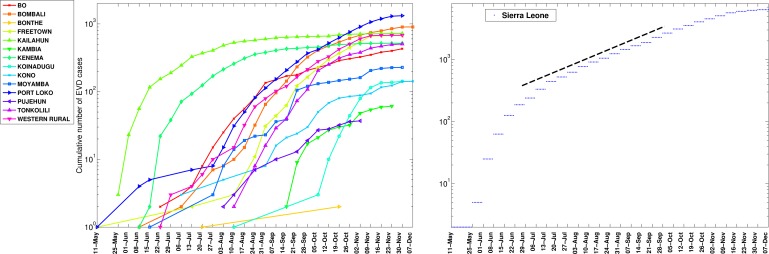
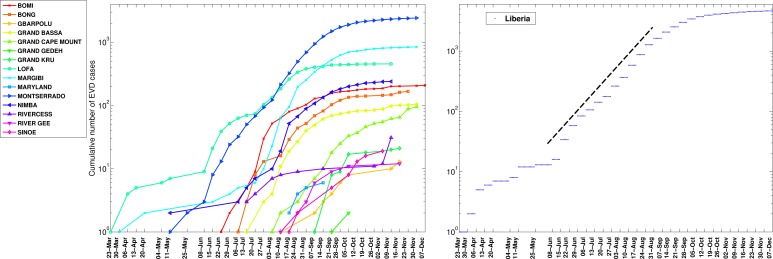
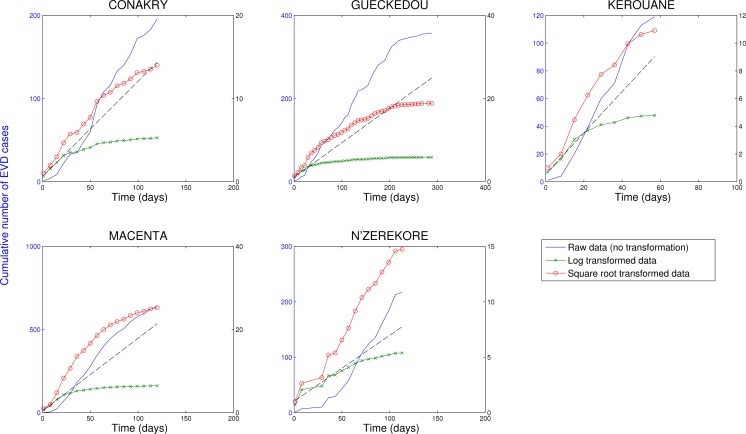
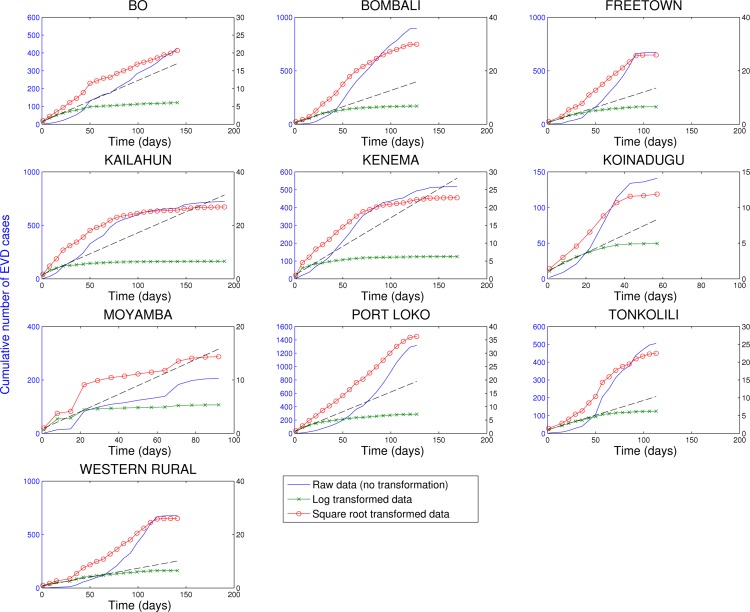
Results: We found significant differences in the growth patterns of EVD cases at the scale of the country, district, and other subnational administrative divisions. The national cumulative curves of EVD cases in Guinea, Sierra Leone, and Liberia show periods of approximate exponential growth. In contrast, local epidemics are asynchronous and exhibit slow growth patterns during 3 or more EVD generations, which can be better approximated by a polynomial than an exponential function.
Conclusions: The slower than expected growth pattern of local EVD outbreaks could result from a variety of factors, including behavior changes, success of control interventions, or intrinsic features of the disease such as a high level of clustering. Quantifying the contribution of each of these factors could help refine estimates of final epidemic size and the relative impact of different mitigation efforts in current and future EVD outbreaks.
Keywords: ebola.
Figures
References
-
- (2014) Ebola virus disease update - West Africa, 21 November 2014.
-
- Gire SK, Goba A, Andersen KG, Sealfon RS, Park DJ, Kanneh L, Jalloh S, Momoh M, Fullah M, Dudas G, Wohl S, Moses LM, Yozwiak NL, Winnicki S, Matranga CB, Malboeuf CM, Qu J, Gladden AD, Schaffner SF, Yang X, Jiang PP, Nekoui M, Colubri A, Coomber MR, Fonnie M, Moigboi A, Gbakie M, Kamara FK, Tucker V, Konuwa E, Saffa S, Sellu J, Jalloh AA, Kovoma A, Koninga J, Mustapha I, Kargbo K, Foday M, Yillah M, Kanneh F, Robert W, Massally JL, Chapman SB, Bochicchio J, Murphy C, Nusbaum C, Young S, Birren BW, Grant DS, Scheiffelin JS, Lander ES, Happi C, Gevao SM, Gnirke A, Rambaut A, Garry RF, Khan SH, Sabeti PC. Genomic surveillance elucidates Ebola virus origin and transmission during the 2014 outbreak. Science. 2014 Sep 12;345(6202):1369-72. PubMed PMID:25214632. - PMC - PubMed
-
- Del Rio C, Mehta AK, Lyon GM 3rd, Guarner J. Ebola hemorrhagic Fever in 2014: the tale of an evolving epidemic. Ann Intern Med. 2014 Nov 18;161(10):746-8. PubMed PMID:25133433. - PubMed
Grants and funding
LinkOut - more resources
Full Text Sources
Other Literature Sources
Research Materials