Review
. 2015 Apr;11(4):192-208.
doi: 10.1038/nrneurol.2015.13. Epub 2015 Feb 17.

The role of inflammation in perinatal brain injury

Affiliations
Review

The role of inflammation in perinatal brain injury

Henrik Hagberg et al. Nat Rev Neurol. 2015 Apr.

Abstract

Inflammation is increasingly recognized as being a critical contributor to both normal development and injury outcome in the immature brain. The focus of this Review is to highlight important differences in innate and adaptive immunity in immature versus adult brain, which support the notion that the consequences of inflammation will be entirely different depending on context and stage of CNS development. Perinatal brain injury can result from neonatal encephalopathy and perinatal arterial ischaemic stroke, usually at term, but also in preterm infants. Inflammation occurs before, during and after brain injury at term, and modulates vulnerability to and development of brain injury. Preterm birth, on the other hand, is often a result of exposure to inflammation at a very early developmental phase, which affects the brain not only during fetal life, but also over a protracted period of postnatal life in a neonatal intensive care setting, influencing critical phases of myelination and cortical plasticity. Neuroinflammation during the perinatal period can increase the risk of neurological and neuropsychiatric disease throughout childhood and adulthood, and is, therefore, of concern to the broader group of physicians who care for these individuals.


Conflict of interest statement

Competing interests

The authors declare no competing interests.

Figures
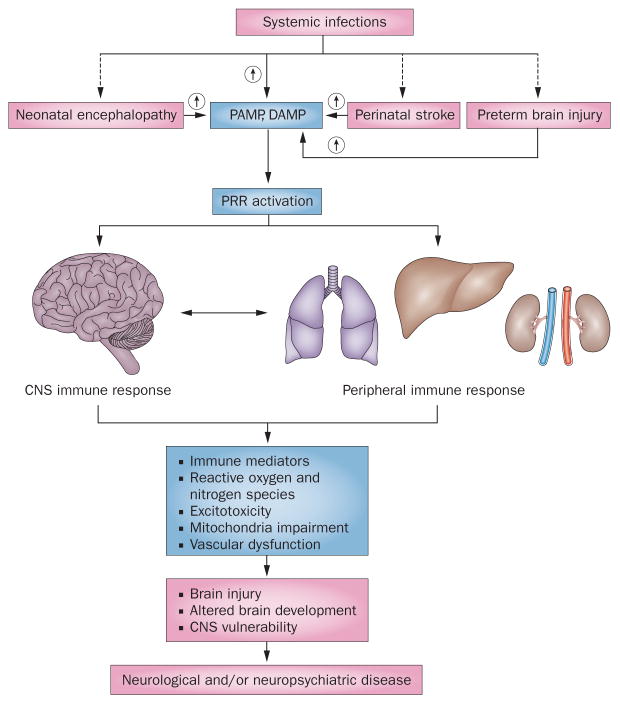
Figure 1
Figure 1
Inflammation in the developing brain. Neonatal encephalopathy, perinatal stroke, preterm brain injury and systemic infections trigger release of PAMP and DAMP, which activate PRRs. Under some conditions, systemic infection can also be an antecedent of the other insults (dashed arrows). PRRs trigger inflammation in the periphery and in the brain. Inflammation can act in concert with hypoxia–ischaemia to induce activation of immune mediators, reactive oxygen and nitrogen species, excitotoxicity, mitochondrial impairment and vascular disruption. These effectors can cause brain injury directly, interfere with brain development and modulate CNS vulnerability, all of which may contribute to neurological and neuropsychiatric disease. Abbreviations: DAMP, damage-associated molecular pattern; PAMP, pathogen-associated molecular pattern; PRR, pattern recognition receptor.
Figure 2
Figure 2
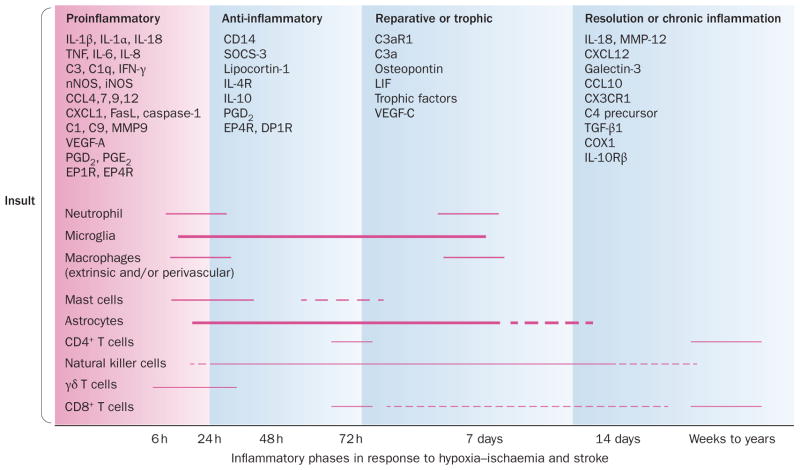
Stages of inflammation in the immature brain after hypoxia–ischaemia and stroke. The hypoxic or ischaemic insult triggers a proinflammatory response followed by anti-inflammatory and reparative phases. These events result either in resolution of inflammation or in chronic inflammation. The critical phases of inflammation are regulated by multiple cytokines, chemokines, prostaglandins and other immune mediators, leading to activation and participation of inflammatory cells that are part of both innate and adaptive immune responses. The figure is a summary based on multiple experimental and clinical studies.,,,,,–,–,, Abbreviations: C, complement; CD, cluster of differentiation; COX, cyclooxygenase; DPR, prostaglandin D receptor; EPR, prostaglandin E receptor; FasL, Fas ligand; iNOS, inducible NOS; LIF, leukemia inhibitory factor; MMP, matrix metalloproteinase; nNOS, neuronal NOS; NOS, nitric oxide synthase; PG, prostaglandin; SOCS, suppressor of cytokine signalling; TGF, transforming growth factor; TNF, tumour necrosis factor; VEGF, vascular endothelial growth factor. Chemokines are abbreviated according to the new classification.
Figure 3
Figure 3
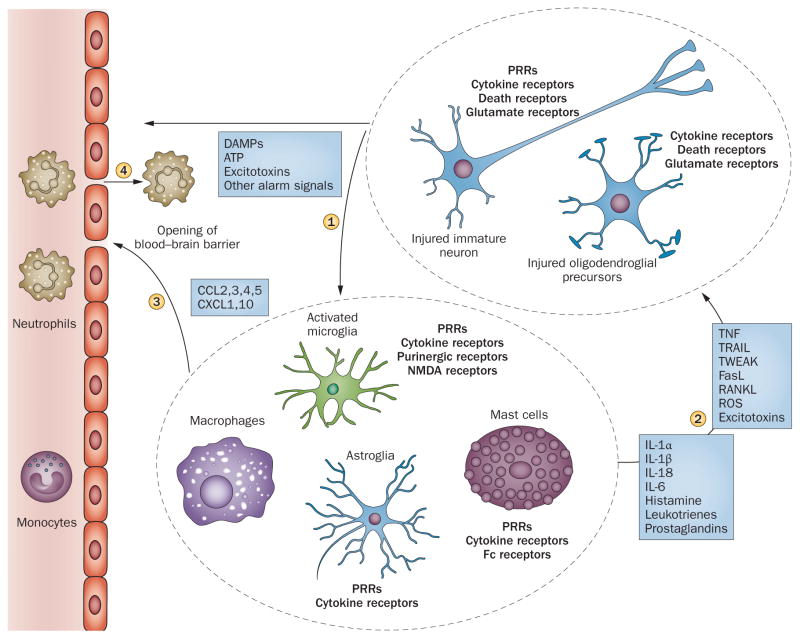
Early innate response to hypoxia–ischaemia. Immune effector cells (microglia, macrophages, astroglia, mast cells) sense alarm signals from injured parenchymal cells via PRRs and cytokine receptors (1). The triggered innate immune response has proinflammatory and toxic influences on the neurons, oligodendroglial precursors (2) and vascular bed (3); increased blood–brain barrier permeability contributes to the recruitment of immune cells from the periphery (4). Abbreviations: DAMP, damage-associated molecular pattern; NMDA, N-methyl-D-aspartate; PRR, pattern recognition receptor; RANKL, receptor activator of nuclear factor-κB ligand; ROS, reactive oxygen species; TNF, tumour necrosis factor; TRAIL, TNF-related apoptosis-inducing ligand; TWEAK, TNF-like weak inducer of apoptosis. Chemokines are abbreviated according to the new classification.
Figure 4
Figure 4
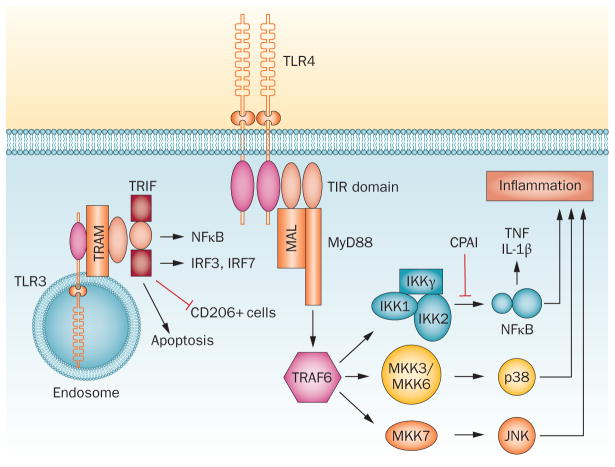
Mechanisms of TLR4 and TLR3 sensitization. TLR4 increases vulnerability of the immature CNS through activation of the MyD88-dependent pathway, leading to NF-κB-dependent production of IL-1β and TNF and activation of JNK. Endosomal TLR3 induces sensitization through TRIF-dependent activation of NF-κB, IRF and apoptosis, and inhibition of potentially cytoprotective CD206+ cells. LPS and hypoxia–ischaemia induce proteolytic activity of tPA, but this can be blocked by CPAI, which reduces NF-κB signalling, microglial activation, and production of proinflammatory cytokines in the brain. JNK inhibition also significantly reduces neuroinflammation, blood–brain barrier leakage and oligodendrocyte progenitor apoptosis after LPS sensitization. Abbreviations: CPAI, plasminogen activator protein-1; IRF, interferon regulatory factor; JNK, c-Jun N-terminal kinase; LPS, lipopolysaccharide; Myd88, myeloid differentiation factor 88; NF-κB, nuclear factor-κB; TLR, Toll-like receptor; TNF, tumour necrosis factor; tPA, tissue plasminogen activator; TRIF, TIR-domain-containing adapter-inducing IFN-β.
Figure 5
Figure 5
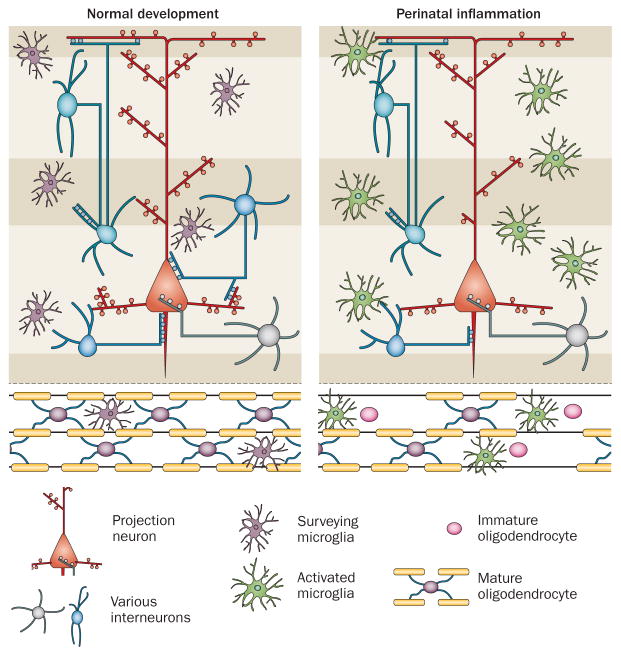
Effects of perinatal inflammation on brain development. Infants born at extremely low gestational age have a markedly increased risk of brain dysfunction, which is attributable to damage and developmental impairment in both white and grey matter. In such situations, microglia become activated. The resulting CNS inflammation impairs oligodendrocyte precursor maturation, which leads to a myelination defect. Furthermore, the cerebral cortex and deep grey matter will be affected by impairments in interneuron survival, axonal integrity, neurite branching, spine density, and synaptogenesis, leading to abnormal connectivity and brain microstructure.

References

    1. Galea I, Bechmann I, Perry VH. What is immune privilege (not)? Trends Immunol. 2007;28:12–18. - PubMed
    1. Meyer U, Feldon J, Dammann O. Schizophrenia and autism: both shared and disorder-specific pathogenesis via perinatal inflammation? Pediatr Res. 2011;69:26R–33R. - PMC - PubMed
    1. Hagberg H, Gressens P, Mallard C. Inflammation during fetal and neonatal life: implications for neurologic and neuropsychiatric disease in children and adults. Ann Neurol. 2012;71:444–457. - PubMed
    1. Fernandez–Lopez D, Natarajan N, Ashwal S, Vexler ZS. Mechanisms of perinatal arterial ischemic stroke. J Cereb Blood Flow Metab. 2014;34:921–932. - PMC - PubMed
    1. Kawai T, Akira S. The role of pattern-recognition receptors in innate immunity: update on Toll-like receptors. Nat Immunol. 2010;11:373–384. - PubMed

Publication types

Substances