. 2015 Apr:59:41-9.
doi: 10.1016/j.ibmb.2015.02.004. Epub 2015 Feb 14.

Epoxide hydrolase activities and epoxy fatty acids in the mosquito Culex quinquefasciatus

Affiliations

Epoxide hydrolase activities and epoxy fatty acids in the mosquito Culex quinquefasciatus

Jiawen Xu et al. Insect Biochem Mol Biol. 2015 Apr.

Abstract

Culex mosquitoes have emerged as important model organisms for mosquito biology, and are disease vectors for multiple mosquito-borne pathogens, including West Nile virus. We characterized epoxide hydrolase activities in the mosquito Culex quinquefasciatus, which suggested multiple forms of epoxide hydrolases were present. We found EH activities on epoxy eicosatrienoic acids (EETs). EETs and other eicosanoids are well-established lipid signaling molecules in vertebrates. We showed EETs can be synthesized in vitro from arachidonic acids by mosquito lysate, and EETs were also detected in vivo both in larvae and adult mosquitoes by LC-MS/MS. The EH activities on EETs can be induced by blood feeding, and the highest activity was observed in the midgut of female mosquitoes. The enzyme activities on EETs can be inhibited by urea-based inhibitors designed for mammalian soluble epoxide hydrolases (sEH). The sEH inhibitors have been shown to play diverse biological roles in mammalian systems, and they can be useful tools to study the function of EETs in mosquitoes. Besides juvenile hormone metabolism and detoxification, insect epoxide hydrolases may also play a role in regulating lipid signaling molecules, such as EETs and other epoxy fatty acids, synthesized in vivo or obtained from blood feeding by female mosquitoes.

Keywords: Eicosanoid; Epoxide hydrolase; Epoxy fatty acid; Inhibitor; Mosquito; Signaling molecule.


Figures

Fig. 1
Fig. 1
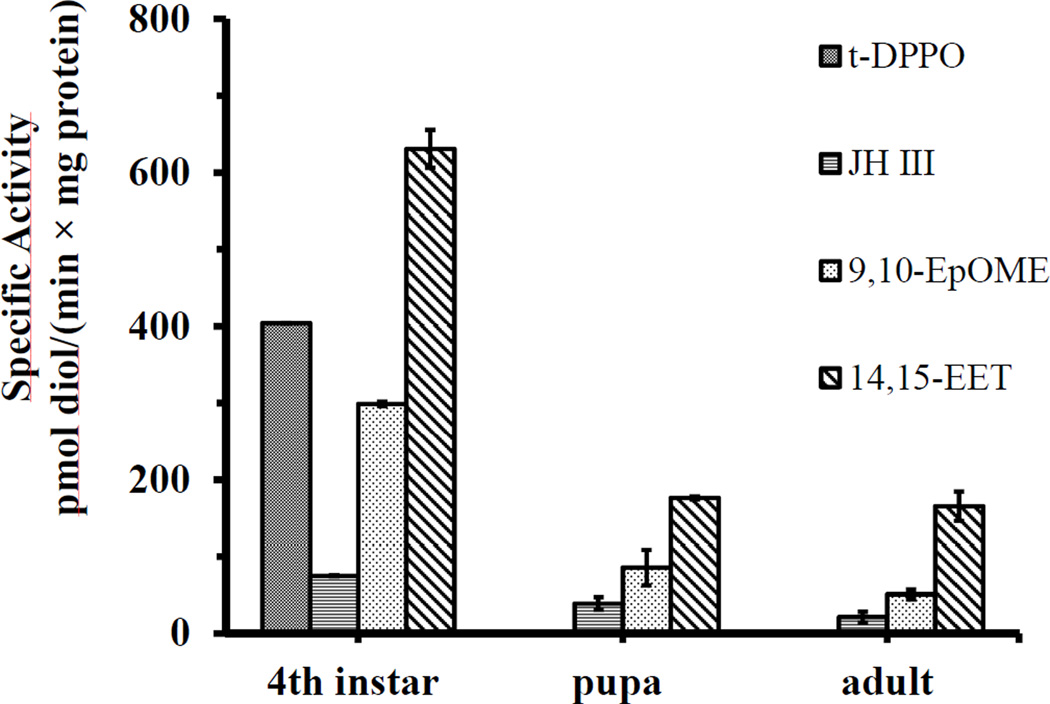
Epoxide hydrolase activities in different developmental stages of Culex quinquefasciatus. Enzyme activities were measured with triplicate assays. Values are mean activity ± SD based on three independent preparations. 4th instar (8–9 days old after hatch), pupa (10–12 days old after hatch) and female adults (4–7 days old after eclosion) were collected and homogenized for EH activity assays.
Fig. 2
Fig. 2
Subcellular distribution of EH activities in 4th instar larvae (8–9 days old after hatch) on four substrates. Values are mean activity ± SD based on three independent preparations. The mitochondria fraction was obtained by centrifuging the lysate at 18,000×g for 20 minutes, and the resulting pellets were resuspended in 50 mM, pH 8 Tris-HCl buffer. The resulting supernatant was centrifuged again at 100,000×g for 1 hour. The supernatant was collected as the cytosolic fraction, and the pellet was resuspended in Tris-HCl buffer as the microsomal fraction.
Fig. 3
Fig. 3
Epoxide hydrolase activities with different chromatographic characteristics. Each datum point is the mean of three independent chromatographic runs. The standard deviations are within 10% of the mean values and are not shown here. A column of 10 ml DEAE ion exchanger was used and 1 column volume is 10 ml of eluting buffer. The NaCl gradient was made by mixing 200 mM and 1 M NaCl in Tris-HCl buffer in a gradient maker. Gradient elution began at 5th column volume and ended at 35th column volume. EH activities in the first five column volumes (unbound enzyme fractions) were not detected. Protein concentration was measured by A280 with BSA as the standard. The binding and eluting conditions are shown in Fig. S1. The balance sheet for the purification is shown in Table S1.
Fig. 4
Fig. 4
Phylogeny analysis of EH sequences in Culex quinquefasciatus and other reported EHs. The full names of abbreviations and corresponding references are: AgEH, epoxide hydrolase from A. gambiae (Xu et al., 2014). HsEH, sEH from H. sapiens (Beetham et al., 1993); MsEH, sEH from M. musculus (Grant et al., 1993); RsEH, sEH from R. norvegicus (Knehr et al., 1993); EH 3, epoxide hydrolase 3 from H,sapiens (Decker et al., 2012); EH 4, epoxide hydrolase 4 from H.sapiens (Decker et al., 2012); CeEH1, sEH1 from C. elegans (Harris et al., 2008); HmEH, mEH from H. sapiens (Skoda et al., 1988); RmEH, mEH from R. norvegicus (Falany et al., 1987); DmEH, mEH from D. melanogaster (Taniai et al., 2003) ; BmJHEH-r1, JHEH-r1 from Bombyx mori (Seino et al., 2010); BmEH, putative epoxide hydrolase 4-like from Bombyx mori; AmEH, putative epxoide hydrolase 4-like from A.mellifera; TcEH, putative epoxide hydrolase 4 from T. castaneum. The accession number of amino acid sequences is shown in the parenthesis. The percentage of replicate trees in which the associated taxa clustered together in the bootstrap test (1000 replicates) is shown next to the branches.
Fig. 5
Fig. 5
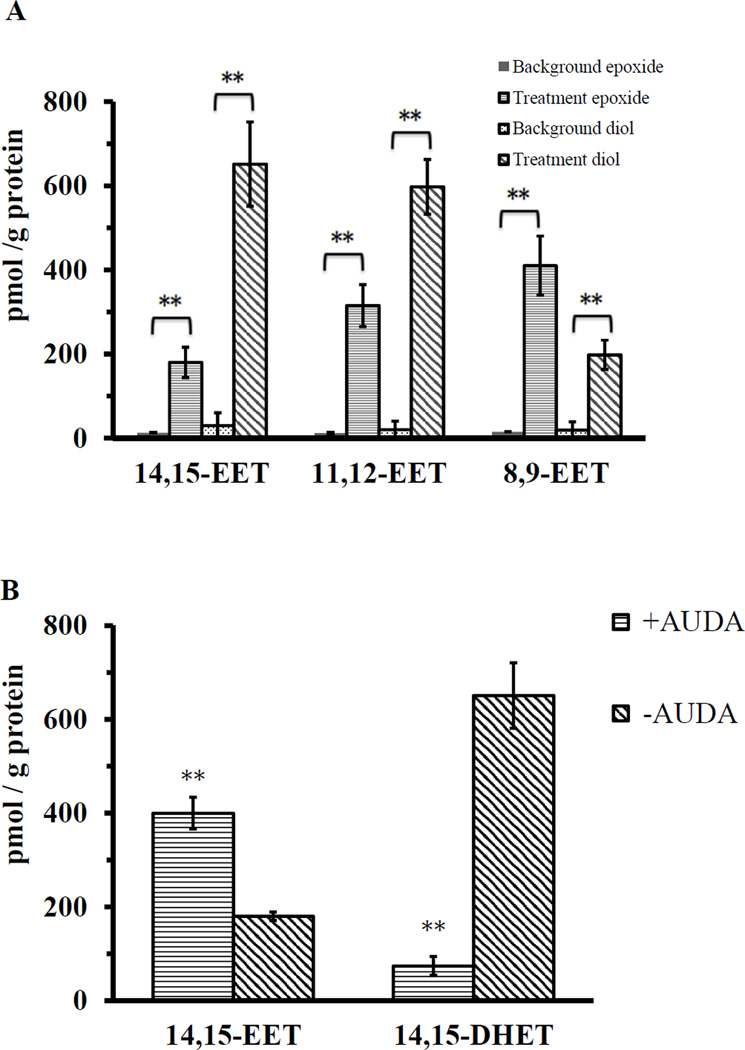
Synthesis of EETs by mosquito 4th instar (8–9 days old after hatch) lysates in vitro. Student’s t test was used to evaluate statistical significance (** indicates p<0.01). Error bars represent the standard deviations of the means. A: Different regioisomers of EETs and corresponding diols detected by LC-MS/MS in 30 minutes of incubation. 5,6-EET was not included because its chemical instability. EETs and diols detected in the arachidonic acid solution and mosquito 4th instar (8–9 days old larvae) lysate only were regarded as background. In the treatment groups, arachidonic acid and NADPH generating system was added into mosquito 4th instar (8–9 days old larvae) lysate. B. Effects of a sEH inhibitor (AUDA) on the in vitro synthesis of 14,15-EET at 30 minutes of incubation. C: Synthesis of 14,15-EET with or without NADPH or CO in 30 minutes of incubation. The data of two control treatments ‘Buffer+ARA’ and ‘ Lysate only’ overlap and therefore only the data of ‘Lysate only’ is shown.
Fig. 5
Fig. 5
Synthesis of EETs by mosquito 4th instar (8–9 days old after hatch) lysates in vitro. Student’s t test was used to evaluate statistical significance (** indicates p<0.01). Error bars represent the standard deviations of the means. A: Different regioisomers of EETs and corresponding diols detected by LC-MS/MS in 30 minutes of incubation. 5,6-EET was not included because its chemical instability. EETs and diols detected in the arachidonic acid solution and mosquito 4th instar (8–9 days old larvae) lysate only were regarded as background. In the treatment groups, arachidonic acid and NADPH generating system was added into mosquito 4th instar (8–9 days old larvae) lysate. B. Effects of a sEH inhibitor (AUDA) on the in vitro synthesis of 14,15-EET at 30 minutes of incubation. C: Synthesis of 14,15-EET with or without NADPH or CO in 30 minutes of incubation. The data of two control treatments ‘Buffer+ARA’ and ‘ Lysate only’ overlap and therefore only the data of ‘Lysate only’ is shown.
Fig. 6
Fig. 6
Epoxide hydrolase activities on 14,15-EET in different tissues of adult mosquitoes. Mosquitoes aged 4–7 days after eclosion were dissected under a microscope. Student’s t test was used to evaluate statistical significance (*p<0.01, **p<0.001) between tissues of males and females. Error bars represent the standard deviations of the means based on three independent measurements.
Fig. 7
Fig. 7
Induction of epoxide hydrolase activities on 14,15-EET after blood feeding. Each datum point represents means ± SD unless the SD is smaller than the datum point. Ten blood-ingested females were sampled every three hours after feeding, Non-ingested females were also sampled as controls. At 6, 9,12,15 hours post blood feeding, the differences were statistically significant (p<0.01 by Student’s t test) from the controls.
Fig. 8
Fig. 8
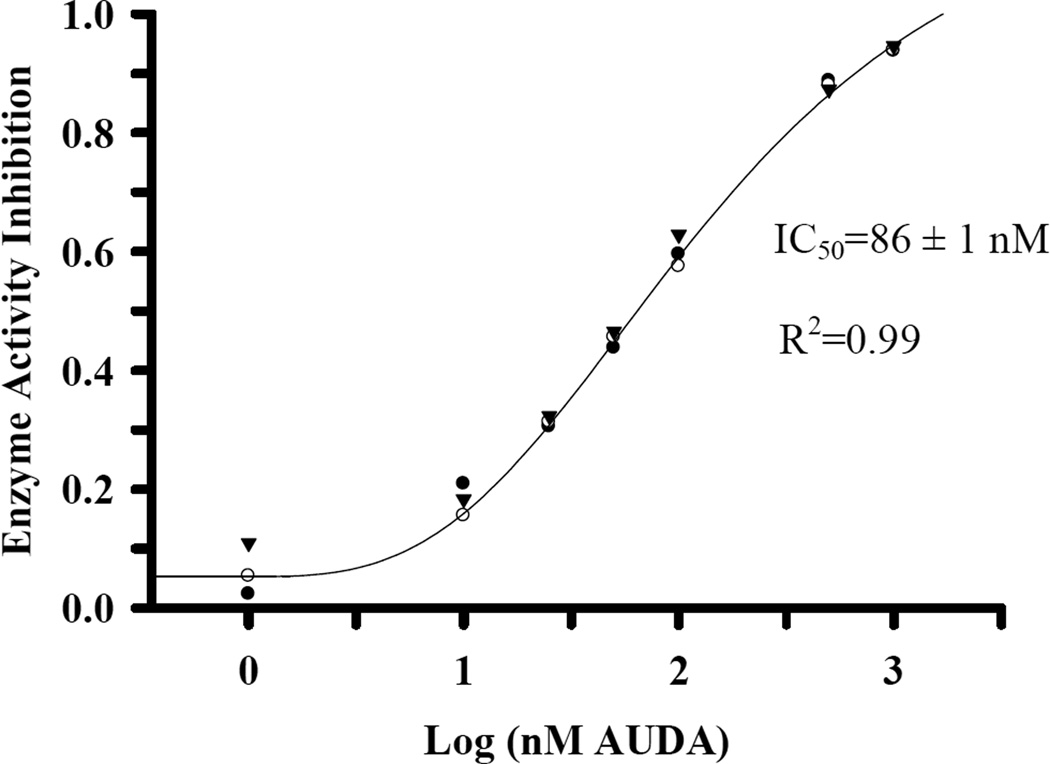
IC50 of AUDA on 14,15-EET. 4th instar (8–9 days old after hatch) lysate was incubated with different concentrations of AUDA, the most potent inhibitor identified in Table 3 for five minutes on ice. The symbols represent the mean of enzyme activity inhibition in three independent measurements. The IC50 is presented as mean ± SD based on three independent measurements. 1 l of 5 mM 14,15 EET in DMSO was added (50 M final concentration) for measuring enzyme activity. The 4 parameter logistic model describes the sigmoid-shaped response was used to calculate IC50 by the software SigmaPlot.

References

    1. Abdel-Aal YAI, Hammock BD. 3-octylthio-1,1,1-trifluoro- 2-propanone, a high affinity and slow binding inhibitor of juvenile hormone esterase from Trichoplusia ni (hübner) Insect Biochemistry. 1985;15:111–122.
    1. Anspaugh DD, Roe RM. Regulation of JH epoxide hydrolase versus JH esterase activity in the cabbage looper, Trichoplusia ni, by juvenile hormone and xenobiotics. Journal of Insect Physiology. 2005;51:523–535. - PubMed
    1. Arand M, Wagner H, Oesch F. Asp333, Asp495, and His523 form the catalytic triad of rat soluble epoxide hydrolase. The Journal of biological chemistry. 1996;271:4223–4229. - PubMed
    1. Arensburger P, Megy K, Waterhouse RM, Abrudan J, Amedeo P, Antelo B, Bartholomay L, Bidwell S, Caler E, Camara F, Campbell CL, Campbell KS, Casola C, Castro MT, Chandramouliswaran I, Chapman SB, Christley S, Costas J, Eisenstadt E, Feschotte C, Fraser-Liggett C, Guigo R, Haas B, Hammond M, Hansson BS, Hemingway J, Hill SR, Howarth C, Ignell R, Kennedy RC, Kodira CD, Lobo NF, Mao C, Mayhew G, Michel K, Mori A, Liu N, Naveira H, Nene V, Nguyen N, Pearson MD, Pritham EJ, Puiu D, Qi Y, Ranson H, Ribeiro JM, Roberston HM, Severson DW, Shumway M, Stanke M, Strausberg RL, Sun C, Sutton G, Tu ZJ, Tubio JM, Unger MF, Vanlandingham DL, Vilella AJ, White O, White JR, Wondji CS, Wortman J, Zdobnov EM, Birren B, Christensen BM, Collins FH, Cornel A, Dimopoulos G, Hannick LI, Higgs S, Lanzaro GC, Lawson D, Lee NH, Muskavitch MA, Raikhel AS, Atkinson PW. Sequencing of Culex quinquefasciatus establishes a platform for mosquito comparative genomics. Science. 2010;330:86–88. - PMC - PubMed
    1. Bartholomay LC, Waterhouse RM, Mayhew GF, Campbell CL, Michel K, Zou Z, Ramirez JL, Das S, Alvarez K, Arensburger P, Bryant B, Chapman SB, Dong Y, Erickson SM, Karunaratne SH, Kokoza V, Kodira CD, Pignatelli P, Shin SW, Vanlandingham DL, Atkinson PW, Birren B, Christophides GK, Clem RJ, Hemingway J, Higgs S, Megy K, Ranson H, Zdobnov EM, Raikhel AS, Christensen BM, Dimopoulos G, Muskavitch MA. Pathogenomics of Culex quinquefasciatus and meta-analysis of infection responses to diverse pathogens. Science. 2010;330:88–90. - PMC - PubMed

Publication types

MeSH terms