


Prevalence of Duchenne and Becker muscular dystrophies in the United States
- PMID: 25687144
- PMCID: PMC4477633
- DOI: 10.1542/peds.2014-2044
Prevalence of Duchenne and Becker muscular dystrophies in the United States
Erratum in
-
Romitti et al. Prevalence of Duchenne and Becker muscular dystrophies in the United States. Pediatrics. 2015;135(3):513-521.Pediatrics. 2015 May;135(5):945. doi: 10.1542/peds.2015-0652. Pediatrics. 2015. PMID: 25934896 No abstract available.
Abstract
Objective: To estimate prevalence of childhood-onset Duchenne and Becker muscular dystrophies (DBMD) in 6 sites in the United States by race/ethnicity and phenotype (Duchenne muscular dystrophy [DMD] or Becker muscular dystrophy [BMD]).
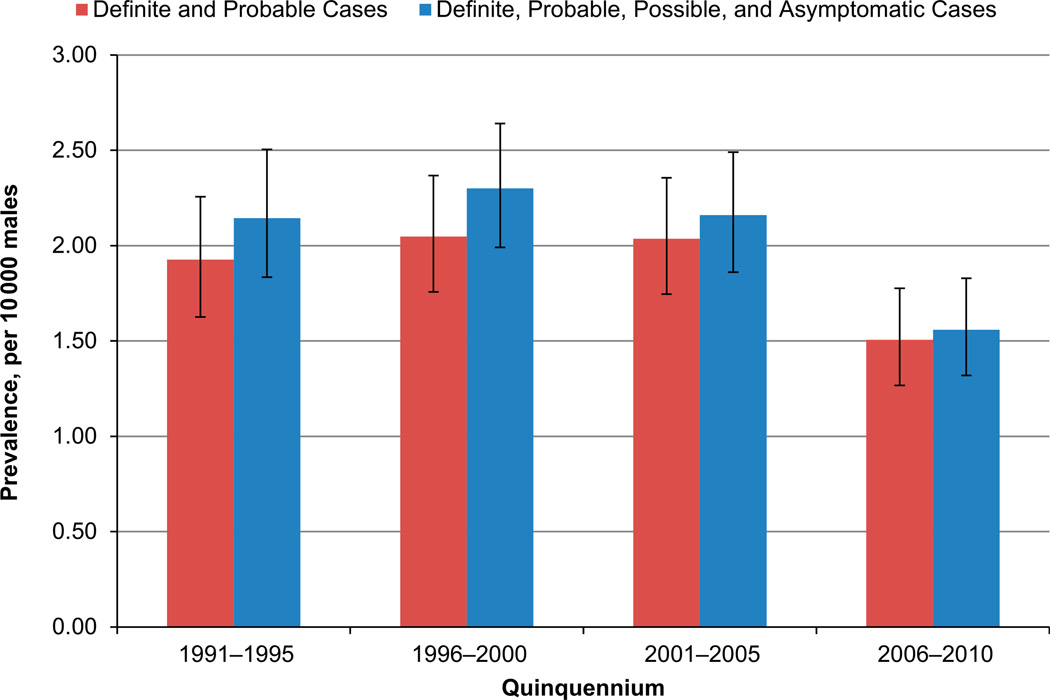
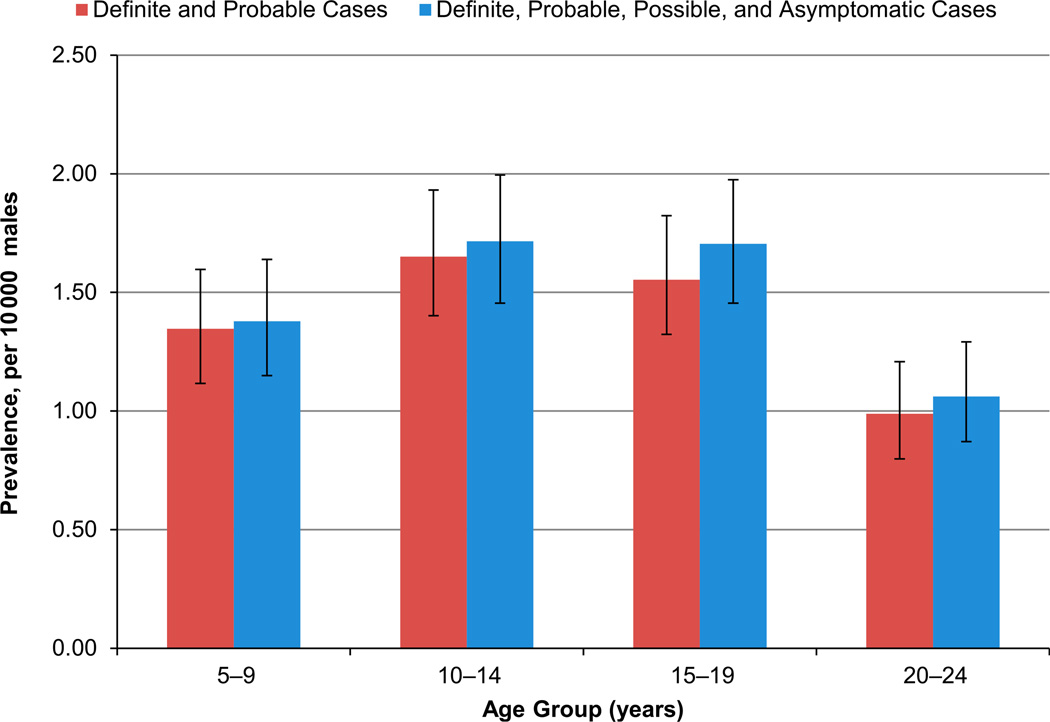
Methods: In 2002, the Centers for Disease Control and Prevention established the Muscular Dystrophy Surveillance, Tracking, and Research Network (MD STARnet) to conduct longitudinal, population-based surveillance and research of DBMD in the United States. Six sites conducted active, multiple-source case finding and record abstraction to identify MD STARnet cases born January 1982 to December 2011. We used cross-sectional analyses to estimate prevalence of DBMD per 10 000 boys, ages 5 to 9 years, for 4 quinquennia (1991-1995, 1996-2000, 2001-2005, and 2006-2010) and prevalence per 10 000 male individuals, ages 5 to 24 years, in 2010. Prevalence was also estimated by race/ethnicity and phenotype.
Results: Overall, 649 cases resided in an MD STARnet site during ≥1 quinquennia. Prevalence estimates per 10 000 boys, ages 5 to 9 years, were 1.93, 2.05, 2.04, and 1.51, respectively, for 1991-1995, 1996-2000, 2001-2005, and 2006-2010. Prevalence tended to be higher for Hispanic individuals than non-Hispanic white or black individuals, and higher for DMD than BMD. In 2010, prevalence of DBMD was 1.38 per 10 000 male individuals, ages 5 to 24 years.
Conclusions: We present population-based prevalence estimates for DBMD in 6 US sites. Prevalence differed by race/ethnicity, suggesting potential cultural and socioeconomic influences in the diagnosis of DBMD. Prevalence also was higher for DMD than BMD. Continued longitudinal surveillance will permit us to examine racial/ethnic and socioeconomic differences in treatment and outcomes for MD STARnet cases.
Keywords: Becker muscular dystrophy; Duchenne muscular dystrophy; ethnicity; population surveillance; prevalence.
Copyright © 2015 by the American Academy of Pediatrics.
Conflict of interest statement
Figures
References
-
- Ballo R, Viljoen D, Beighton P. Duchenne and Becker muscular dystrophy prevalence in South Africa and molecular findings in 128 persons affected. S Afr Med J. 1994;84(8 pt 1):494–497. - PubMed
-
- Chung B, Wong V, Ip P. Prevalence of neuromuscular diseases in Chinese children: a study in southern China. J Child Neurol. 2003;18(3):217–219. - PubMed
-
- Nakagawa M, Nakahara K, Yoshidome H, et al. Epidemiology of progressive muscular dystrophy in Okinawa, Japan. Classification with molecular biological techniques. Neuroepidemiology. 1991;10(4):185–191. - PubMed
-
- Peterlin B, Zidar J, Meznaric-Petrusa M, Zupancic N. Genetic epidemiology of Duchenne and Becker muscular dystrophy in Slovenia. Clin Genet. 1997;51(2):94–97. - PubMed
-
- Monckton G, Hoskin V, Warren S. Prevalence and incidence of muscular dystrophy in Alberta, Canada. Clin Genet. 1982;21(1):19–24. - PubMed
Publication types
MeSH terms
Grants and funding
LinkOut - more resources
Full Text Sources
Other Literature Sources
