. 2015 May;40(4):233-43.
doi: 10.1093/chemse/bjv001. Epub 2015 Feb 15.

The genetic basis for variation in olfactory behavior in Drosophila melanogaster

Affiliations

The genetic basis for variation in olfactory behavior in Drosophila melanogaster

Gunjan H Arya et al. Chem Senses. 2015 May.

Abstract

The genetic underpinnings that contribute to variation in olfactory perception are not fully understood. To explore the genetic basis of variation in olfactory perception, we measured behavioral responses to 14 chemically diverse naturally occurring odorants in 260400 flies from 186 lines of the Drosophila melanogaster Genetic Reference Panel, a population of inbred wild-derived lines with sequenced genomes. We observed variation in olfactory behavior for all odorants. Low to moderate broad-sense heritabilities and the large number of tests for genotype-olfactory phenotype association performed precluded any individual variant from reaching formal significance. However, the top variants (nominal P < 5×10(-5)) were highly enriched for genes involved in nervous system development and function, as expected for a behavioral trait. Further, pathway enrichment analyses showed that genes tagged by the top variants included components of networks centered on cyclic guanosine monophosphate and inositol triphosphate signaling, growth factor signaling, Rho signaling, axon guidance, and regulation of neural connectivity. Functional validation with RNAi and mutations showed that 15 out of 17 genes tested indeed affect olfactory behavior. Our results show that in addition to chemoreceptors, variation in olfactory perception depends on polymorphisms that can result in subtle variations in synaptic connectivity within the nervous system.

Keywords: Drosophila melanogaster Genetic Reference Panel; behavioral genetics; genetic networks; genome-wide association analysis; olfactory behavior.


Figures

Figure 1.
Figure 1.
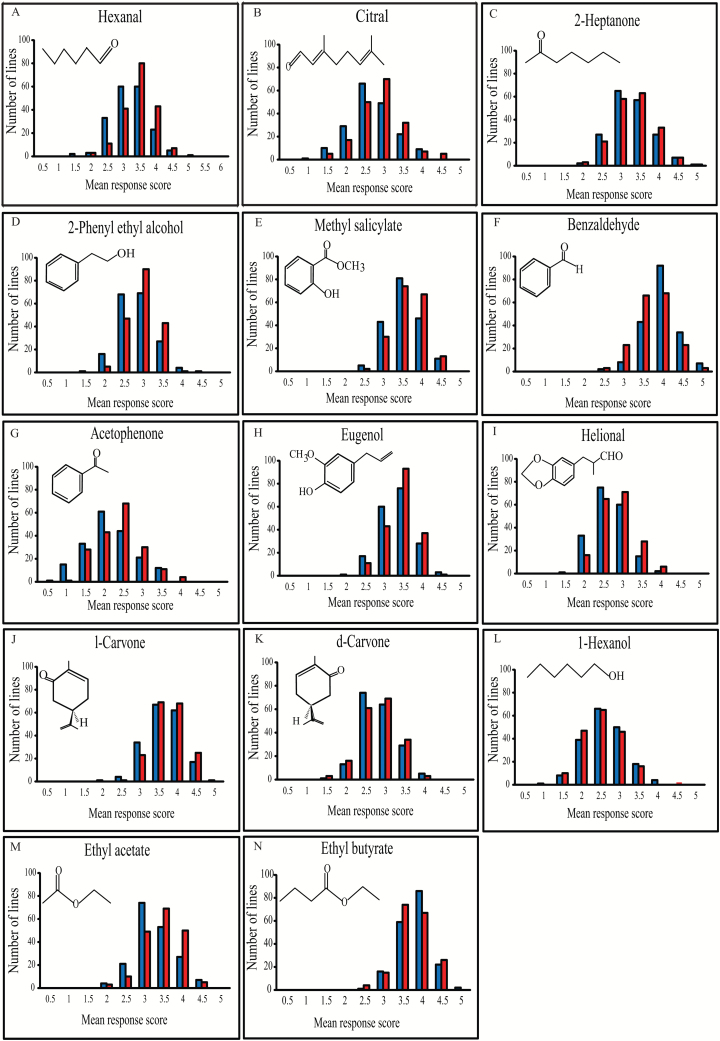
Variation in behavioral responses to 14 odorants in 186 DGRP lines. Variation in olfactory responses are depicted for (A) hexanal, (B) citral, (C) 2-heptanone, (D) 2-phenyl ethyl alcohol, (E) methyl salicylate, (F) benzaldehyde, (G) acetophenone, (H) eugenol, (I) helional, (J) l-carvone, (K) d-carvone, (L) 1-hexanol, (M) ethyl acetate, and (N) ethyl butyrate. Responses of males are shown by blue bars and of females by red bars.
Figure 2.
Figure 2.
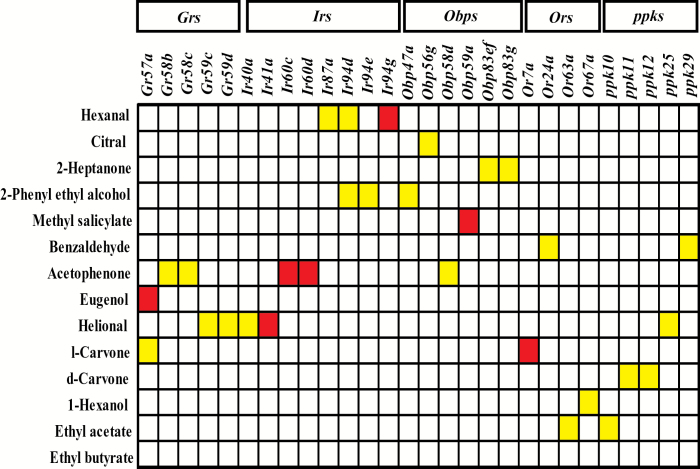
Polymorphisms in chemosensory receptor genes associated with variation in olfactory behavior. The diagram represents polymorphic markers in 23 chemosensory genes associated with variation in olfactory behavior toward 14 odorants identified by GWA analysis. We performed 4 different GWA analyses for each variant; the P value represents the lowest of the 4 P values in cases where more than one analysis per variant or multiple variants in the same gene reached the reporting threshold. P < 10−5 (red); P < 5×10⁻⁵ (yellow).
Figure 3.
Figure 3.
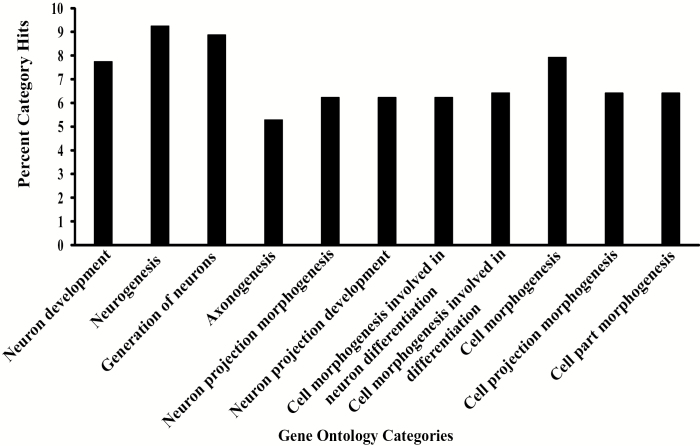
GO analyses. Significantly enriched GO (Benjamini correction: P < 0.05) for genes with sequence variants associated with variation in behavioral responses to one or more odorants. The analysis is based on biological processes level 5 using the DAVID algorithm and software (Huang et al. 2009).
Figure 4.
Figure 4.
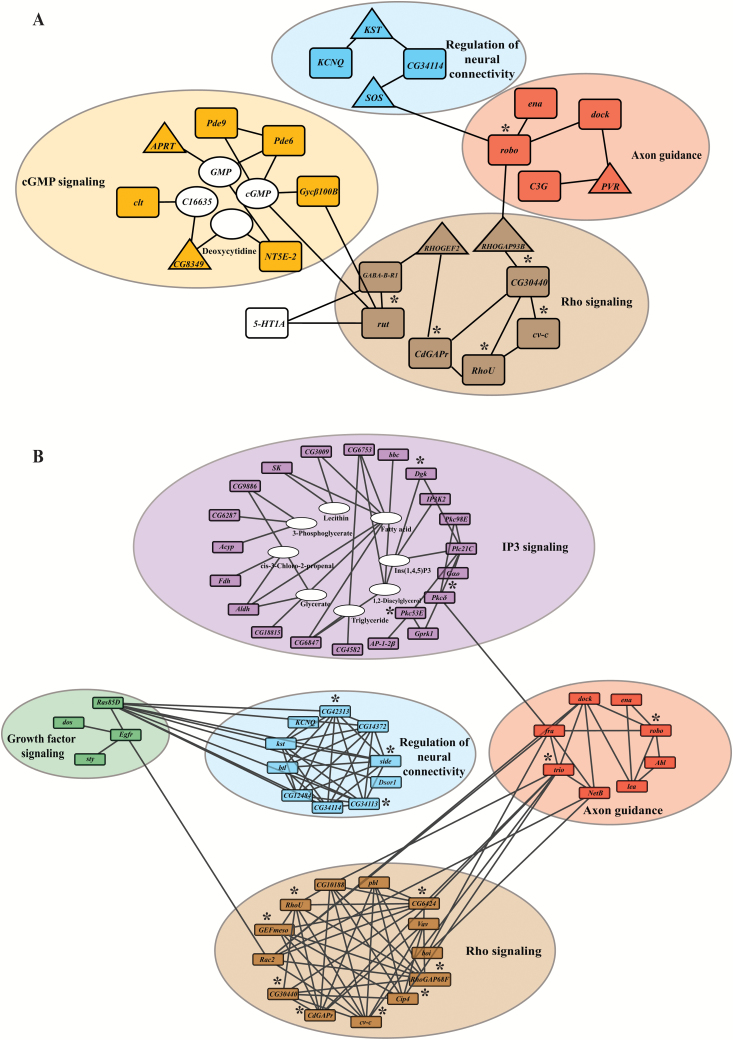
Genetic networks associated with variation in olfactory behavior. (A) A genetic network allowing one missing gene (permutation P < 0.04) derived from candidate genes detected at a nominal significance threshold in the GWA analysis of P < 10−5. The network was obtained with the R-spider algorithm (Antonov et al. 2010). Missing genes are indicated with triangles. (B) A genetic network with no missing genes (permutation P < 0.005) derived from candidate genes detected at a nominal significance threshold in the GWA analysis of P < 5×10⁻⁵. Candidate genes selected for subsequent mutational analysis or RNAi targeting are marked with an asterisk.
Figure 5.
Figure 5.
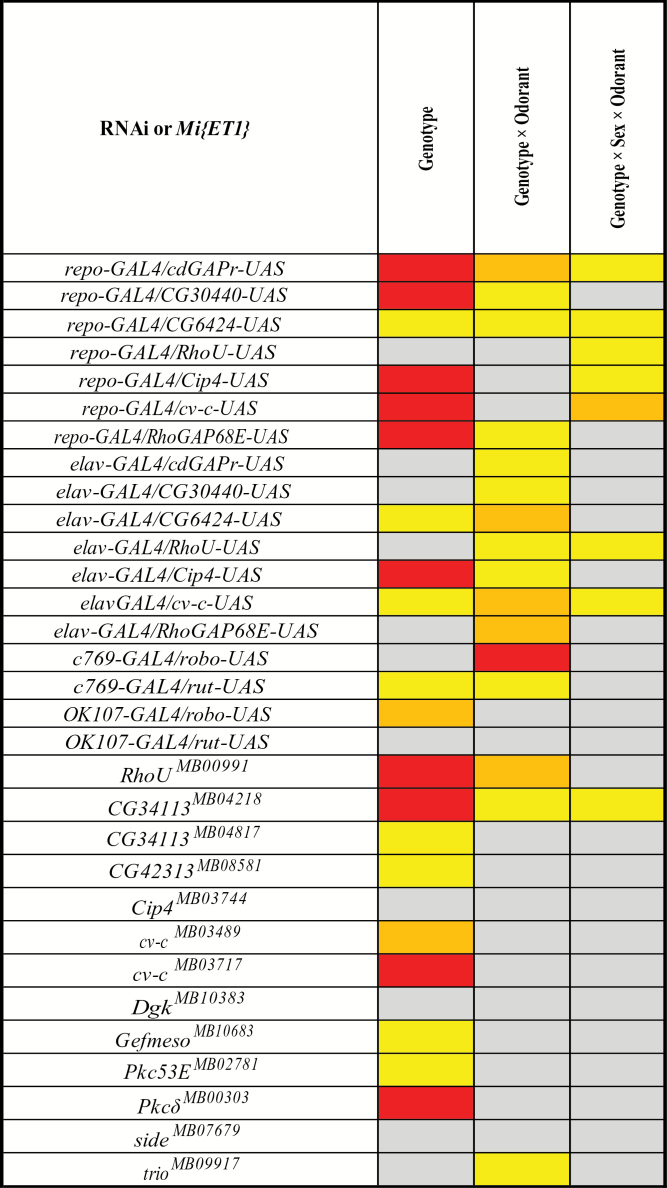
Mutational analysis and RNAi targeting of candidate genes. The boxes indicate P values of the main effect of genotype and the genotype × odorant and genotype × sex × odorant terms from ANOVAs comparing the olfactory behavior of each mutation or RNAi construct and its control line across a battery of different odorants. P ≤ 0.001 (red); 0.001 < P ≤ 0.01 (orange); 0.01 < P ≤ 0.05 (yellow); P > 0.05 (gray).

References

    1. Anholt RRH. 2010. Making scents of behavioral genetics: lessons from Drosophila . Genet Res. 92:349–359. - PMC - PubMed
    1. Anholt RR, Lyman RF, Mackay TF. 1996. Effects of single P-element insertions on olfactory behavior in Drosophila melanogaster . Genetics. 143:293–301. - PMC - PubMed
    1. Antonov AV, Schmidt EE, Dietmann S, Krestyaninova M, Hermjakob H. 2010. R spider: a network-based analysis of gene lists by combining signaling and metabolic pathways from Reactome and KEGG databases. Nucleic Acids Res. 38:W78–W83. - PMC - PubMed
    1. Araneda RC, Firestein S. 2004. The scents of androstenone in humans. J Physiol. 554:1. - PMC - PubMed
    1. Arya GH, Weber AL, Wang P, Magwire MM, Serrano-Negron YL, Anholt RRH. 2010. Natural variation, functional pleiotropy and transcriptional contexts of Odorant binding protein genes in Drosophila melanogaster . Genetics. 186:1475–1485. - PMC - PubMed

Publication types

MeSH terms

LinkOut - more resources