


An experimental study of gender and cultural differences in hue preference
- PMID: 25688219
- PMCID: PMC4311615
- DOI: 10.3389/fpsyg.2015.00030
An experimental study of gender and cultural differences in hue preference
Abstract
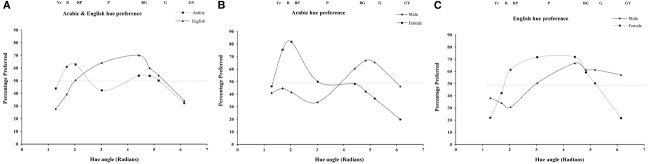
This paper investigates the influence of both gender and culture on color preference. Inspection of previous studies of color preference reveals that many of these studies have poor control over the colors that are shown-the chromatic co-ordinates of colors are either not noted or the illuminant that colors are shown under is not controlled. This means that conclusions about color preference are made using subjective terms for hue with little knowledge about the precise colors that were shown. However, recently, a new quantitative approach to investigating color preference has been proposed, where there is no need to summarize color preference using subjective terms for hue (Hurlbert and Ling, 2007; Ling and Hurlbert, 2007). This approach aims to quantitatively summarize hue preference in terms of weights on the two channels or "cardinal axes" underlying color vision. Here I further extend Hurlbert and Ling's (2007) approach to investigating color preference, by replicating their study but with Arabic and English participants, and to answer several questions: First, are there cultural differences in the shape of the overall preference curve for English and Arabic participants? Second, are there gender differences in the shape of the overall preference curve for English and Arabic participants? Thirty eight British and 71 Saudi Arabian (Arabic) participants were compared. Results revealed that Arabic and English preference curves were found to differ, yet there was greater similarity for Arabic and English males than Arabic and English females. There was also a sex difference that was present for both Arabic and English participants. The male curve is fairly similar for both samples: peak-preference is in the blue-green region, and a preference minimum is in the red-pink/purple region. For Arabic females the preference peak appears to be in the red-pink region, whilst for English females it is shifted toward purple/blue-green.
Keywords: color preference; culture differences; gender differences; hue preference.
Figures
References
-
- Camgoz N., Yener C., Guvenc D. (2002). Effect of hue, saturation, and brightness on preference. Color Res. Appl. 27, 199–207 10.1002/col.10051 - DOI
-
- Chandler A. R. (1934). Beauty and Human Nature. New York: Appleton–Century-Crofts.
LinkOut - more resources
Full Text Sources
Other Literature Sources
