Review
. 2015:2015:798426.
doi: 10.1155/2015/798426. Epub 2015 Jan 22.

Structure-function based molecular relationships in Ewing's sarcoma

Affiliations
Review

Structure-function based molecular relationships in Ewing's sarcoma

Roumiana Todorova. Biomed Res Int. 2015.

Abstract

Ewing's Sarcoma Oncogene (ews) on chromosome 22q12 is encoding a ubiquitously expressed RNA-binding protein (EWS) with unknown function that is target of tumor-specific chromosomal translocations in Ewing's sarcoma family of tumors. A model of transcription complex was proposed in which the heterodimer Rpb4/7 binds to EAD, connecting it to Core RNA Pol II. The DNA-binding domain, provided by EFP, is bound to the promoter. Rpb4/7 binds RNA, stabilizing the transcription complex. The complex Rpb4/7 can stabilize the preinitiation complexes by converting the conformation of RNA Pol II. EWS may change its conformation, so that NTD becomes accessible. Two different mechanisms of interaction between EWS and RNA Pol II are proposed: (I) an intermolecular EWS-EWS interaction between two molecules, pushing conformation from "closed" to "open" state, or (II) an intramolecular interaction inside the molecule of EWS, pushing conformation of the molecule from "closed" to "open" state. The modified forms of EWS may interact with Pol II subunits hsRpb5 and hsRpb7. The EWS and EFPs binding partners are described schematically in a model, an attempt to link the transcription with the splicing. The proposed model helps to understand the functional molecular interactions in cancer, to find new partners and ways to treat cancer.


Figures
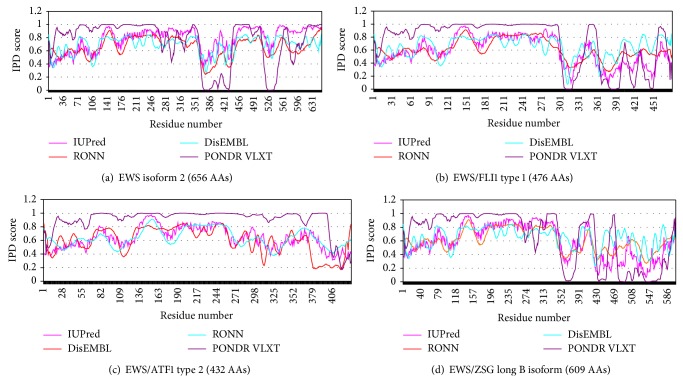
Figure 1
Figure 1
The IPD of native protein EWS isoform 2 (656 AAs) and isoforms of EWS oncogenic proteins EWS/ FLI1 (476 AA), EWS/ATF1 (432 AA), and EWS/ZSG long B isoform (609 AA) were estimated by Predictors IUPred [3], DisEMBL [5], RONN [7], and PONDR [8]. Higher IPD score is equivalent to higher disorder tendency estimated by the Predictor. (a) EWS isoform 2 (656 AAs). (b) EWS/FLI1 type 1 (476 AAs). (c) EWS/ATF1 type 2 (432 AAs). (d) EWS/ZSG long B isoform (609 AAs).
Figure 2
Figure 2
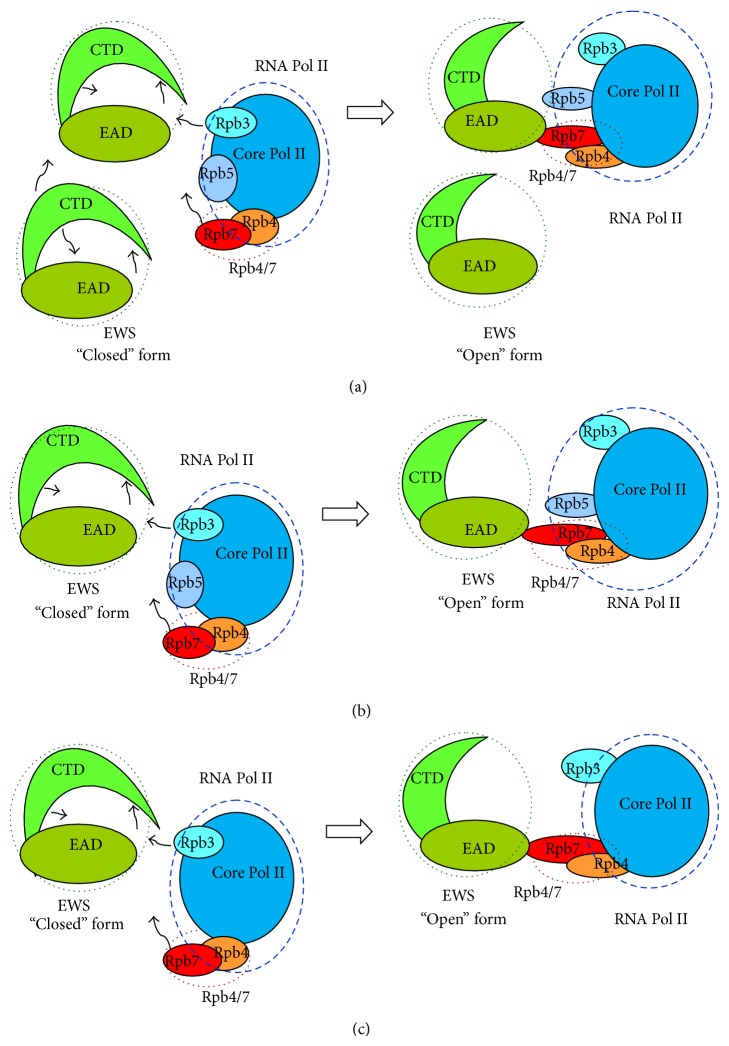
Proposed mechanism of the interaction between EWS and RNA Pol II (presented schematically). (a) Mechanism I. The EWS-EWS intermolecular protein-protein interactions induce the transition from “closed” to “open” conformation of the molecule, thus making the N-terminal part of EWS accessible for interaction with Rpb5 and the heterodimer Rpb4/7. (b) Mechanism II. An intramolecular interaction inside the EWS results in pushing conformation of the molecule from “closed” to “open” state, making it accessible for other molecules, such as subunits of RNA Pol II. Following this mechanism, the subunit Rpb3 from Pol II is interacting weakly with EWS that induces changes in the conformation of the molecule, leaving its N-terminal part accessible for interaction with Rpb5 and the heterodimer Rpb4/7. (c) Mechanism II. An intramolecular interaction inside the EWS results in pushing conformation of the molecule from “closed” to “open” state, making it accessible for other molecules, such as subunits of RNA Pol II. Following this proposed mechanism, the interacting partners pushing the conformation of EWS from “closed” to “open” state are only the subunit of RNA Pol II Rpb3 and the complex Rpb4/7.
Figure 3
Figure 3
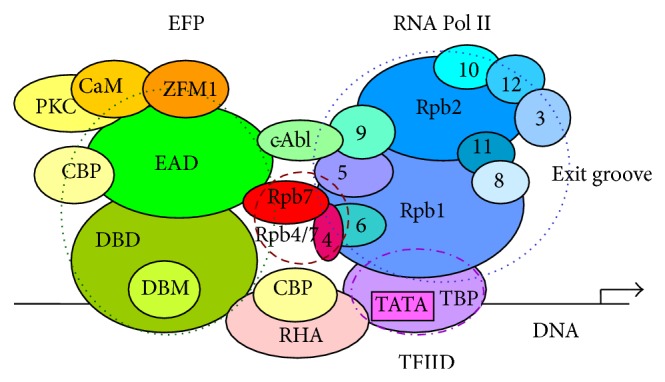
Schematic model of the transcription complex (transactivation by the EAD), including some of the interacting partners of EWS, based on the EFPs fusion proteins. The EAD is bound to the promoter via the DNA-binding motif (DBM) in the DNA-binding domain (DBD) of the EFP (bZIP for the ATF1 as EFP), and Core Pol II binds DNA via the TBP TATA box of the transcription factor TFIID. The N-terminus of EAD directly contacts Rpb5 and Rpb7 via the N-terminus, while the intact EWS does not. The heterodimer Rpb4/7 binds to the EAD, thus connecting it to the Core RNA Pol II. The complex Rpb4/7 can stabilize the pre-initiation complexes by converting the conformation of RNA Pol II from open to closed. The Rpb7 is forming several direct contacts with Rpb1, Rpb2, and Rpb6 holding them together in a preferred conformation. The conformation of Pol II changes during different stages. The Core Pol II may adopt an open configuration, allowing the dsDNA to enter the active-site groove. The Rpb4/7 associates with Core Pol II through the N-terminal ribonucleoprotein-like domain of Rpb7 and the partially ordered N-terminal region of Rpb4. Some additional components, CBP, PKC, CaM, and ZFM1, interacting with the EAD, and RHA, interacting with EFP, are shown. DBD-DNA-binding domain. DBM-DNA-binding motif; for EAD-ATF1 the DBM is bZIP.

References

    1. Law W. J., Cann K. L., Hicks G. G. TLS, EWS and TAF15: a model for transcriptional integration of gene expression. Briefings in Functional Genomics and Proteomics. 2006;5(1):8–14. doi: 10.1093/bfgp/ell015. - DOI - PubMed
    1. Kovar H. Downstream EWS/FLI1—upstream Ewing's sarcoma. Genome Medicine. 2010;2(1, article 8) doi: 10.1186/gm129. - DOI - PMC - PubMed
    1. Ohno T., Ouchida M., Lee L., Gatalica Z., Rao V. N., Reddy E. S. P. The EWS gene, involved in Ewing family of tumors, malignant melanoma of soft parts and desmoplastic small round cell tumors, codes for an RNA binding protein with novel regulatory domains. Oncogene. 1994;9(10):3087–3097. - PubMed
    1. Ng K. P., Potikyan G., Savene R. O. V., Denny C. T., Uversky V. N., Lee K. A. W. Multiple aromatic side chains within a disordered structure are critical for transcription and transforming activity of EWS family oncoproteins. Proceedings of the National Academy of Sciences of the United States of America. 2007;104(2):479–484. doi: 10.1073/pnas.0607007104. - DOI - PMC - PubMed
    1. Ng K. P., Li K. K., Lee K. A. In vitro activity of the EWS oncogene transcriptional activation domain. Biochemistry. 2009;48(13):2849–2857. doi: 10.1021/bi802366h. - DOI - PubMed

MeSH terms

LinkOut - more resources