


Spatio-temporal dynamics of adaptation in the human visual system: a high-density electrical mapping study
- PMID: 25688539
- PMCID: PMC4390449
- DOI: 10.1111/ejn.12849
Spatio-temporal dynamics of adaptation in the human visual system: a high-density electrical mapping study
Abstract
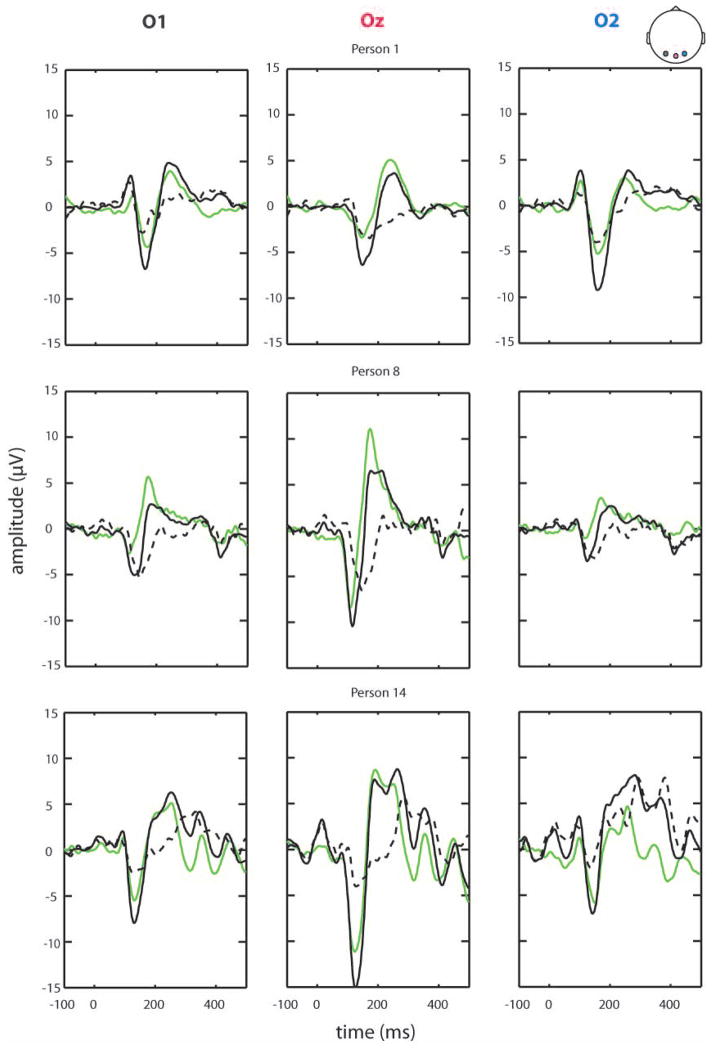
When sensory inputs are presented serially, response amplitudes to stimulus repetitions generally decrease as a function of presentation rate, diminishing rapidly as inter-stimulus intervals (ISIs) fall below 1 s. This 'adaptation' is believed to represent mechanisms by which sensory systems reduce responsivity to consistent environmental inputs, freeing resources to respond to potentially more relevant inputs. While auditory adaptation functions have been relatively well characterized, considerably less is known about visual adaptation in humans. Here, high-density visual-evoked potentials (VEPs) were recorded while two paradigms were used to interrogate visual adaptation. The first presented stimulus pairs with varying ISIs, comparing VEP amplitude to the second stimulus with that of the first (paired-presentation). The second involved blocks of stimulation (N = 100) at various ISIs and comparison of VEP amplitude between blocks of differing ISIs (block-presentation). Robust VEP modulations were evident as a function of presentation rate in the block-paradigm, with strongest modulations in the 130-150 ms and 160-180 ms visual processing phases. In paired-presentations, with ISIs of just 200-300 ms, an enhancement of VEP was evident when comparing S2 with S1, with no significant effect of presentation rate. Importantly, in block-presentations, adaptation effects were statistically robust at the individual participant level. These data suggest that a more taxing block-presentation paradigm is better suited to engage visual adaptation mechanisms than a paired-presentation design. The increased sensitivity of the visual processing metric obtained in the block-paradigm has implications for the examination of visual processing deficits in clinical populations.
Keywords: EEG; habituation; inhibition; plasticity; vision.
© 2015 Federation of European Neuroscience Societies and John Wiley & Sons Ltd.
Conflict of interest statement
All authors of this paper declare no conflicts-of-interest, financial or otherwise, that could have biased their contributions to this work. The senior author, Dr. Foxe, attests that all authors had access to the full dataset and to all stages of the analyses.
Figures


References
-
- Adler LEW, MC, Freedman R. Neurophysiologic Studies of Sensory Gating in Schizophrenia: Comparison of Auditory and Visual Responses. Biol Psychiatry. 1985;20:1284–1296. - PubMed
-
- Arnfred SM, Eder DN, et al. Gating of the vertex somatosensory and auditory evoked potential P50 and the correlation to skin conductance orienting response in healthy men. Psychiatry Res. 2001;101(3):221–235. - PubMed
-
- Bedwell JS, Chan CC, et al. Changes in the visual-evoked P1 potential as a function of schizotypy and background color in healthy young adults. J Psychiatr Res. 2013;47(4):542–547. - PubMed
-
- Braff DL, Light GA, et al. Prepulse inhibition and P50 suppression are both deficient but not correlated in schizophrenia patients. Biol Psychiatry. 2007;61(10):1204–1207. - PubMed
-
- Brockhaus-Dumke A, Mueller R, et al. Sensory gating revisited: Relation between brain oscillations and auditory evoked potentials in schizophrenia. Schizophrenia Research. 2008;99(1–3):238–249. - PubMed
Publication types
MeSH terms
Grants and funding
LinkOut - more resources
Full Text Sources
Other Literature Sources
