


Regulation of neural responses to emotion perception by ketamine in individuals with treatment-resistant major depressive disorder
- PMID: 25689570
- PMCID: PMC4445748
- DOI: 10.1038/tp.2015.10
Regulation of neural responses to emotion perception by ketamine in individuals with treatment-resistant major depressive disorder
Abstract
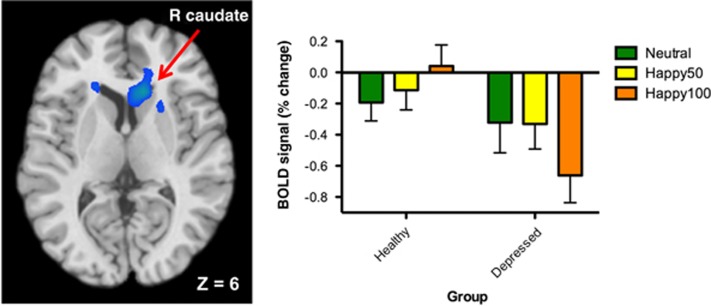
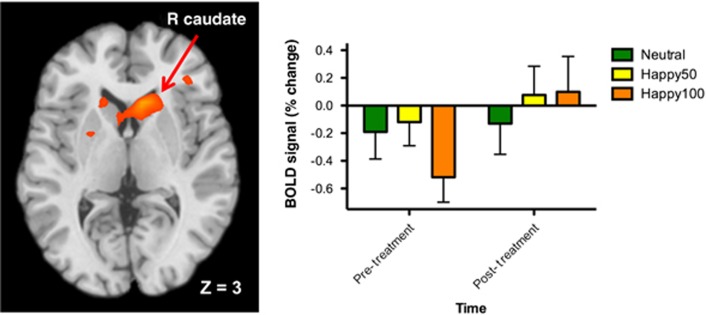
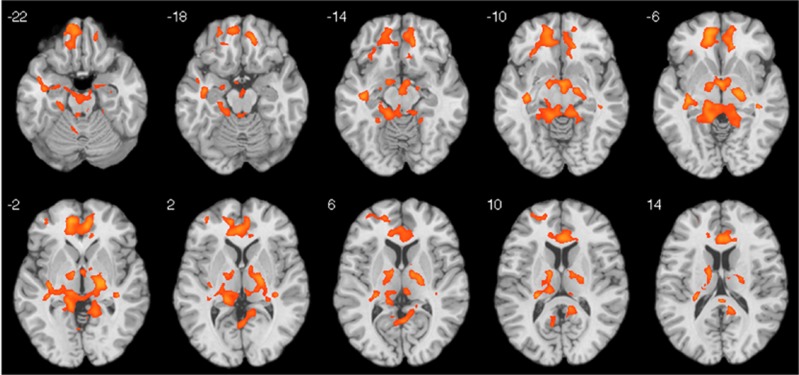
The glutamate N-methyl-D-aspartate receptor antagonist ketamine has demonstrated antidepressant effects in individuals with treatment-resistant major depressive disorder (TRD) within 24 h of a single dose. The current study utilized functional magnetic resonance imaging (fMRI) and two separate emotion perception tasks to examine the neural effects of ketamine in patients with TRD. One task used happy and neutral facial expressions; the other used sad and neutral facial expressions. Twenty patients with TRD free of concomitant antidepressant medication underwent fMRI at baseline and 24 h following administration of a single intravenous dose of ketamine (0.5 mg kg(-1)). Adequate data were available for 18 patients for each task. Twenty age- and sex-matched healthy volunteers were scanned at one time point for baseline comparison. Whole-brain, voxel-wise analyses were conducted controlling for a family-wise error rate (FWE) of P<0.05. Compared with healthy volunteers, TRD patients showed reduced neural responses to positive faces within the right caudate. Following ketamine, neural responses to positive faces were selectively increased within a similar region of right caudate. Connectivity analyses showed that greater connectivity of the right caudate during positive emotion perception was associated with improvement in depression severity following ketamine. No main effect of group was observed for the sad faces task. Our results indicate that ketamine specifically enhances neural responses to positive emotion within the right caudate in depressed individuals in a pattern that appears to reverse baseline deficits and that connectivity of this region may be important for the antidepressant effects of ketamine.
Figures
References
-
- Trivedi MH, Rush AJ, Wisniewski SR, Nierenberg AA, Warden D, Ritz L, et al. Evaluation of outcomes with citalopram for depression using measurement-based care in STAR*D: implications for clinical practice. Am J Psychiatry. 2006;163:28–40. - PubMed
-
- Trivedi MH, Fava M, Wisniewski SR, Thase ME, Quitkin F, Warden D, et al. Medication augmentation after the failure of SSRIs for depression. N Engl J Med. 2006;354:1243–1252. - PubMed
-
- Berman RM, Cappiello A, Anand A, Oren DA, Heninger GR, Charney DS, et al. Antidepressant effects of ketamine in depressed patients. Biol Psychiatry. 2000;47:351–354. - PubMed
-
- Zarate CA, Jr, Singh JB, Carlson PJ, Brutsche NE, Ameli R, Luckenbaugh DA, et al. A randomized trial of an N-methyl-D-aspartate antagonist in treatment-resistant major depression. Arch Gen Psychiatry. 2006;63:856–864. - PubMed
Publication types
MeSH terms
Substances
Grants and funding
LinkOut - more resources
Full Text Sources
Other Literature Sources
