. 2015 Sep;10(3):457-67.
doi: 10.1007/s11481-015-9589-x. Epub 2015 Feb 18.

Reciprocal Regulation of Substance P and IL-12/IL-23 and the Associated Cytokines, IFNγ/IL-17: A Perspective on the Relevance of This Interaction to Multiple Sclerosis

Affiliations

Reciprocal Regulation of Substance P and IL-12/IL-23 and the Associated Cytokines, IFNγ/IL-17: A Perspective on the Relevance of This Interaction to Multiple Sclerosis

Janek Vilisaar et al. J Neuroimmune Pharmacol. 2015 Sep.

Abstract

The neuropeptide substance P (SP) exhibits cytokine-like properties and exerts different effects in autoimmune inflammation. Various immune cells express SP and its neurokinin-1 receptor (NK1R) isoforms. A role for SP has been demonstrated in a number of autoimmune conditions, including multiple sclerosis (MS). In this work, we studied the role of SP and NK1R in human immune cells with a focus on their relationship with IL-12/IL-23 family cytokines and the associated IFN-γ/IL-17.

Aims: (1) To determine the role of SP mediated effects on induction of various inflammatory cytokines in peripheral blood mononuclear cells (PBMC); (2) to investigate the expression of SP and its receptor in T cells and the effects of stimulation with IL-12 and IL-23. Quantitative real-time PCR, flow cytometry, ELISA, promoter studies on PBMC and primary T cells from healthy volunteers, and Jurkat cell line. Treatment with SP significantly increased the expression of IL-12/IL-23 subunit p40, IL-23 p19 and IL-12 p35 mRNA in human PBMC. Expression of NK1R and SP in T cells was upregulated by IL-23 but a trend was observed with IL-12. The IL-23 effect likely involves IL-17 production that additionally mediates IL-23 effects. Mutual interactions exist with SP enhancing the cytokines IL-23 and IL-12, and SP and NK1R expression being differentially but potentially synergistically regulated by these cytokines. These findings suggest a proinflammatory role for SP in autoimmune inflammation. We propose a model whereby immunocyte derived SP stimulates Th1 and Th17 autoreactive cells migrating to the central nervous system (CNS), enhances their crossing the blood brain barrier and perpetuates inflammation in the CNS by being released from damaged nerves and activating both resident glia and infiltrating immune cells. SP may be a therapeutic target in MS.


Conflict of interest statement

The authors declare that they have no conflict of interest.

Figures
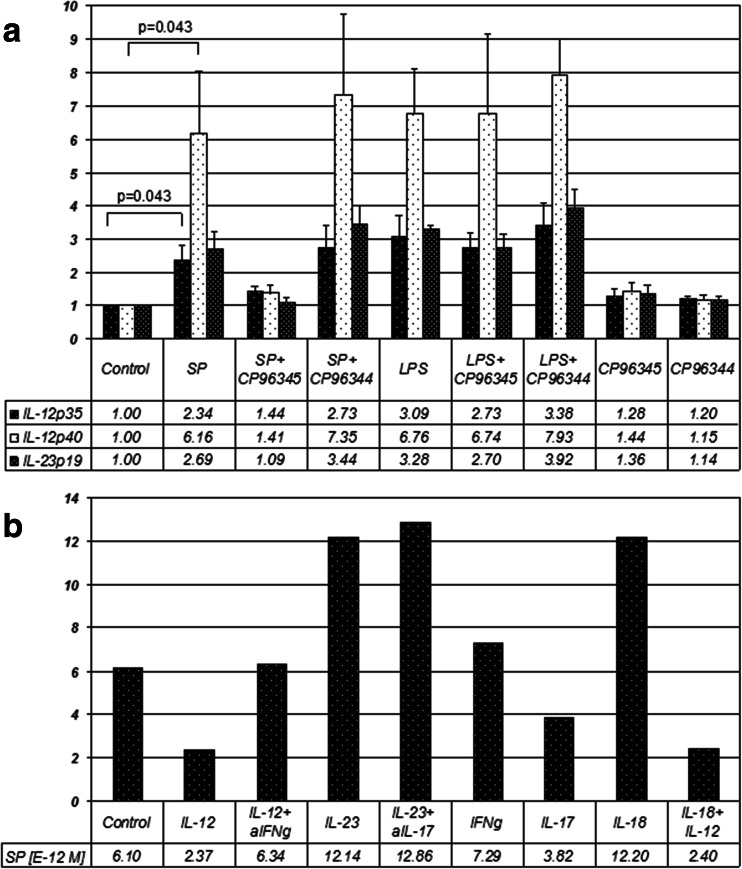
Fig. 1
Fig. 1
a Quantitative PCR results showing IL-12p35, IL-12/23p40 and IL-23p19 mRNA abundance in PBMCs in response to 24 h incubation with different stimuli. The values represent arbitrary units after normalization with corresponding values of β2MG as an internal standard. Each bar represents averages of 5 different healthy donors, error bars indicate SEM; b representative results from one healthy donor showing molar concentrations of SP (times 10−12 M) in cell culture supernatants on ELISA, following a 24 h stimulation of T blasts with different stimuli. The concentrations are converted from mass concentrations (pg/ml) given on ELISA
Fig. 2
Fig. 2
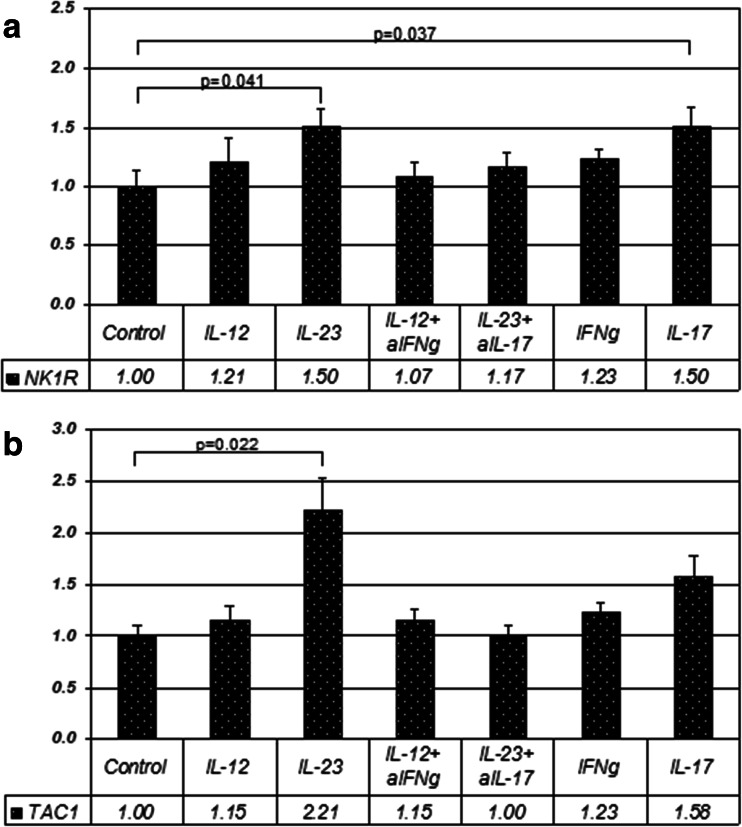
a Quantitative PCR was used to assess mRNA-level expression of NK1R relative to internal standard β2MG. Each bar represents an average of 10 stimulation assays on T cell blasts from 10 different healthy donors +/- SEM. The results of individual assays were expressed in arbitrary units of mRNA abundance, normalised with the corresponding values of β2MG; b mRNA-abundance of TAC1 relative to internal standard β2MG: mean ratios of stimulation assays on T blasts from 10 different healthy donors +/- SEM
Fig. 3
Fig. 3
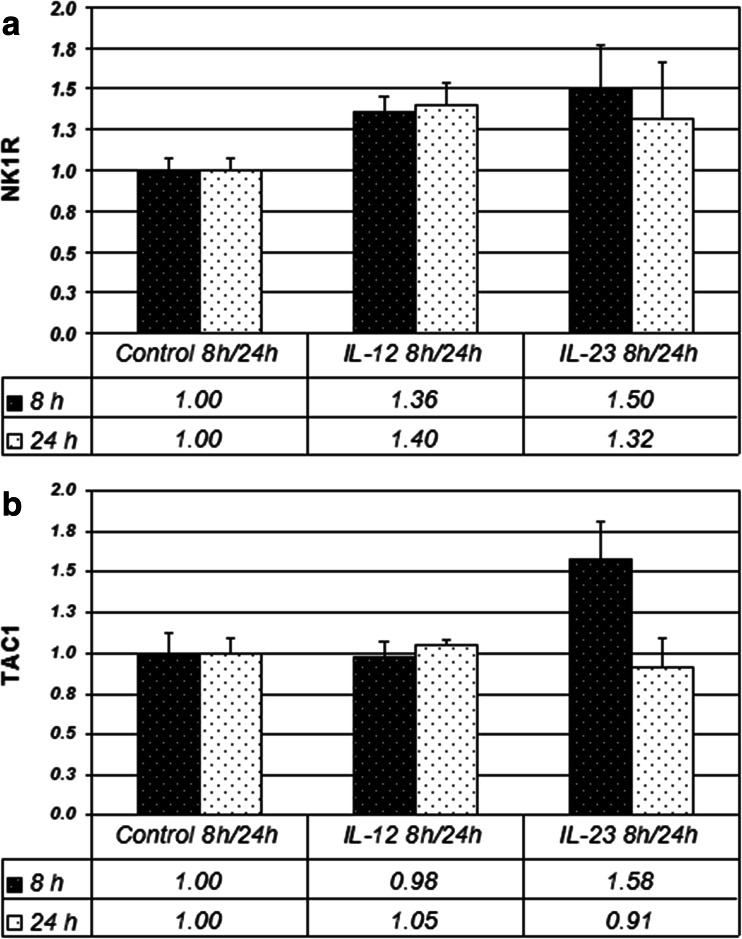
NK1R and TAC1 mRNA abundance in CD4+ cells following 8 and 24 h stimulation (10 ng/ml IL-12 or 10 ng/ml IL-23), normalized with β2MG as internal standard. The values represent mean ratios of 4 healthy donors +/- SEM
Fig. 4
Fig. 4
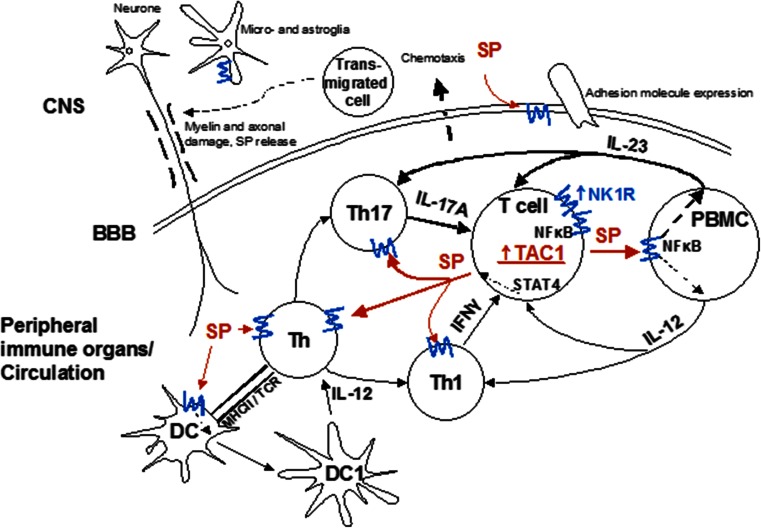
Schematic diagram illustrating substance P (SP) and cytokine interactions in autoimmune demyelinating disease (e.g. MS). For clarity, only the main effects on pro-inflammatory Th17 and Th1 pathways have been depicted with thicker arrows representing stronger responses suggested by our study. Blue lines indicate NK1R. SP effects are shown in red. CNS central nervous system; BBB blood–brain barrier; DC dendritic cell; PBMC peripheral blood mononuclear cell; MHCII major histocompatibility complex II; TCR T cell receptor

References

    1. Ahluwalia A, De Felipe C, O’Brien J, Hunt SP, Perretti M. Impaired IL-1beta-induced neutrophil accumulation in tachykinin NK1 receptor knockout mice. Br J Pharmacol. 1998;124:1013–1015. doi: 10.1038/sj.bjp.0701978. - DOI - PMC - PubMed
    1. AppliedBiosystems . User bulletin #2 ABI PRISM 7700 sequence detection system. Foster City: Applied Biosystems; 1997.
    1. Arsenescu R, Blum AM, Metwali A, Elliott DE, Weinstock JV. IL-12 induction of mRNA encoding substance P in murine macrophages from the spleen and sites of inflammation. J Immunol. 2005;174:3906–3911. doi: 10.4049/jimmunol.174.7.3906. - DOI - PubMed
    1. Beinborn M, et al. TGF-beta regulates T-cell neurokinin-1 receptor internalization and function. Proc Natl Acad Sci U S A. 2010;107:4293–4298. doi: 10.1073/pnas.0905877107. - DOI - PMC - PubMed
    1. Bettelli E, et al. Reciprocal developmental pathways for the generation of pathogenic effector TH17 and regulatory T cells. Nature. 2006;441:235–238. doi: 10.1038/nature04753. - DOI - PubMed

Publication types

MeSH terms

LinkOut - more resources