Clinical Trial
. 2015 May;35(5):873-81.
doi: 10.1038/jcbfm.2015.4. Epub 2015 Feb 18.

The contribution of arterial blood gases in cerebral blood flow regulation and fuel utilization in man at high altitude

Affiliations
Clinical Trial

The contribution of arterial blood gases in cerebral blood flow regulation and fuel utilization in man at high altitude

Christopher K Willie et al. J Cereb Blood Flow Metab. 2015 May.

Abstract

The effects of partial acclimatization to high altitude (HA; 5,050 m) on cerebral metabolism and cerebrovascular function have not been characterized. We hypothesized (1) increased cerebrovascular reactivity (CVR) at HA; and (2) that CO2 would affect cerebral metabolism more than hypoxia. PaO2 and PaCO2 were manipulated at sea level (SL) to simulate HA exposure, and at HA, SL blood gases were simulated; CVR was assessed at both altitudes. Arterial-jugular venous differences were measured to calculate cerebral metabolic rates and cerebral blood flow (CBF). We observed that (1) partial acclimatization yields a steeper CO2-H(+) relation in both arterial and jugular venous blood; yet (2) CVR did not change, despite (3) mean arterial pressure (MAP)-CO2 reactivity being doubled at HA, thus indicating effective cerebral autoregulation. (4) At SL hypoxia increased CBF, and restoration of oxygen at HA reduced CBF, but neither had any effect on cerebral metabolism. Acclimatization resets the cerebrovasculature to chronic hypocapnia.


Figures
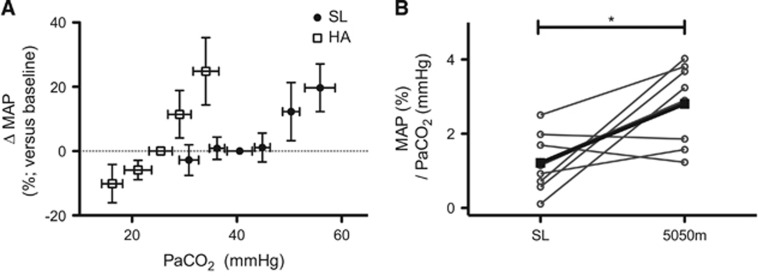
Figure 1
Figure 1
Percent difference in mean arterial pressure (MAP) from baseline (A) during euoxic changes in PaCO2 at sea level (SL) (solid squares) and high altitude (HA) (hollow squares), and the individual slopes of this relationship in the hypercapnic range (B). Mean slopes (±s.d.) for this relationship were SL hypercapnic range 1.2±0.7%/mm Hg; HA, hypocapnic range 1.1±0.7%/mm Hg (not-shown); HA, hypercapnic range 2.8±1.0%/mm Hg. *P<0.05.
Figure 2
Figure 2
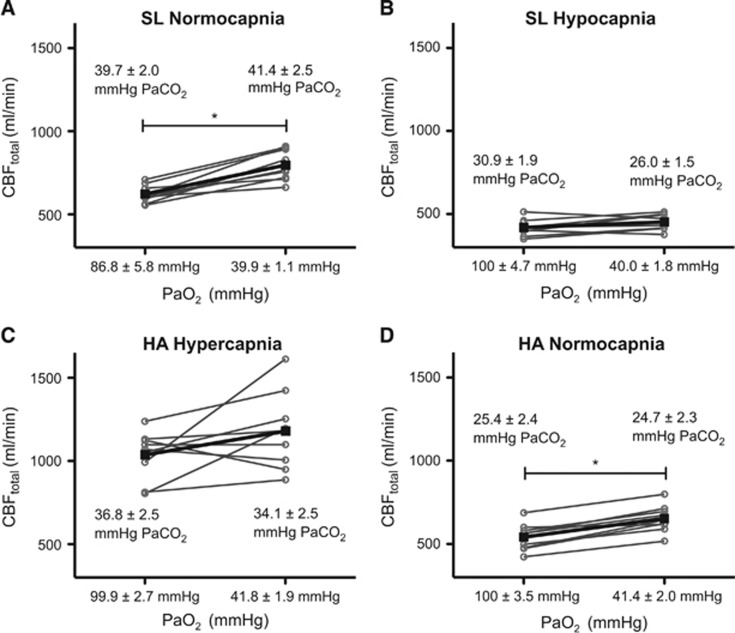
Individual cerebral blood flow (CBFtotal) values during isocapnic changes in PaO2 at sea level (SL) and high altitude (HA). The top plots (A and B) show data from SL; the bottom plots (C and D) show data from 5,050 m. The left side of each plot depicts CBF while PaO2 was ~100 mm Hg (except at SL—plot A—where ambient PO2 yielded a smaller PaO2), whereas hypoxia is shown on the right side of each plot. The left hand plots (A and C) show isocapnia clamped at ~40 mm Hg at SL and ~35 mm Hg at HA (the lower PaCO2 values at HA were due to inability of subjects to tolerate higher values; see Results and Discussion). Right side plots (B and D) show isocapnic clamp at ~25 mm Hg. Please see Materials and methods for further details on gas permutations. *P<0.05.
Figure 3
Figure 3
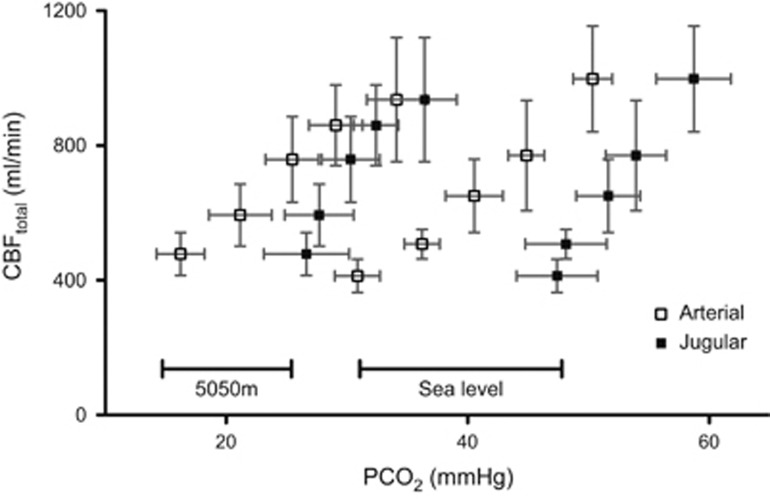
Total cerebral blood flow (CBFtotal) during steady-state euxoic changes in PCO2 at sea level (SL) and high altitude (HA). Hollow squares represent CBF plotted against arterial PCO2 and solid squares against internal jugular vein PCO2. CBF was significantly altered from baseline at all levels of PCO2 at both SL and 5,050 m (P<0.05). Data are mean±s.d.
Figure 4
Figure 4
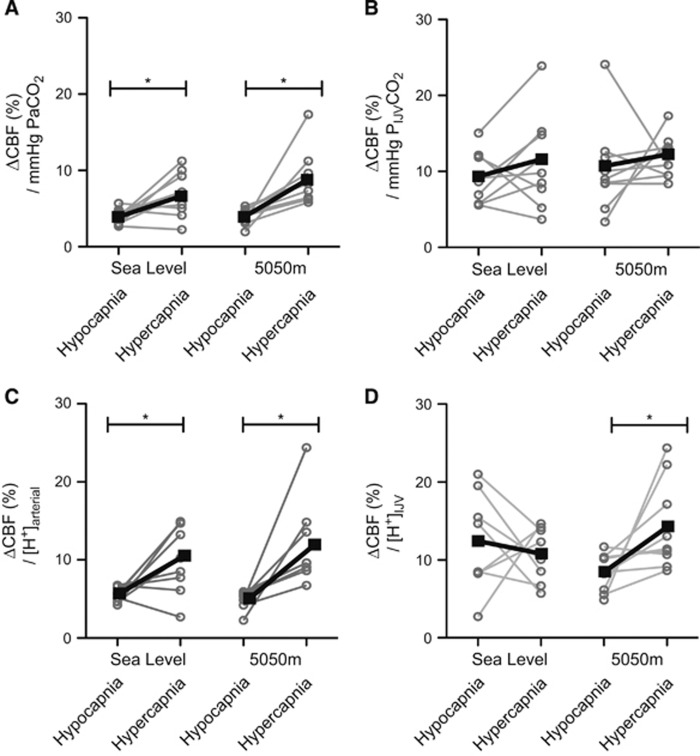
Individual (circles, gray) and mean (squares, black) cerebrovascular reactivity (CVR) to euoxic changes in arterial (left) and jugular (right) PCO2 (Top) and [H+] (bottom). CVR in the hypocapnic range was lower than in the hypercapnic at both elevations when determined as a function of PaCO2 or arterial [H+] (A and C; P<0.05). PIJVCO2 CVR did not differ between hypo- and hypercapnia nor between altitudes (B), whereas [H+]IJV was greater in the hypercapnic range at high altitude (HA) (D); P<0.05. The very high arterial CVR in one individual at HA (11.2%/mm Hg) was more than two standard deviations above the mean (6.8±5.4%/mm Hg); however, removal of this individual did not affect statistical significance. IJV, internal jugular vein. *P<0.05.
Figure 5
Figure 5
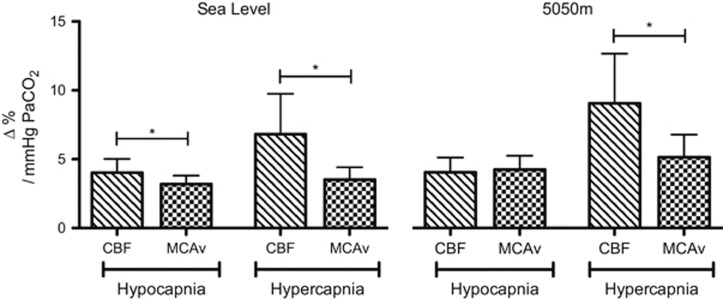
Comparison of cerebral blood flow (CBF) versus middle cerebral artery (MCA) velocity (MCAv) reactivities to change in PaCO2 at sea level (SL) and high altitude (HA). MCAv cerebrovascular reactivity (CVR) was lower than CBF CVR in the hypercapnic range at both altitudes, likely due to dilation of the MCA during increases in CO2, slowing of MCA blood velocity and consequent underestimation of reactivity to increases in PaCO2. Data are mean±s.d. *P<0.05.
Figure 6
Figure 6
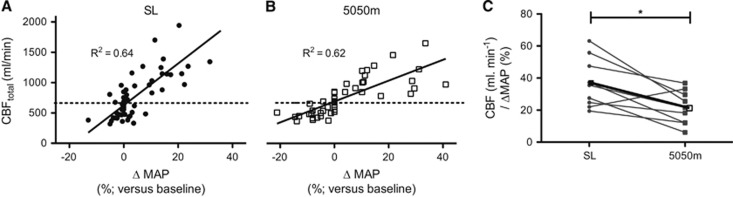
Relationships between cerebral blood flow (CBF) and ΔMAP at sea level (SL) and high altitude (HA). Plots A and B depict CBF versus the percent change in MAP from baseline at SL (A) and HA (B). Each individual's change in CBF per percent ΔMAP within the hypercapnic range is given in plot C. This CBF-MAP reactivity was observed to decrease in every subject but one, despite a greater MAP-PCO2 reactivity at HA that elicited greater hypertension than at SL. P<0.0001 for the linear fit of all regression equations. MAP, mean arterial pressure. *P<0.05.
Figure 7
Figure 7
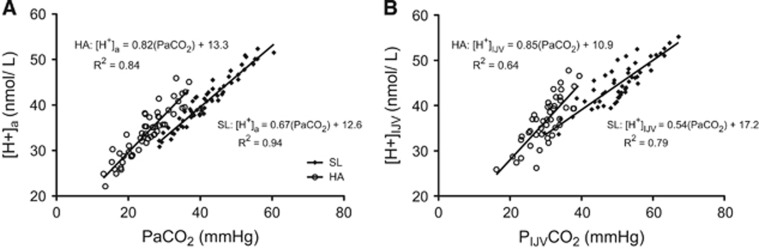
Proton concentration in arterial (A) and internal jugular venous blood (B) at sea level (SL) and high altitude (HA) during acute euoxic changes in PETCO2. Slopes of the regression were significantly less at SL than at HA for both arterial and internal jugular venous blood (P<0.05). P<0.0001 for the linear fit of all regression equations.

References

    1. Willie CK, Tzeng YC, Fisher JA, Ainslie PN. Integrative regulation of human brain blood flow. J Physiol. 2014;592:841–859. - PMC - PubMed
    1. Ainslie PN, Subudhi AW. Cerebral blood flow at high altitude. High Alt Med Biol. 2014;15:133–140. - PubMed
    1. Willie CK, Smith KJ, Day TA, Ray LA, Lewis NC, Bakker A, et al. Regional cerebral blood flow in humans at high altitude: gradual ascent and 2 wk at 5,050m. J Appl Physiol (1985) 2014;116:905–910. - PubMed
    1. Bradley RD, Semple SJ. A comparison of certain acidbase characteristics of arterial blood, jugular venous blood and cerebrospinal fluid in man, and the effect on them of some acute and chronic acid-base disturbances. J Physiol. 1962;160:381–391. - PMC - PubMed
    1. Severinghaus JW, Chiodi H, Eger EI, Brandstater B, Hornbein TF. Cerebral blood flow in man at high altitude. Role of cerebrospinal fluid pH in normalization of flow in chronic hypocapnia. Circ Res. 1966;19:274–282. - PubMed

Publication types