


doi: 10.1128/AAC.04903-14.
Epub 2015 Feb 17.
Emergence of KPC-2-producing Pseudomonas aeruginosa sequence type 463 isolates in Hangzhou, China
Affiliations
- PMID: 25691651
- PMCID: PMC4394785
- DOI: 10.1128/AAC.04903-14
Item in Clipboard
Emergence of KPC-2-producing Pseudomonas aeruginosa sequence type 463 isolates in Hangzhou, China
Antimicrob Agents Chemother.
2015 May.
Abstract
Thirty-nine Klebsiella pneumoniae carbapenemase (KPC)-producing Pseudomonas aeruginosa isolates, all exhibiting high-level resistance to carbapenems and other β-lactam antibiotics, were isolated in Hangzhou, China. Molecular epidemiology analysis indicated the presence of two dominant clones, namely, clones A and B, both of which belong to sequence type 463 (ST463). A genetic environment analysis demonstrated that both clones harbor an ISKpn8 transposase, bla(KPC-2), and an ISKpn6-like transposase. These findings depict the features of clonal expansion and transmission of KPC-2-producing P. aeruginosa strains in Hangzhou, China.
Copyright © 2015, American Society for Microbiology. All Rights Reserved.
Figures
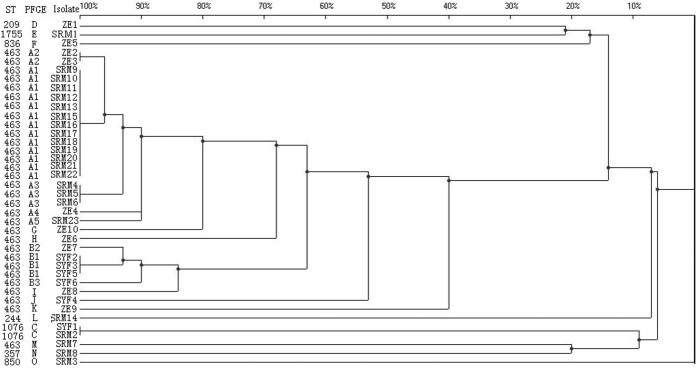
PFGE profile of SpeI-digested DNA from 39 KPC-producing P. aeruginosa isolates. An unweighted-pair group method using average linkages (UPGMA) dendrogram based on Dice similarity coefficients was generated using the UVIBand software (Bio-Rad). Eighty-five percent similarity was used as the cutoff point.
References
-
- Wang F, Zhu DM, Hu FP, Jiang XF, Hu ZD, Li Q, Sun ZY, Chen ZJ, Xu YC, Zhang XJ, Wang CQ, Wang AM, Ni YX, Sun JY, Zhu YZ, Yu YS, Lin J, Xu YH, Shen JL, Su DH, Zhuo C, Wei LH, Wu L, Zhang ZX, Ji P, Zhang H, Kong J, Hu YJ, Ai XM, Shan B, Du Y. 2013. CHINET 2012 surveillance of bacterial resistance in China. Chin J Infect Chemother 13:321–330.
-
- Davies TA, Queenan AM, Morrow BJ, Shang W, Amsler K, He W, Lynch AS, Pillar C, Flamm RK. 2011. Longitudinal survey of carbapenem resistance and resistance mechanisms in Enterobacteriaceae and non-fermenters from the USA in 2007–09. J Antimicrob Chemother 66:2298–2307. doi: 10.1093/jac/dkr290. - DOI - PubMed
-
- Edelstein MV, Skleenova EN, Shevchenko OV, D'Souza JW, Tapalski DV, Azizov IS, Sukhorukova MV, Pavlukov RA, Kozlov RS, Toleman MA, Walsh TR. 2013. Spread of extensively resistant VIM-2-positive ST235 Pseudomonas aeruginosa in Belarus, Kazakhstan, and Russia: a longitudinal epidemiological and clinical study. Lancet Infect Dis 13:867–876. doi: 10.1016/S1473-3099(13)70168-3. - DOI - PubMed
-
- CLSI. 2014. Performance standards for antimicrobial susceptibility testing; 24th informational supplement. CLSI document M100-S24. Clinical and Laboratory Standards Institute, Wayne, PA.
MeSH terms
Substances
LinkOut - more resources
Full Text Sources
Medical
