. 2015 Jun;236(2):201-9.
doi: 10.1002/path.4516. Epub 2015 Mar 23.

Multifocal endometriotic lesions associated with cancer are clonal and carry a high mutation burden

Affiliations

Multifocal endometriotic lesions associated with cancer are clonal and carry a high mutation burden

Michael S Anglesio et al. J Pathol. 2015 Jun.

Abstract

Endometriosis is a significant risk factor for clear cell and endometrioid ovarian cancers and is often found contiguous with these cancers. Using whole-genome shotgun sequencing of seven clear cell ovarian carcinomas (CCC) and targeted sequencing in synchronous endometriosis, we have investigated how this carcinoma may evolve from endometriosis. In every case we observed multiple tumour-associated somatic mutations in at least one concurrent endometriotic lesion. ARID1A and PIK3CA mutations appeared consistently in concurrent endometriosis when present in the primary CCC. In several cases, one or more endometriotic lesions carried the near-complete complement of somatic mutations present in the index CCC tumour. Ancestral mutations were detected in both tumour-adjacent and -distant endometriotic lesions, regardless of any cytological atypia. These findings provide objective evidence that multifocal benign endometriotic lesions are clonally related and that CCCs arising in these patients progress from endometriotic lesions that may already carry sufficient cancer-associated mutations to be considered neoplasms themselves, albeit with low malignant potential. We speculate that genomically distinct classes of endometriosis exist and that ovarian endometriosis with high mutational burden represents one class at high risk for malignant transformation.

Keywords: cancer precursor; clear cell carcinoma; endometriosis; ovarian cancer; sequencing.


Figures

Figure 1
Figure 1
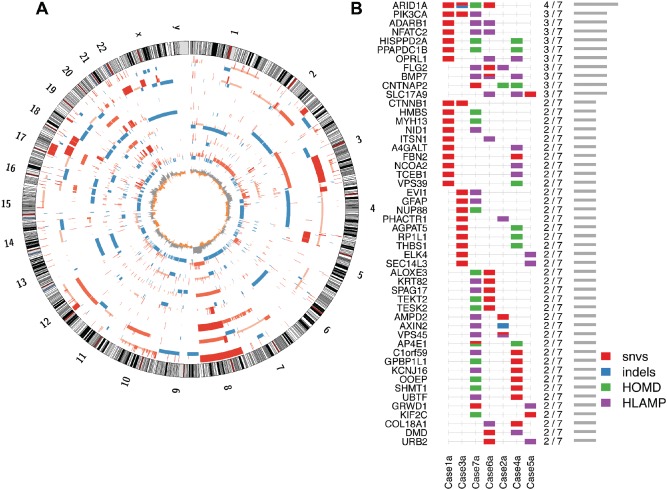
Overview of somatic genomic architecture and mutational pattern across sampled CCC tumours. (A) Circos plot, showing somatic DNA copy number gains (red) and losses (blue) in each CCC primary tumour, in order from the outermost ring (cases 1–7): bar heights indicate relative gains or losses, eg higher red bars indicate high‐level amplification, short blue bars indicate heterozygous deletions and the innermost ring shows the frequency of the gains (grey) and losses (orange) among the seven cases. (B) Genes most frequently affected by a somatic INDEL, SNV or extreme copy number event [homozygous deletion (HOMD) or high‐level amplification (HLAMP)]: at least one known somatic truncating variant in ARID1A is not illustrated here, as it was not found in whole‐genome data, neither was it able to be validated in our deep‐sequencing assay (case 4; see supplementary material, Figure S1), due to low coverage, likely related to high GC content
Figure 2
Figure 2
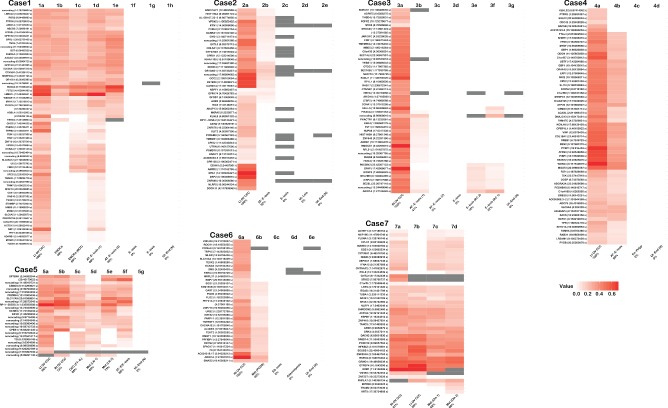
Heat map summary of verified somatic SNVs (s) and INDELs (i) in primary CCC tumours and other related or benign specimens from each case. Whenever possible, multiple samples of tumour, metastatic disease, putative precursor (including endometriosis) and/or benign lesion were examined from each case (see also supplementary material, Table S1, Figure S4). In all cases the left‐most specimen is the primary tumour used in WGSS and samples are ordered using their presumed relationship to the primary tumour, from other ovarian sites, metastatic sites, endometriosis (with and without atypia) to benign lesions and normal uterine endometrium. Patient‐matched germline DNA was used as the reference in both WGSS and deep sequencing confirmation experiments; intensity of red increases with allelic frequency; grey bars denote positions with insufficient coverage. Sub‐specimens are labelled under each panel; the percentage listed in the label refers to the conservation of somatic mutations compared to the index tumour specimen (see also supplementary material, Figure S3). Gene symbol, genomic position and mutation type is noted at the left of each panel; additional detail can be found in Tables S1 and S2 (see supplementary material): Lt OV, left ovary; Rt OV, right ovary; E‐osis, endometriosis; AT‐E‐osis, atypical endometriosis; ES‐osis, endosalpingiosis; Met, metastasis; EN‐Polyp, endometrial polyp; Ut‐End(N), uterine endometrium (normal); FT‐IL, Fallopian tube intraluminal fragment; LN, lymph node; BOT, borderline ovarian tumour; Ut‐Leio, uterine leiomyoma; RC, rectosigmoid colon; Om, omentum; PCDS, posterior cul‐de‐sac
Figure 3
Figure 3
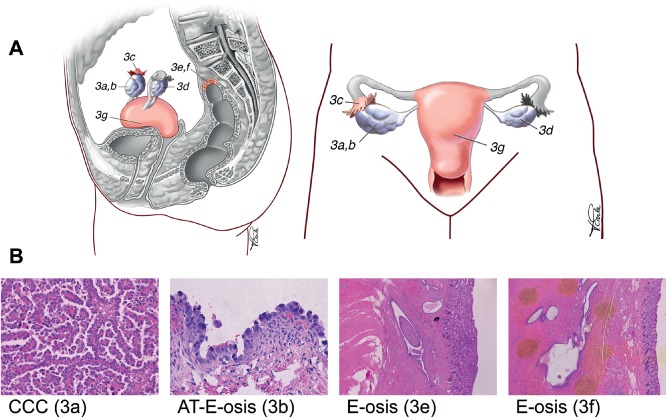
Specimens collected from case 3. (A) Anatomical diagram of the genital tract, indicating the positions of the specimens collected. The main tumour mass was on the right ovary (3a), with adjacent atypical endometriosis present around the ovary (3b) and tube (3c). Additional foci of endometriosis without atypia were also sampled from around the left ovary (3d) and the rectosigmoid colon (3e, 3f). Normal endometrium was also sampled (3 g). (B) H&E‐stained sections corresponding to the index tumour, atypical endometriosis (3b) and distant endometriosis without atypia (3e). The specimens shown appear to be clonally related, based on discovery of identical somatic mutations (see also Figure 2)

References

    1. Rogers PA, D'Hooghe TM, Fazleabas A, et al. Defining future directions for endometriosis research: workshop report from the 2011 World Congress of Endometriosis in Montpellier, France. Reprod Sci 2013; 20: 483–499. - PMC - PubMed
    1. Eskenazi B, Warner ML. Epidemiology of endometriosis. Obstet Gynecol Clin N Am 1997; 24: 235–258. - PubMed
    1. Burney RO, Giudice LC. Pathogenesis and pathophysiology of endometriosis. Fertil Steril 2012; 98: 511–519. - PMC - PubMed
    1. Anglesio MS, Carey MS, Kobel M, et al. Clear cell carcinoma of the ovary: a report from the first Ovarian Clear Cell Symposium, June 24th, 2010. Gynecol Oncol 2011; 121: 407–415. - PubMed
    1. Merritt MA, Green AC, Nagle CM, et al. Talcum powder, chronic pelvic inflammation and NSAIDs in relation to risk of epithelial ovarian cancer. Int J Cancer 2008; 122: 170–176. - PubMed

Publication types

MeSH terms