. 2015 Feb 17;108(4):810-820.
doi: 10.1016/j.bpj.2014.11.3487.

Simulating the entropic collapse of coarse-grained chromosomes

Affiliations

Simulating the entropic collapse of coarse-grained chromosomes

Tyler N Shendruk et al. Biophys J. .

Abstract

Depletion forces play a role in the compaction and decompaction of chromosomal material in simple cells, but it has remained debatable whether they are sufficient to account for chromosomal collapse. We present coarse-grained molecular dynamics simulations, which reveal that depletion-induced attraction is sufficient to cause the collapse of a flexible chain of large structural monomers immersed in a bath of smaller depletants. These simulations use an explicit coarse-grained computational model that treats both the supercoiled DNA structural monomers and the smaller protein crowding agents as combinatorial, truncated Lennard-Jones spheres. By presenting a simple theoretical model, we quantitatively cast the action of depletants on supercoiled bacterial DNA as an effective solvent quality. The rapid collapse of the simulated flexible chromosome at the predicted volume fraction of depletants is a continuous phase transition. Additional physical effects to such simple chromosome models, such as enthalpic interactions between structural monomers or chain rigidity, are required if the collapse is to be a first-order phase transition.


Figures

Figure 1
Figure 1
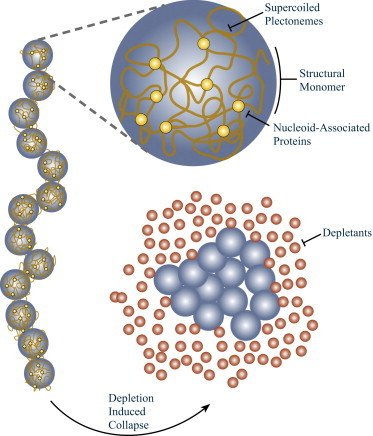
The coarse-grained model of bacterial chromosomal DNA after Jun and Wright (5). Structural monomers of supercoiled plectonemes of DNA are locally stabilized to form a cross-linked gel by various nucleoid-associated proteins. The chromosome is considered to be a linear chain of structural monomers. Surrounding proteins act as molecular crowding agents that can lead to collapse to a condensed state. To see this figure in color, go online
Figure 2
Figure 2
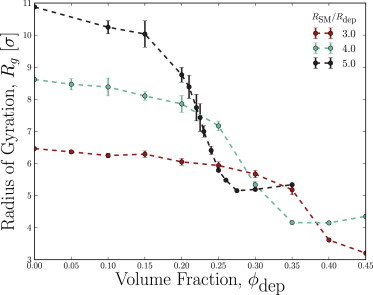
The radii of gyration of NSM = 15 chains of combinatorial-WCA structural monomers as a function of depletant volume fraction, ϕdep. The observed transition to a collapsed state varies as a function of the size ratio RSM/Rdep. To see this figure in color, go online.
Figure 3
Figure 3
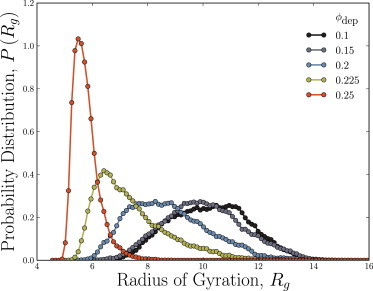
Distributions of radii of gyration Rg for the size ratio of RSM/Rdep = 5 and various volume fractions of depletants. The volume fractions shown are in the transition region near the critical volume fraction of depletants ϕdep, but the probability distributions remain unimodal. There appears to be no coexistence of both swollen and collapsed coils. To see this figure in color, go online.
Figure 4
Figure 4
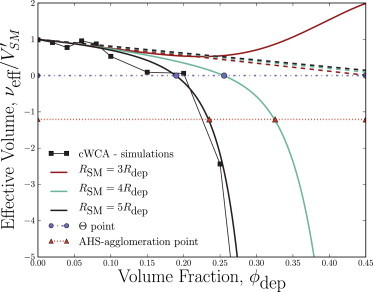
The effective volume of structural monomers interacting via depletant-induced pair potentials as a function of depletant volume fraction ϕdep. Simulation results for the size ratio of RSM/Rdep = 5 (black squares) compare well with both the linear AO (dashed lines) and the MT (solid lines) models at low volume fractions, approaching the physical volume VSM as ϕdep → 0. At higher volume fractions the simulations and MT model drop rapidly to negative values, passing through the θ-point νeffΘ (blue dotted line and circles) and the AHS-agglomeration point νeffAHS (red dash-dot line and triangles). To see this figure in color, go online.
Figure 5
Figure 5
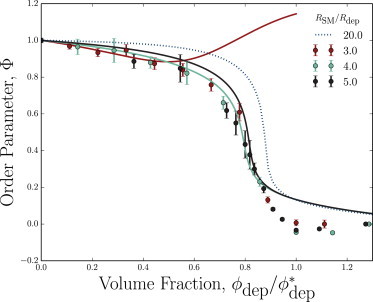
The order parameter Φ ≡ (RgRglob)/(RathermalRglob) reduces the radius of gyration axis of Fig. 2. When plotted against the rescaled volume fraction ϕdep/ϕdepcWCA, the simulation curves for RSM/Rdep = {3, 4, 5} collapse to a single curve. The theory results from substituting the effective volume from Eq. 10 into the Flory theory (Eq. 4) and estimating the AHS-agglomeration point ϕdepAHS as the critical volume fraction. (Dashed curve) In addition to the size ratios simulated, the Flory prediction for a larger size ratio of RSM/Rdep = 20 is also indicated. To see this figure in color, go online.

Comment in

  • Chromosome, cell cycle, and entropy.
    Jun S. Jun S. Biophys J. 2015 Feb 17;108(4):785-786. doi: 10.1016/j.bpj.2014.12.032. Biophys J. 2015. PMID: 25692581 Free PMC article. No abstract available.

References

    1. Luijsterburg M.S., White M.F., Dame R.T. The major architects of chromatin: architectural proteins in bacteria, archaea and eukaryotes. Crit. Rev. Biochem. Mol. Biol. 2008;43:393–418. - PubMed
    1. Jun S., Mulder B. Entropy-driven spatial organization of highly confined polymers: lessons for the bacterial chromosome. Proc. Natl. Acad. Sci. USA. 2006;103:12388–12393. - PMC - PubMed
    1. Arnold A., Jun S. Time scale of entropic segregation of flexible polymers in confinement: implications for chromosome segregation in filamentous bacteria. Phys. Rev. E Stat. Nonlin. Soft Matter Phys. 2007;76:031901. - PubMed
    1. Fan J., Tuncay K., Ortoleva P.J. Chromosome segregation in Escherichia coli division: a free energy-driven string model. Comput. Biol. Chem. 2007;31:257–264. - PubMed
    1. Jun S., Wright A. Entropy as the driver of chromosome segregation. Nat. Rev. Microbiol. 2010;8:600–607. - PMC - PubMed

Publication types

MeSH terms

LinkOut - more resources