


Multi locus variable-number tandem repeat (MLVA) typing tools improved the surveillance of Salmonella enteritidis: a 6 years retrospective study
- PMID: 25693200
- PMCID: PMC4334661
- DOI: 10.1371/journal.pone.0117950
Multi locus variable-number tandem repeat (MLVA) typing tools improved the surveillance of Salmonella enteritidis: a 6 years retrospective study
Erratum in
-
Correction: Multi Locus Variable-Number Tandem Repeat (MLVA) Typing Tools Improved the Surveillance of Salmonella Enteritidis: A 6 Years Retrospective Study.PLoS One. 2018 May 30;13(5):e0198527. doi: 10.1371/journal.pone.0198527. eCollection 2018. PLoS One. 2018. PMID: 29847577 Free PMC article.
Abstract
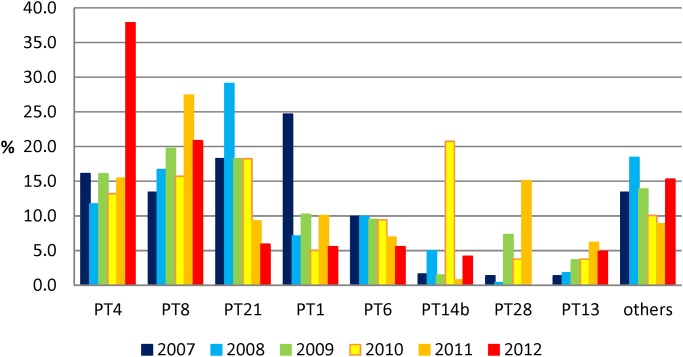
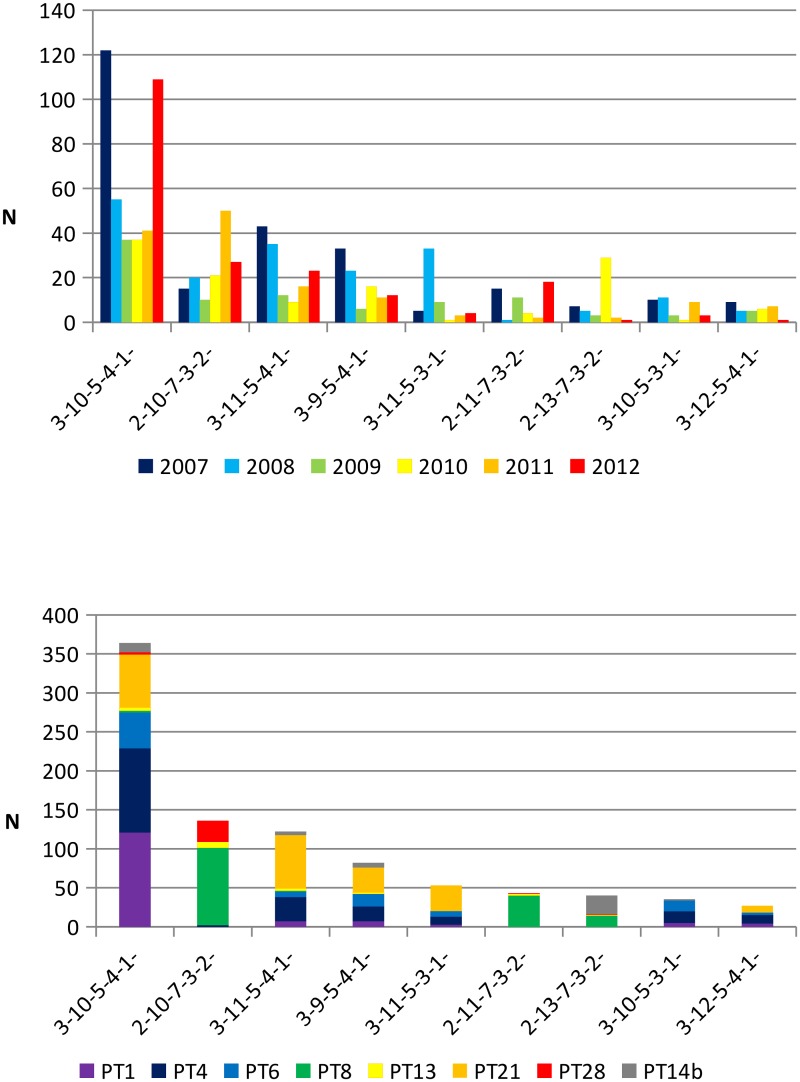
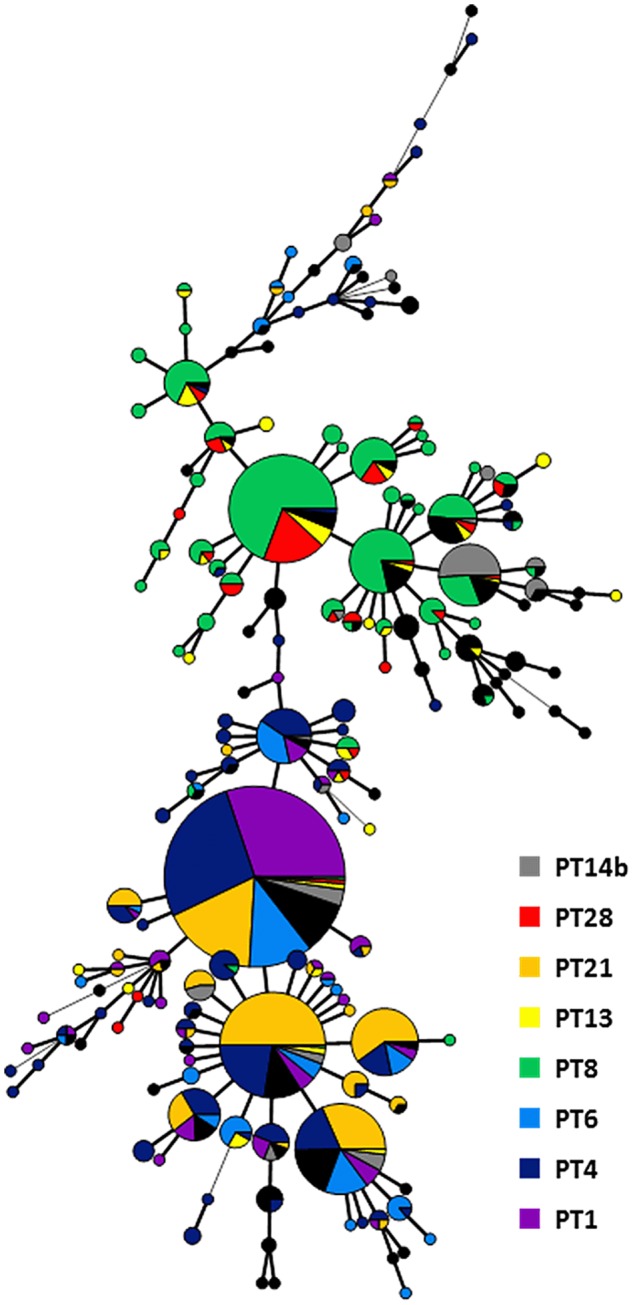
Surveillance of Salmonella enterica subsp. enterica serovar Enteritidis is generally considered to benefit from molecular techniques like multiple-locus variable-number of tandem repeats analysis (MLVA), which allow early detection and confinement of outbreaks. Here, a surveillance study, including phage typing, antimicrobial susceptibility testing and MLVA on 1,535 S. Enteritidis isolates collected between 2007 and 2012, was used to evaluate the added value of MLVA for public health surveillance in Belgium. Phage types PT4, PT8, PT21, PT1, PT6, PT14b, PT28 and PT13 dominate the Belgian S. Enteritidis population. The isolates of S. Enteritidis were most frequently susceptible to all antibiotics tested. 172 different MLVA profiles were detected, of which 9 frequent profiles included 67.2% of the S. Enteritidis population. During a serial passage experiment on selected isolates to investigate the in vitro stability of the 5 MLVA loci, no variations over time were observed indicating that the MLVA profiles were stable. The MLVA profile of isolates originating from different outbreaks in the Democratic Republic of the Congo (DRC) between 2010 and 2011 were distinct from any of the MLVA profiles found in Belgian isolates throughout the six year observational period and demonstrates that MLVA improves public health surveillance of S. Enteritidis. However, MLVA should be complemented with other subtyping methods when investigating outbreaks is caused by the most common MLVA profile.
Conflict of interest statement
Figures
References
-
- European Food Safety Authority (EFSA), European Centre for Disease Prevention and Control (ECDC) (2013) The European Union summary report on trends and sources of zoonoses agents and food-borne outbreaks in 2011. EFSA Journal 11: 3129.
-
- Grimont PAD, Weill, F-X (2007) Antigenic formulae of the Salmonella serovars. WHO Collaborating Center for Reference and Research on Salmonella 9th edition.
-
- Bertrand S, Mattheus W, Vanhoof R (2013) Salmonella en Shigella stammen afgezonderd in België in 2011. Report No D/2012/2505/30. [Dutch]
-
- Dewaele I, Heyndrickx M, Rasschaert G, Bertrand S, Wildemauwe C, Wattiau P, et al. (2013) Phage and MLVA Typing of Salmonella Enteritidis Isolated from Layers and Humans in Belgium from 2000–2010, A Period in which Vaccination of Laying Hens was Introduced. Zoonoses Public Health. 10.1111/zph.12096 - DOI - PubMed
Publication types
MeSH terms
Substances
LinkOut - more resources
Full Text Sources
Other Literature Sources
