. 2015 Apr;66(8):2359-69.
doi: 10.1093/jxb/eru536. Epub 2015 Feb 17.

The cadmium-tolerant pea (Pisum sativum L.) mutant SGECdt is more sensitive to mercury: assessing plant water relations

Affiliations

The cadmium-tolerant pea (Pisum sativum L.) mutant SGECdt is more sensitive to mercury: assessing plant water relations

Andrey A Belimov et al. J Exp Bot. 2015 Apr.

Abstract

Heavy metals have multiple effects on plant growth and physiology, including perturbation of plant water status. These effects were assessed by exposing the unique Cd-tolerant and Cd-accumulating pea (Pisum sativum L.) mutant SGECd(t) and its wild-type (WT) line SGE to either cadmium (1, 4 μM CdCl2) or mercury (0.5, 1, 2 μM HgCl2) in hydroponic culture for 12 days. When exposed to Cd, SGECd(t) accumulated more Cd in roots, xylem sap, and shoot, and had considerably more biomass than WT plants. WT plants lost circa 0.2 MPa turgor when grown in 4 μM CdCl2, despite massive decreases in whole-plant transpiration rate and stomatal conductance. In contrast, root Hg accumulation was similar in both genotypes, but WT plants accumulated more Hg in leaves and had a higher stomatal conductance, and root and shoot biomass compared with SGECd(t). Shoot excision resulted in greater root-pressure induced xylem exudation of SGECd(t) in the absence of Cd or Hg and following Cd exposure, whereas the opposite response or no genotypic differences occurred following Hg exposure. Exposing plants that had not been treated with metal to 50 μM CdCl2 for 1h increased root xylem exudation of WT, whereas 50 μM HgCl2 inhibited and eliminated genotypic differences in root xylem exudation, suggesting differences between WT and SGECd(t) plants in aquaporin function. Thus, root water transport might be involved in mechanisms of increased tolerance and accumulation of Cd in the SGECd(t) mutant. However, the lack of cross-tolerance to Cd and Hg stress in the mutant indicates metal-specific mechanisms related to plant adaptation.

Keywords: Aquaporin; cadmium; drought; mercury; pea; root sap flow; water deficit..


Figures

Fig. 1.
Fig. 1.
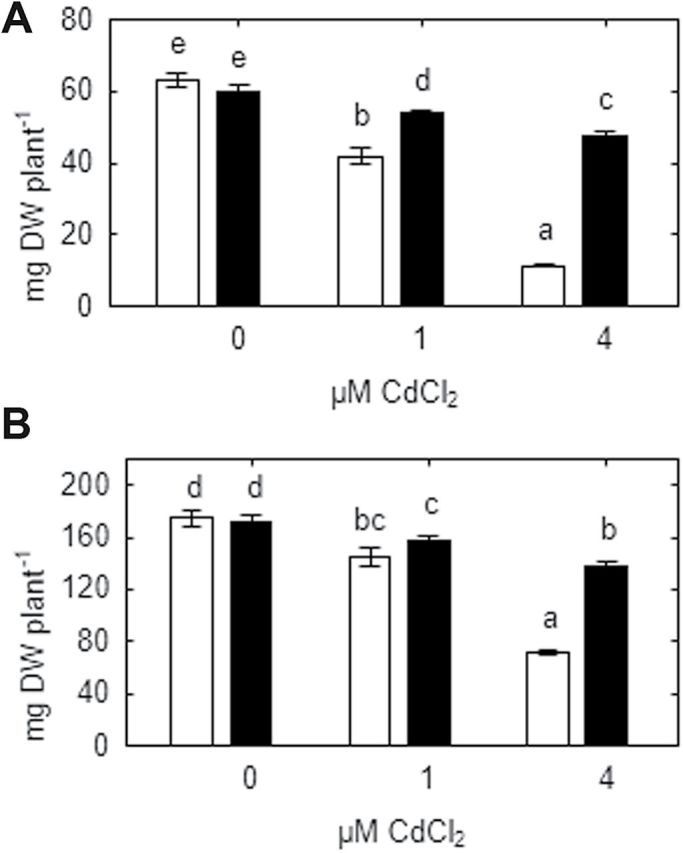
Root (A) and shoot (B) biomass of SGE (open bars) and SGECdt (filled bars) pea genotypes grown at different cadmium concentrations. Different letters show significant differences between treatments (LSD test; P<0.05). Means of three experiments with at least five determinations each.
Fig. 2.
Fig. 2.
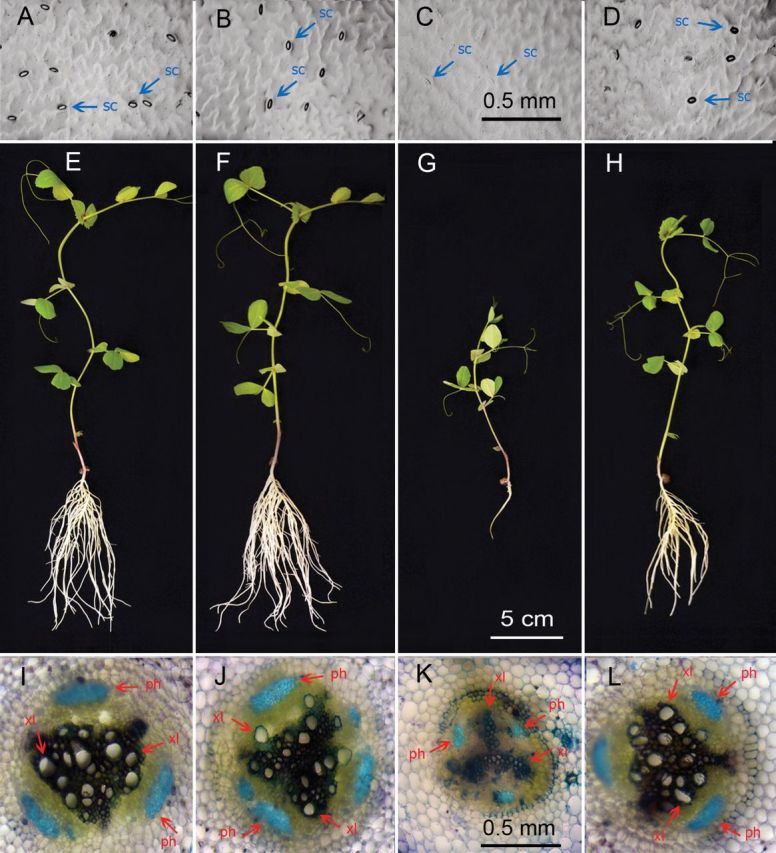
Images of lower leaf surface (A–D) with stomatal complexes (sc) indicated, representative pea plants (E–H), and root cross sections (I–L) with xylem (xl) and phloem (ph) tissues indicated, from wild-type SGE plants untreated with cadmium (A, E, I), mutant SGECdt untreated with cadmium (B, F, J), wild type SGE plants treated with 4 μM CdCl2 (C, G, K), and mutant SGECdt treated with 4 μM CdCl2 (D, H, L).
Fig. 3.
Fig. 3.
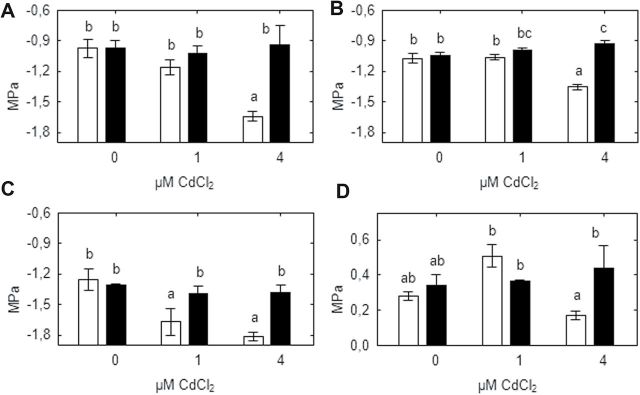
Effect of cadmium on leaf water potential (A), shoot water potential (B), leaf osmotic potential (C), and turgor (D) of SGE (open bars) and SGECdt (filled bars) pea genotypes. Different letters show significant differences between treatments (LSD test; P<0.05). Means of three experiments with at least five determinations.
Fig. 4.
Fig. 4.
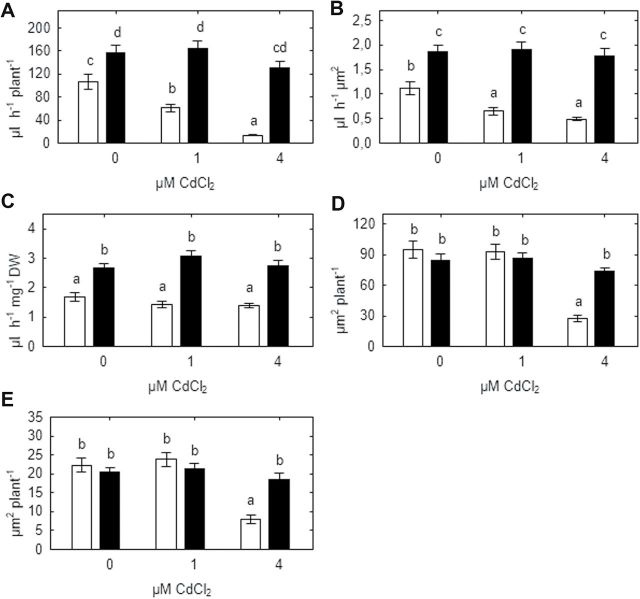
Effect of cadmium on absolute root sap flow rate (A), and specific root sap flow rates expressed on a root xylem area (B) or root weight (C) basis, along with xylem (D) and phloem (E) area of SGE (open bars) and SGECdt (filled bars) pea genotypes. Different letters show significant differences between treatments (LSD test; P<0.05). Means of two experiments with at least three determinations.
Fig. 5.
Fig. 5.
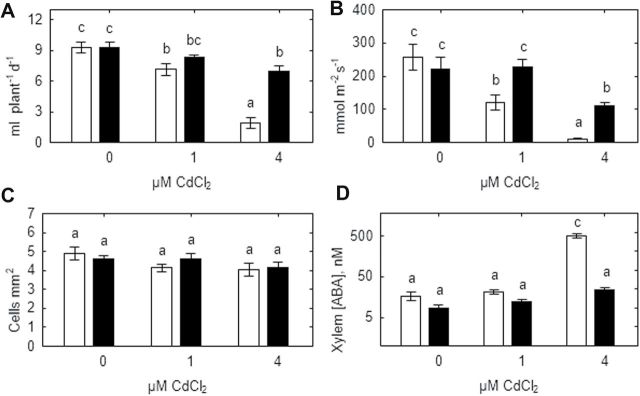
Effect of cadmium on whole-plant transpiration (A), stomatal conductance (B), stomatal density (C), and xylem ABA concentration (D) of SGE (open bars) and SGECdt (filled bars) pea genotypes. Note the logarithmic scale on (D). Different letters show significant differences between treatments (LSD test; P<0.05). Means of two experiments with at least five determinations.
Fig. 6.
Fig. 6.
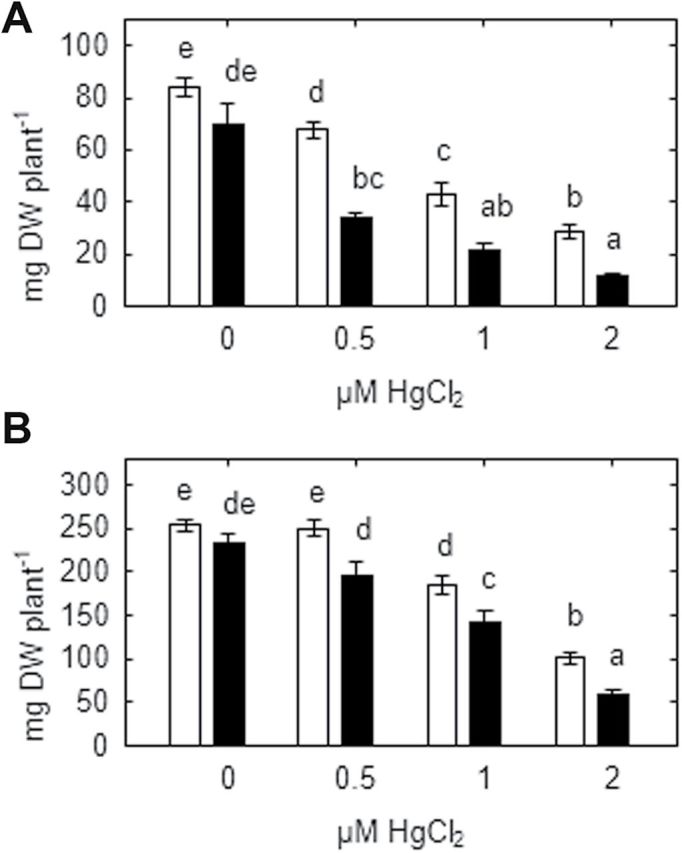
Root (A) and shoot (B) biomass of SGE (open bars) and SGECdt (filled bars) pea genotypes grown at different mercury concentrations. Different letters show significant differences between treatments (LSD test; P<0.05). Means of two experiments with at least five determinations.
Fig. 7.
Fig. 7.
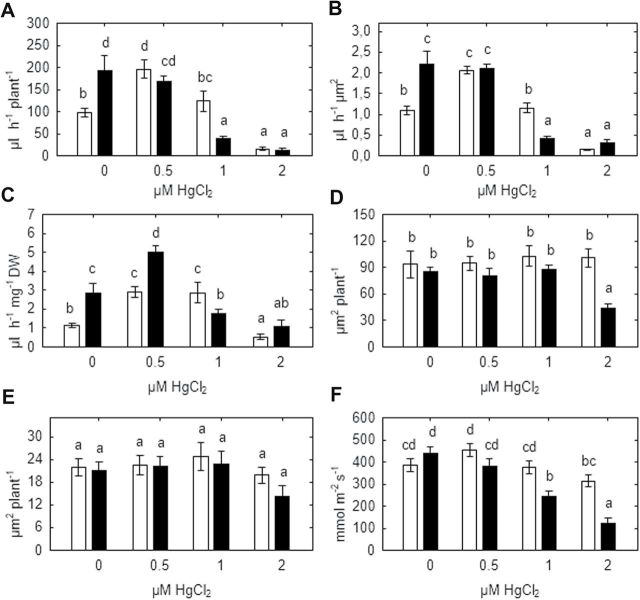
Effect of mercury on absolute root sap flow rate (A), and specific root sap flow rates expressed on a root xylem area (B) or root weight (C) basis, along with xylem (D) and phloem (E) area and stomatal conductance (F) of SGE (open bars) and SGECdt (filled bars) pea genotypes. Different letters show significant differences between treatments (LSD test; P<0.05). Means of two experiments with at least five determinations.
Fig. 8.
Fig. 8.
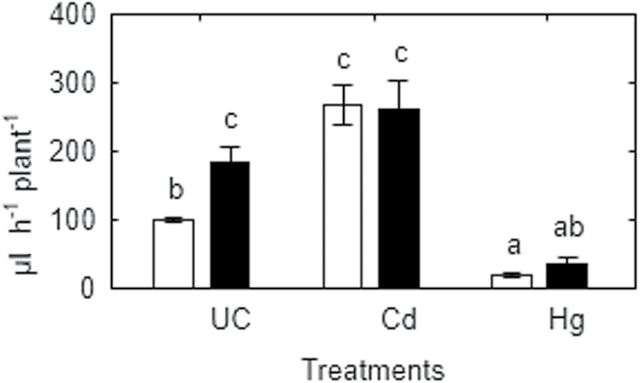
Absolute root sap flow rate of SGE (open bars) and SGECdt (filled bars) pea genotypes after 1h exposure to 50 μM CdCl2 (Cd), 50 μM HgCl2 (Hg) or untreated controls (UC). Different letters show significant differences between treatments (LSD test; P<0.05). Means of two experiments with at least four determinations.
Fig. 9.
Fig. 9.
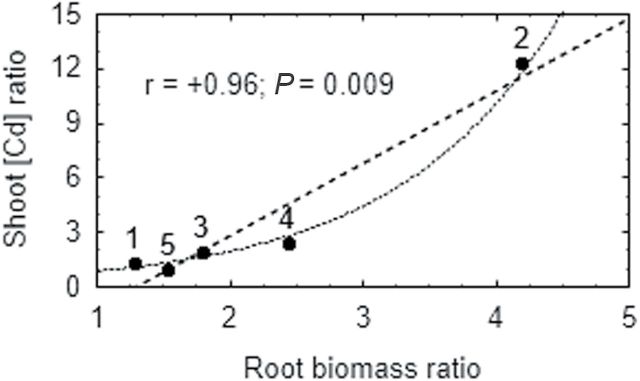
Pooled data on relationship between the effect of cadmium on genotypic differences (SGECdt/SGE ratio) in root biomass and shoot cadmium concentration. Black points show experimental data with cadmium concentrations in nutrient solution and reference: 1, 1 μM CdCl2 (this study); 2, 4 μM CdCl2 (this study); 3, 2.5 μM CdCl2 (Tsyganov et al., 2004); 4, 3 μM CdCl2 (Tsyganov et al., 2007); 5, 4 μM CdCl2 (Malkov et al., 2007). Dash and dotted lines show linear and exponential fitting, respectively.

References

    1. Aroca R, Amodeo A, Fernandez-Illescas S, Herman EM, Chaumont F, Chrispeels MJ. 2005. The role of aquaporins and membrane damage in chilling and hydrogen peroxide induced changes in the hydraulic conductance of maize roots. Plant Physiology 137, 341–353. - PMC - PubMed
    1. Aroca R, Ferrante A, Vernieri P, Chrispeels MJ. 2006. Drought, abscisic acid and transpiration rate effects on the regulation of PIP aquaporin gene expression and abundance in Phaseolus vulgaris plants. Annals of Botany 98, 1301–1310. - PMC - PubMed
    1. Aroca R., Porcel R., Ruiz-Lozano J.M. 2012. Regulation of root water uptake under abiotic stress conditions. Journal of Experimental Botany 63, 43–57. - PubMed
    1. Aroca R, Tognoni F, Irigoyen JJ, Sanchez-Diaz M, Pardossi A. 2001. Different root low temperature response of two maize genotypes differing in chilling sensitivity. Plant Physiology and Biochemistry 39, 1067–1073.
    1. Barceló J, Vázquez MD, Poshenrieder C. 1988. Cd induced structural and ultrastructural changes in the vascular system of bush bean stems. Botanica Acta 101, 254–261.

Publication types

MeSH terms