Review
. 2015 Jan;4(1):3-14.
doi: 10.3978/j.issn.2225-319X.2014.08.01.

Ministernotomy or minithoracotomy for minimally invasive aortic valve replacement: a Bayesian network meta-analysis

Affiliations
Review

Ministernotomy or minithoracotomy for minimally invasive aortic valve replacement: a Bayesian network meta-analysis

Kevin Phan et al. Ann Cardiothorac Surg. 2015 Jan.

Abstract

Background: Establishing the relative merits of ministernotomy (MS) and minithoracotomy (MT) approaches to minimally invasive aortic valve replacement (MIAVR) is difficult given the limited available direct evidence. Network meta-analysis is a Bayesian approach that can combine direct and indirect evidence to better define the benefits and risks of MS and MT.

Methods: Electronic searches were performed using six databases from their inception to June 2014. Relevant studies utilizing a minimally invasive approach for aortic valve replacement were identified. Data were extracted and analyzed according to predefined clinical endpoints. Both traditional and Bayesian meta-analysis approaches were conducted.

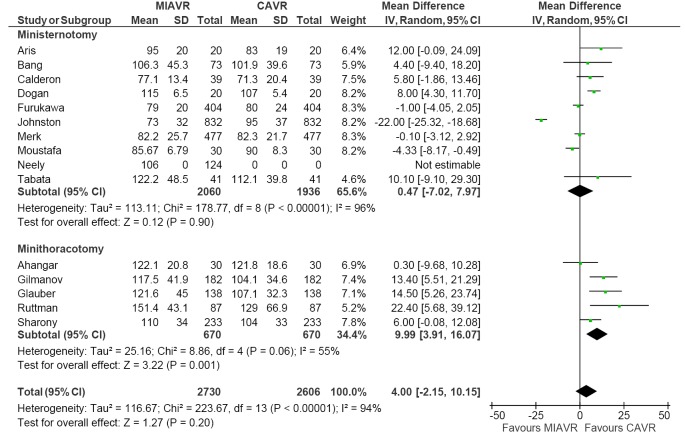
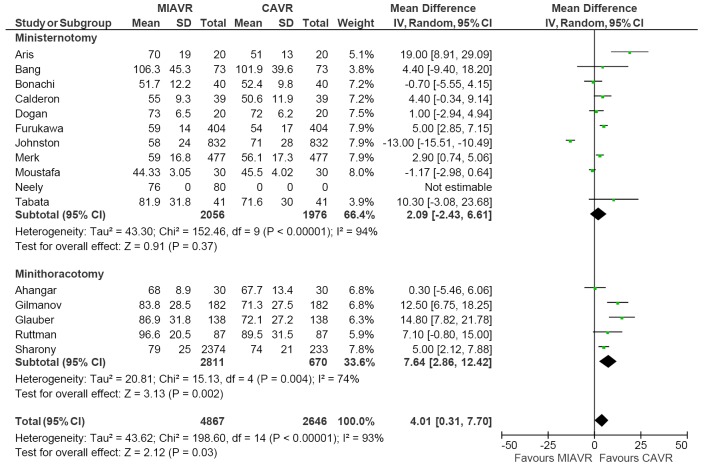
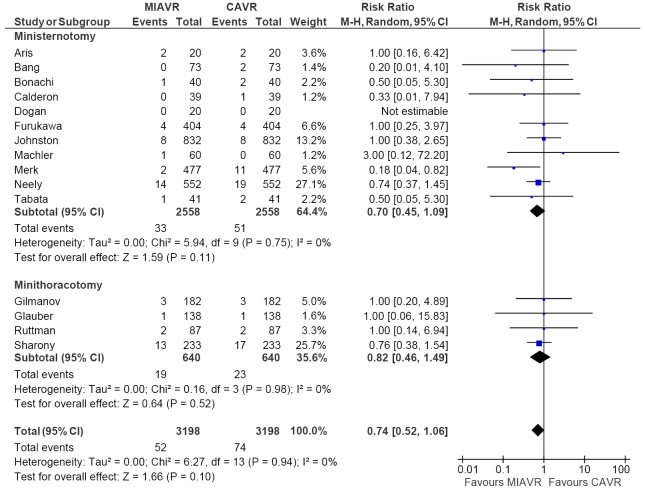
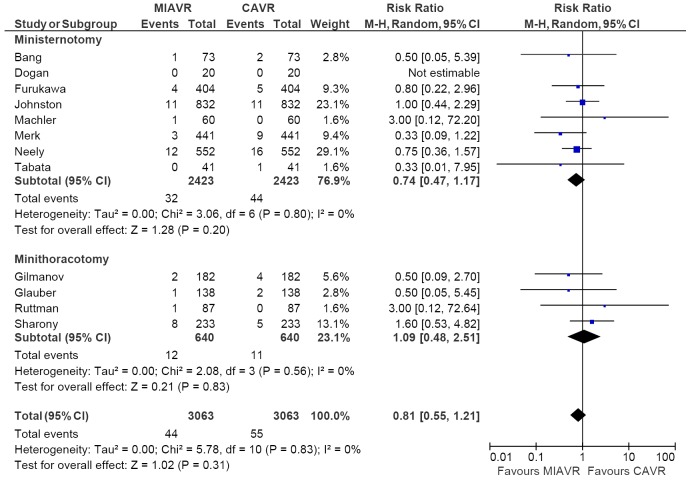
Results: Compared to full sternotomy, MT was associated with longer cardiopulmonary bypass (CPB) duration (WMD, 9.99; 95% CI, 3.91, 16.07; I(2)=55%; P=0.001) and cross-clamp duration (WMD, 7.64; 95% CI, 2.86, 12.42; P=0.002; I(2)=74%). When compared to MS using network meta-analysis, no significant difference in duration was detected. Postoperative outcomes including 30-day mortality, stroke, and reoperation for bleeding and wound infection were comparable between MS and MT using both traditional and Bayesian meta-analysis techniques.

Conclusions: The current evidence demonstrates that MIAVR via MS or MT is a safe and efficacious alternative to conventional median sternotomy. MT may be associated with longer CPB and cross-clamp durations, but has similar post-operative outcomes compared to MS. An individualized approach tailored to both the patient and surgical team is likely to provide optimal outcomes.

Keywords: Aortic valve replacement; Bayesian; ministernotomy; minithoracotomy; network meta-analysis.


Figures
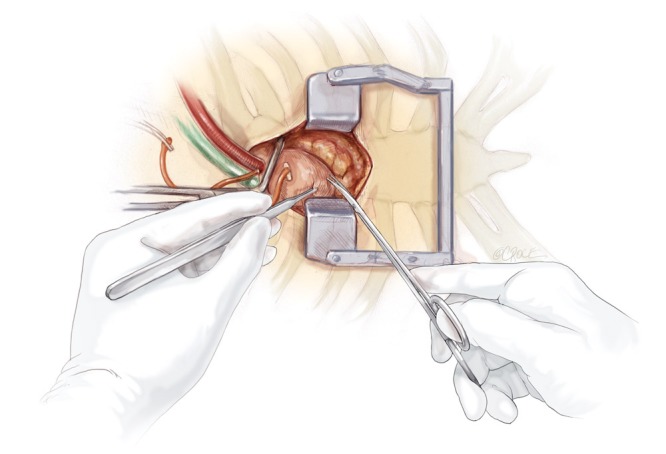
Figure 1
Figure 1
Minimally invasive aortic valve replacement offers an alternative surgical approach to median sternotomy with potential advantages of reduced trauma, intensive care stay, hospitalization, and improved cosmesis.
Figure 2
Figure 2
Forest plot of the weighted mean difference (WMD) in cardiopulmonary bypass (CPB) duration between minimally invasive (MIAVR) and conventional aortic valve replacement (CAVR). The estimate of the WMD of each trial corresponds to the middle of the squares, and the horizontal line shows the 95% confidence interval (CI). On each line, the mean and standard deviation (SD) of CPB durations in individual studies is shown for both treatment and control groups. For each subgroup, the sum of the statistics, along with the summary WMD, is represented by the middle of the solid diamonds. A test of heterogeneity between the trials within a subgroup is given below the summary statistics. IV, inverse variance.
Figure 3
Figure 3
Forest plot of the weighted mean difference (WMD) in cross-clamp duration between minimally invasive (MIAVR) and conventional aortic valve replacement (CAVR). The estimate of the WMD of each trial corresponds to the middle of the squares, and the horizontal line shows the 95% confidence interval (CI). On each line, the mean and standard deviation (SD) of cross-clamp durations in individual studies is shown for both treatment and control groups. For each subgroup, the sum of the statistics, along with the summary WMD, is represented by the middle of the solid diamonds. A test of heterogeneity between the trials within a subgroup is given below the summary statistics. IV, inverse variance.
Figure 4
Figure 4
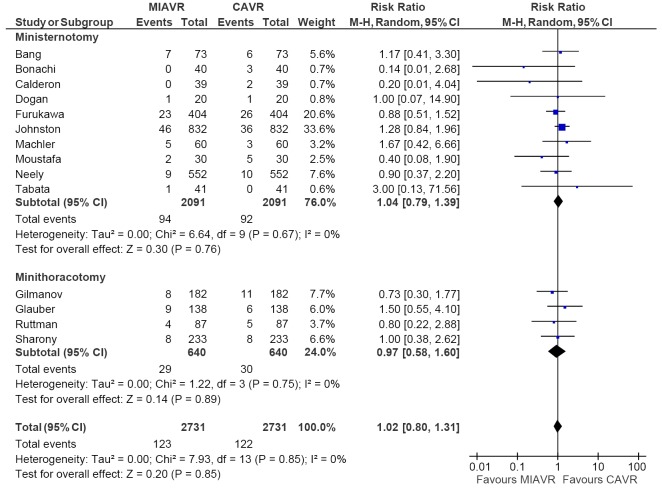
Forest plot of the risk ratio (RR) of 30-day mortality in patients undergoing minimally invasive (MIAVR) versus conventional aortic valve replacement (CAVR). The estimate of the RR of each trial corresponds to the middle of the squares, and the horizontal line shows the 95% confidence interval (CI). On each line, the number of events as a fraction of the total number is shown for both treatment and control groups. For each subgroup, the sum of the statistics, along with the summary RR, is represented by the middle of the solid diamonds. A test of heterogeneity between the trials within a subgroup is given below the summary statistics. M-H, Mantel-Haenszel.
Figure 5
Figure 5
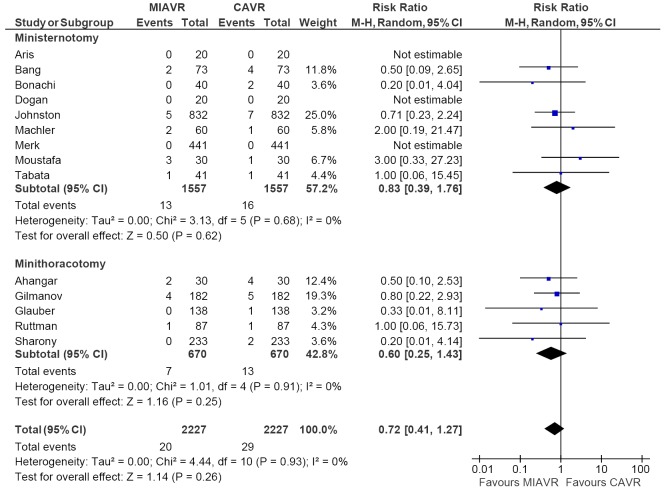
Forest plot of the risk ratio (RR) of postoperative strokes in patients undergoing minimally invasive (MIAVR) versus conventional aortic valve replacement (CAVR). The estimate of the RR of each trial corresponds to the middle of the squares, and the horizontal line shows the 95% confidence interval (CI). On each line, the number of events as a fraction of the total number is shown for both treatment and control groups. For each subgroup, the sum of the statistics, along with the summary RR, is represented by the middle of the solid diamonds. A test of heterogeneity between the trials within a subgroup is given below the summary statistics. M-H, Mantel-Haenszel.
Figure 6
Figure 6
Forest plot of the risk ratio (RR) of reoperations for bleeding in patients undergoing minimally invasive (MIAVR) versus conventional aortic valve replacement (CAVR). The estimate of the RR of each trial corresponds to the middle of the squares, and the horizontal line shows the 95% confidence interval (CI). On each line, the number of events as a fraction of the total number is shown for both treatment and control groups. For each subgroup, the sum of the statistics, along with the summary RR, is represented by the middle of the solid diamonds. A test of heterogeneity between the trials within a subgroup is given below the summary statistics. M-H, Mantel-Haenszel.
Figure 7
Figure 7
Forest plot of the risk ratio (RR) of wound infections in patients undergoing minimally invasive (MIAVR) versus conventional aortic valve replacement (CAVR). The estimate of the RR of each trial corresponds to the middle of the squares, and the horizontal line shows the 95% confidence interval (CI). On each line, the number of events as a fraction of the total number is shown for both treatment and control groups. For each subgroup, the sum of the statistics, along with the summary RR, is represented by the middle of the solid diamonds. A test of heterogeneity between the trials within a subgroup is given below the summary statistics. M-H, Mantel-Haenszel.
Figure 8
Figure 8
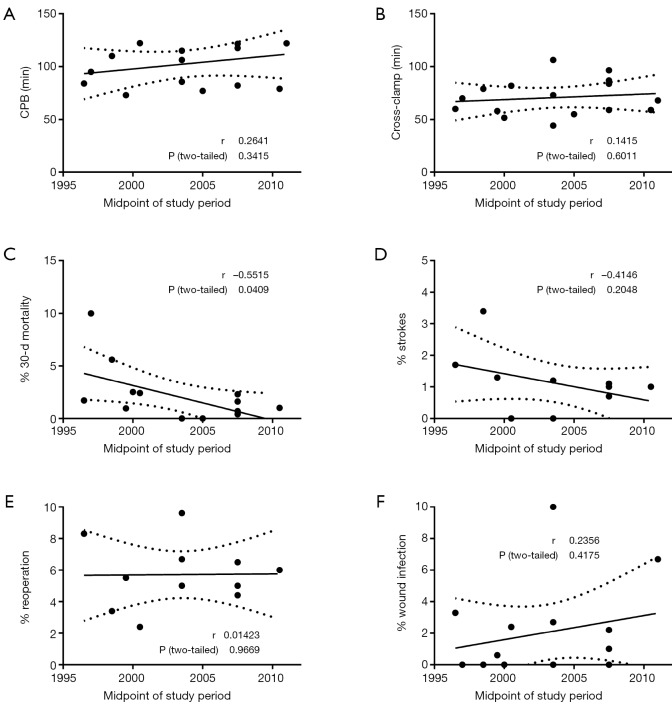
Meta-regression analyses showing significant correlation between the midpoint of the study period and 30-day mortality rate. The solid line indicates the correlation trend line, while dotted lines indicate the 95% confidence interval.

References

    1. Murtuza B, Pepper JR, Stanbridge RD, et al. Minimal access aortic valve replacement: is it worth it? Ann Thorac Surg 2008;85:1121-31. - PubMed
    1. Phan K, Xie A, Di Eusanio M, et al. A Meta-Analysis of Minimally Invasive Versus Conventional Sternotomy for Aortic Valve Replacement. Ann Thorac Surg 2014;98:1499-511. - PubMed
    1. Glauber M, Miceli A, Bevilacqua S, et al. Minimally invasive aortic valve replacement via right anterior minithoracotomy: early outcomes and midterm follow-up. J Thorac Cardiovasc Surg 2011;142:1577-9. - PubMed
    1. Glauber M, Miceli A, Gilmanov D, et al. Right anterior minithoracotomy versus conventional aortic valve replacement: a propensity score matched study. J Thorac Cardiovasc Surg 2013;145:1222-6. - PubMed
    1. Glower DD, Desai BS, Hughes GC, et al. Aortic valve replacement via right minithoracotomy versus median sternotomy: a propensity score analysis. Innovations (Phila) 2014 ;9:75-81; discussion 81. - PubMed