Minimally invasive aortic valve surgery: state of the art and future directions
- PMID: 25694973
- PMCID: PMC4311160
- DOI: 10.3978/j.issn.2225-319X.2015.01.01
Minimally invasive aortic valve surgery: state of the art and future directions
Abstract
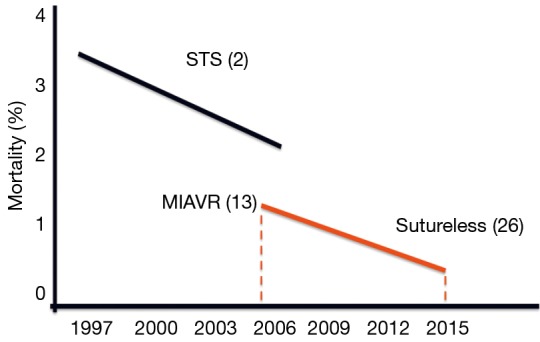
Minimally invasive aortic valve replacement (MIAVR) is defined as an aortic valve replacement (AVR) procedure that involves a small chest wall incision as opposed to conventional full sternotomy (FS). The MIAVR approach is increasingly being used with the aim of reducing the "invasiveness" of the surgical procedure, while maintaining the same efficacy, quality and safety of a conventional approach. The most common MIAVR techniques are ministernotomy (MS) and right anterior minithoracotomy (RT) approaches. Compared with conventional surgery, MIAVR has been shown to reduce postoperative mortality and morbidity, providing faster recovery, shorter hospital stay and better cosmetics results, requires less rehabilitations resources and consequently cost reduction. Despite these advantages, MIAVR is limited by the longer cross-clamp and cardiopulmonary bypass (CPB) times, which have raised some concerns in fragile and high risk patients. However, with the introduction of sutureless and fast deployment valves, operative times have dramatically reduced by 35-40%, standardizing this procedure. According to these results, the MIAVR approach using sutureless valves may be the "real alternative" to the transcatheter aortic valve implantation (TAVI) procedures in high risk patients "operable" patients. Prospective randomized trials are required to confirm this hypothesis.
Keywords: Minimally invasive; aortic valve replacement (AVR); sutureless valve.
Figures

References
-
- Carabello BA, Paulus WJ. Aortic stenosis. Lancet 2009;373:956-66. - PubMed
-
- Brown JM, O'Brien SM, Wu C, et al. Isolated aortic valve replacement in North America comprising 108,687 patients in 10 years: changes in risks, valve types, and outcomes in the Society of Thoracic Surgeons National Database. J Thorac Cardiovasc Surg 2009;137:82-90. - PubMed
-
- Schmitto JD, Mokashi SA, Cohn LH. Minimally-invasive valve surgery. J Am Coll Cardiol 2010;56:455-62. - PubMed
-
- STS National Database Spring 2003, Executive Summary. Duke Clinical Research Institute, Durham, NC (2003).
-
- Rosengart TK, Feldman T, Borger MA, et al. Percutaneous and minimally invasive valve procedures: a scientific statement from the American Heart Association Council on Cardiovascular Surgery and Anesthesia, Council on Clinical Cardiology, Functional Genomics and Translational Biology Interdisciplinary Working Group, and Quality of Care and Outcomes Research Interdisciplinary Working Group. Circulation 2008;117:1750-67. - PubMed
Publication types
LinkOut - more resources
Full Text Sources
Other Literature Sources