


Salvage pelvic lymph node dissection in recurrent prostate cancer: surgical and early oncological outcome
- PMID: 25695051
- PMCID: PMC4324111
- DOI: 10.1155/2015/198543
Salvage pelvic lymph node dissection in recurrent prostate cancer: surgical and early oncological outcome
Abstract
Methodology: Seventeen patients with prostate-specific antigen (PSA) rise following local treatment for prostate cancer with curative intent underwent open or minimally invasive salvage pelvic lymph node dissection (SLND) for oligometastatic disease (<4 synchronous metastases) or as staging prior to salvage radiotherapy. Biochemical recurrence after complete biochemical response (cBR) was defined as 2 consecutive PSA increases >0,2 ng/mL; and after incomplete biochemical response as 2 consecutive PSA rises. Newly found metastasis on imaging defined clinical progression (CP). Palliative androgen deprivation therapy (ADT) was initiated if >3 metastases were detected or if patients became symptomatic. Kaplan-Meier statistics were applied.
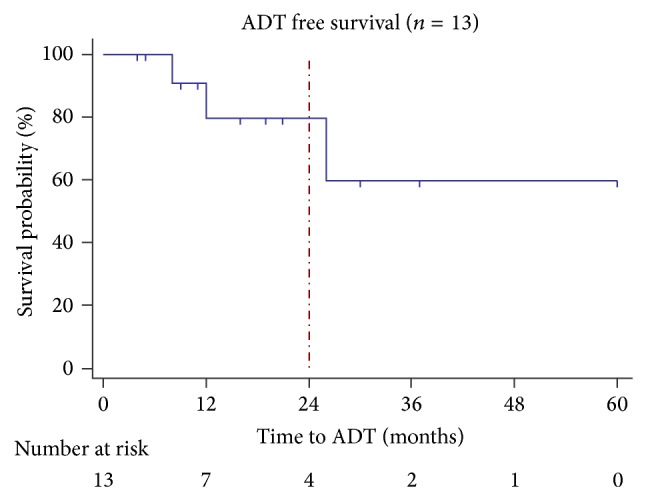
Results: Clavien-Dindo grade 1, 2, 3a, and 3b complications were seen in 6, 1, 1, and 2 patients, respectively. Median follow-up time was 22 months. Among 13 patients treated for oligometastatic disease, 8 (67%) had a PSA decline, with 3 patients showing cBR. Median PSA progression-free survival (FS) was 4.1 months and median CP-FS 7 months. Three patients started ADT, resulting in a 2-year ADT-FS rate of 79.5%.
Conclusion: SLND is feasible, but postoperative complication rate seems higher than that for primary LND. Biochemical and clinical response duration is limited, but as part of an oligometastatic treatment regime it can defer palliative ADT.
Figures

References
-
- Evangelista L., Zattoni F., Guttilla A., Saladini G., Colletti P. M., Rubello D. Choline PET or PET/CT and biochemical relapse of prostate cancer: a systematic review and meta-analysis. Clinical Nuclear Medicine. 2013;38(5):305–314. - PubMed
MeSH terms
Substances
LinkOut - more resources
Full Text Sources
Other Literature Sources
Medical
Research Materials
Miscellaneous
