. 2015:2015:303791.
doi: 10.1155/2015/303791. Epub 2015 Jan 28.

Low mutational burden of eight genes involved in the MAPK/ERK, PI3K/AKT, and GNAQ/11 pathways in female genital tract primary melanomas

Affiliations

Low mutational burden of eight genes involved in the MAPK/ERK, PI3K/AKT, and GNAQ/11 pathways in female genital tract primary melanomas

Kalliopi I Pappa et al. Biomed Res Int. 2015.

Abstract

Mucosal melanomas exhibit discrete genetic features compared to cutaneous melanoma. Limited studies on gynecological melanomas revealed significant heterogeneity and low mutational burden. To gain further insight into their genetics and DNA repair efficiency, we systematically investigated the status of eight genes whose products are critically involved in the MAPK/ERK, PI3K/AKT, and GNAQ/11 pathways, including BRAF, NRAS, HRAS, KRAS, c-KIT, PI3K, GNAQ, and GNA11, in a series of 16 primary gynecological melanomas, covering all anatomical locations, ranging from stages I to III. Analysis either by real-time PCR coupled with fluorescence melting curve analysis or by PCR followed by direct sequencing, along with studies for DNA mismatch repair status using immunohistochemistry, disclosed that 15 out of the 16 cases displayed wild-type genotypes, with a single case of vulvar primary melanoma, harboring the activating mutation BRAF(V600E). Investigations on whether this could reflect partly an efficient mismatch repair (MMR) mechanism were confirmed by normal expression of hMLH1 and hMSH2, suggesting that the lack of mutations could be explained by the operation of alternative pathogenetic mechanisms modulating downstream effectors of the signaling pathways. Our data suggest the presence of additional genetic components and provide the impetus for systematic approaches to reveal these yet unidentified genetic parameters.


Figures
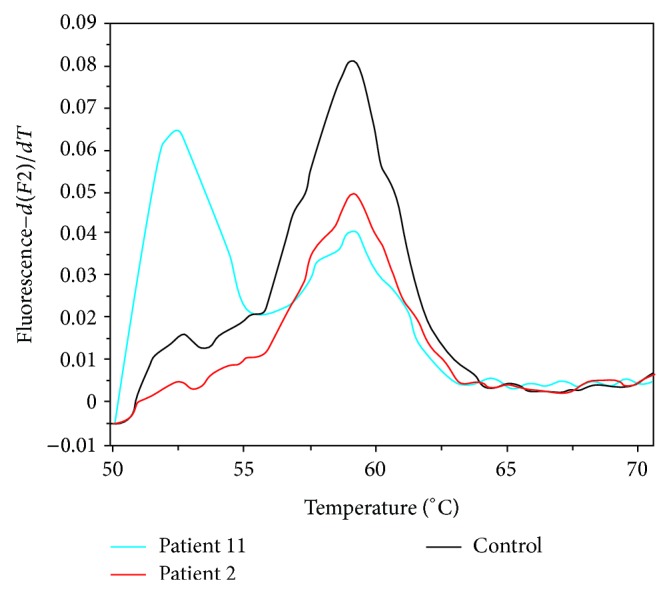
Figure 1
Figure 1
Fluorescent melting curve analysis for the detection of the BRAFV600E point mutation based on the resulting distinct melting temperatures (T m) of duplexes formed between the wild-type probe and the DNA from either the wild-type or the V600E mutant. The melting peaks for the wild-type and the V600E mutant occur at different melting temperatures, that is, 59.2°C and 52.5°C, respectively. The BRAFV600E mutation is shown for patient 11 (blue curve), whose tumor cells exhibit both types of BRAF alleles, since the PCR product shows also a wild-type peak. Patient 2 (red curve) lacks the mutation, exhibiting a single peak, corresponding to the normal control peak (black curve).
Figure 2
Figure 2
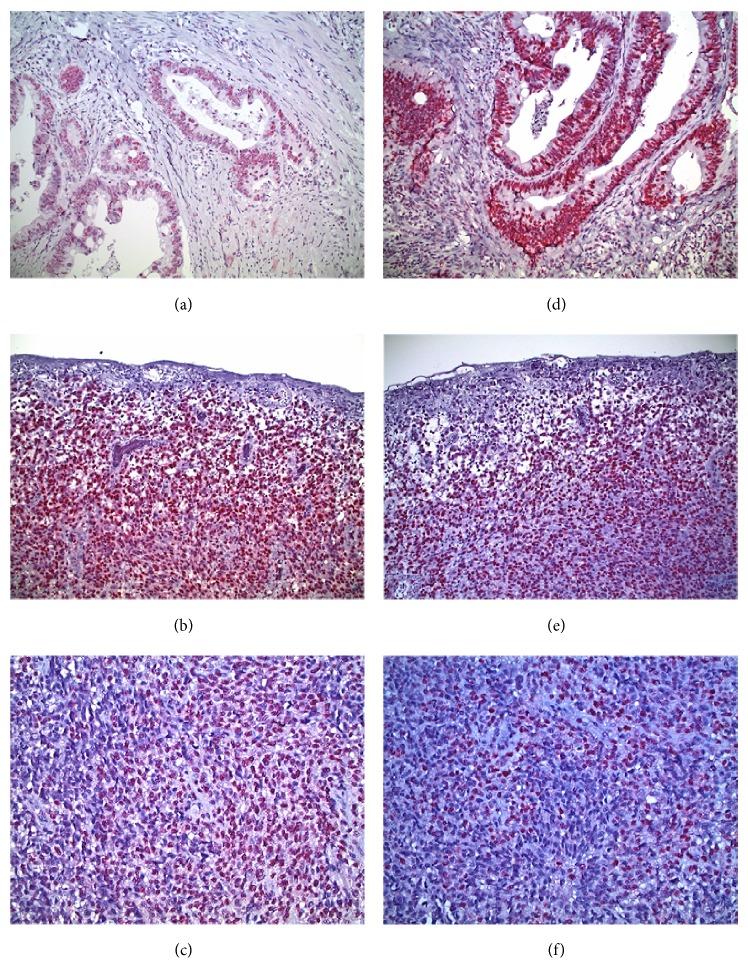
Immunohistochemistry analysis for the expression of the hMLH1 and hMSH2 MMR proteins in mucosal melanomas. (a) MMR-proficient/BRAF mutant colorectal cancer control exhibiting positive nuclear staining for hMLH1. (b) Vertical growth phase mucosal melanoma with ulcerated surface. Almost all melanoma cells display intense nuclear staining for hMLH1. (c) Mucosal melanoma with spindle and epithelioid cells strongly positive for hMLH1. (d) MMR-proficient/BRAF mutant colorectal cancer control displaying positive nuclear staining for hMSH2. (e) Vertical growth phase mucosal melanoma with ulcerated surface and diffuse nuclear staining for hMSH2. (f) Mucosal melanoma with spindle and epithelioid cells strongly positive for hMSH2. Photomicrographs (a), (b), (d), and (e) are of ×20 magnification, and photomicrographs (c) and (f) are of ×40 magnification.
Figure 3
Figure 3
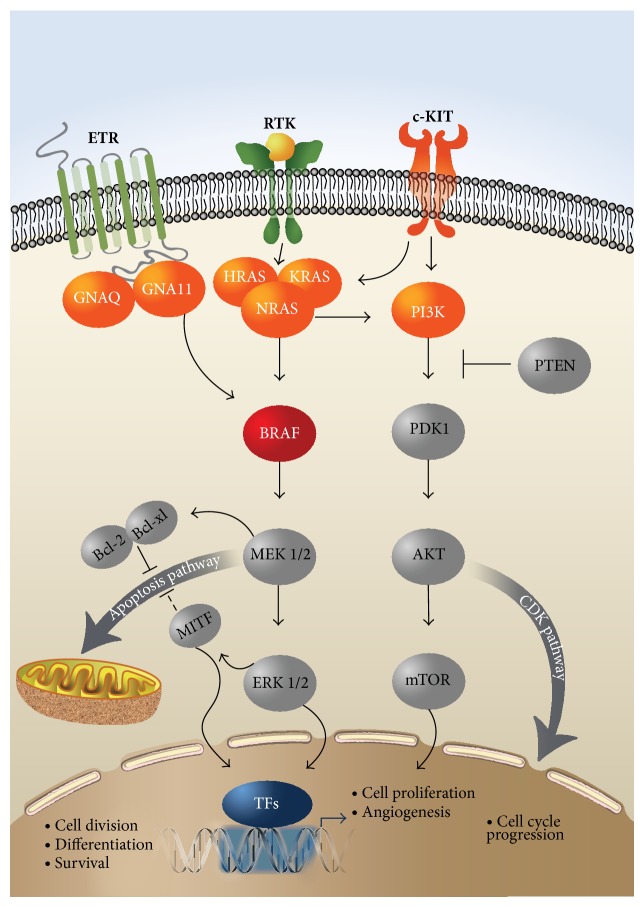
The individual involvement of the products of the eight studied genes (shown in red colour) in the (a) RAS/RAF/MEK/MAPK, (b) PI3K/AKT, and (c) GNAQ/11 signalling transduction pathways. BRAF (shown in dark red colour) was the only gene found mutated in a single patient in our series. All three members of the RAS family of GTPases, that is, the HRAS, KRAS, and NRAS, function as regulated binary switches and, following growth factor stimulation via the receptor tyrosine kinase (RTK), bind and activate downstream effectors, mainly BRAF and PI3K, leading sequentially to the activation of the ERK and AKT kinases, operating in the two major signal transduction pathways, respectively. Additional pathways, such as the apoptosis pathway and the CDK pathway leading to cell cycle progression, can be further activated from these downstream effectors of the two major pathways. Upstream of RAS and PI3K, c-KIT can be also mutated or amplified in melanoma and in turn activate the downstream effectors of the two major pathways. An alternative pathway via the endothelin receptor (ETR), involving two heterotrimeric G-α-proteins, that is, GNAQ and GNA11, can also activate the BRAF/MEK/MAPK/ERK pathway and appears to be important for both normal melanocyte development and melanoma formation. Finally, MITF plays also an essential role in melanocyte-specific transcription, exhibiting multiple regulatory functions. mTOR, mammalian target of rapamycin; MITF, microphthalmia-associated transcription factor; TFs, transcription factors.

References

    1. Mihajlovic M., Vlajkovic S., Jovanovic P., Stefanovic V. Primary mucosal melanomas: a comprehensive review. International Journal of Clinical and Experimental Pathology. 2012;5(8):739–753. - PMC - PubMed
    1. Carvajal R. D., Spencer S. A., Lydiatt W. Mucosal melanoma: a clinically and biologically unique disease entity. Journal of the National Comprehensive Cancer Network. 2012;10(3):345–356. - PubMed
    1. Gungor T., Altinkaya S. O., Ozat M., Bayramoglu H., Mollamahmutoglu L. Primary malignant melanoma of the female genital tract. Taiwanese Journal of Obstetrics and Gynecology. 2009;48(2):169–175. doi: 10.1016/S1028-4559(09)60281-3. - DOI - PubMed
    1. Bradgate M. G., Rollason T. P., McConkey C. C., Powell J. Malignant melanoma of the vulva: a clinicopathological study of 50 women. British Journal of Obstetrics and Gynaecology. 1990;97(2):124–133. doi: 10.1111/j.1471-0528.1990.tb01737.x. - DOI - PubMed
    1. Phillips G. L., Bundy B. N., Okazaki T., Kucera P. R., Stehman F. B. Malignant melanoma of the vulva treated by radical hemivulvectomy. A prospective study of the Gynecologic Oncology Group. Cancer. 1994;73(10):2626–2632. - PubMed

Publication types

MeSH terms

Substances