


Review
doi: 10.1155/2015/657086.
Epub 2015 Jan 27.
Exosomes: novel biomarkers for clinical diagnosis
Affiliations
- PMID: 25695100
- PMCID: PMC4322857
- DOI: 10.1155/2015/657086
Item in Clipboard
Review
Exosomes: novel biomarkers for clinical diagnosis
ScientificWorldJournal.
2015.
Abstract
Exosomes are 30-120 nm endocytic membrane-derived vesicles that participate in cell-to-cell communication and protein and RNA delivery. Exosomes harbor a variety of proteins, nucleic acids, and lipids and are present in many and perhaps all bodily fluids. A significant body of literature has demonstrated that molecular constituents of exosomes, especially exosomal proteins and microRNAs (miRNAs), hold great promise as novel biomarkers for clinical diagnosis. In this minireview, we summarize recent advances in the research of exosomal biomarkers and their potential application in clinical diagnostics. We also provide a brief overview of the formation, function, and isolation of exosomes.
Figures
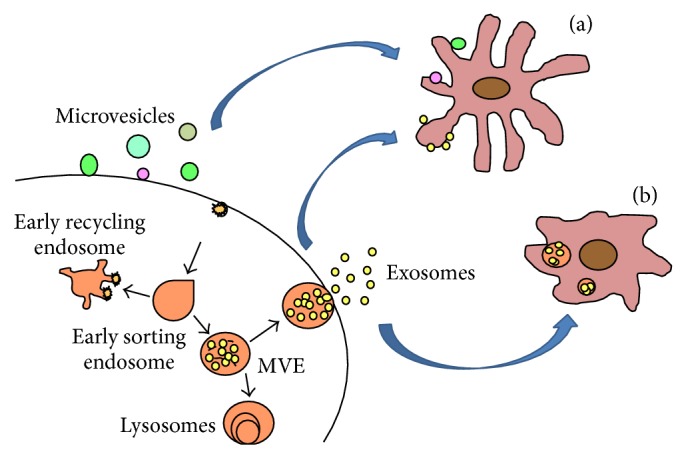
Exosomes are released from host cell and uptook by recipient cells. Exosomes are generated in host cell by merging MVBs with the cell membrane and releasing into the extracellular space. These exosomes can be fused with the plasma membrane (a) or be internalized (b) by recipient cells.
References
-
- Johnstone R. M. The Jeanne Manery-Fisher Memorial Lecture 1991. Maturation of reticulocytes: formation of exosomes as a mechanism for shedding membrane proteins. Biochemistry and Cell Biology. 1992;70(3-4):179–190. - PubMed
-
- Théry C., Zitvogel L., Amigorena S. Exosomes: composition, biogenesis and function. Nature Reviews Immunology. 2002;2(8):569–579. - PubMed
Publication types
MeSH terms
Substances
LinkOut - more resources
Full Text Sources
Other Literature Sources
