


Escape from crossover interference increases with maternal age
- PMID: 25695863
- PMCID: PMC4335350
- DOI: 10.1038/ncomms7260
Escape from crossover interference increases with maternal age
Abstract
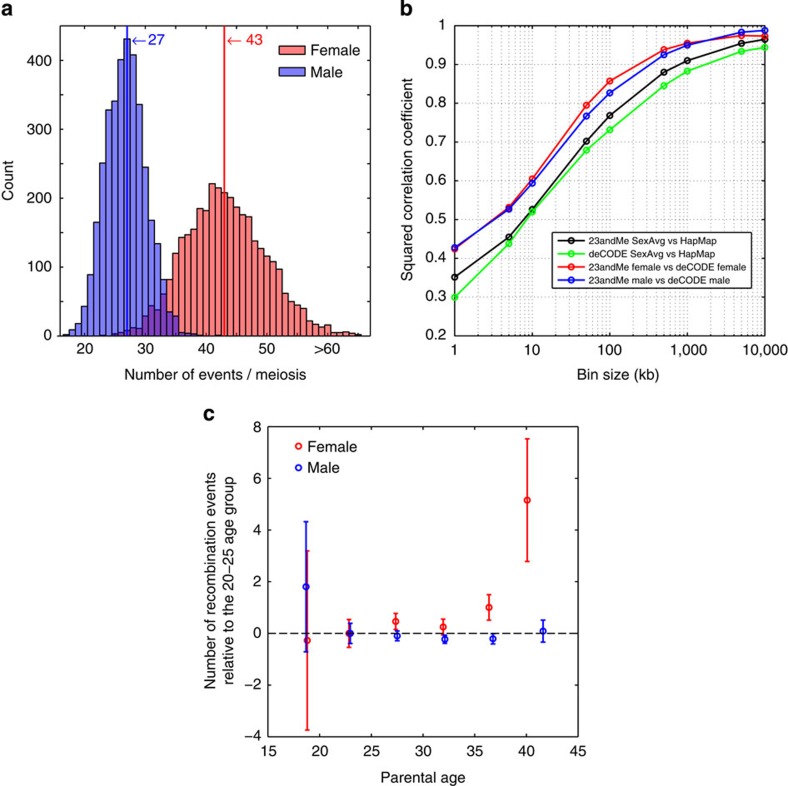
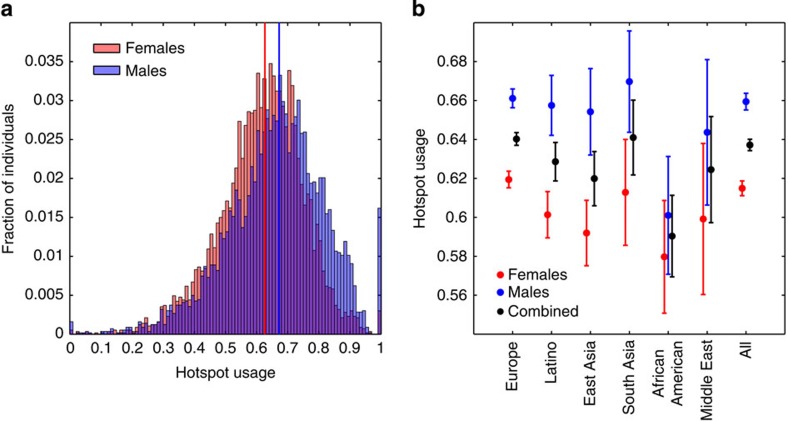
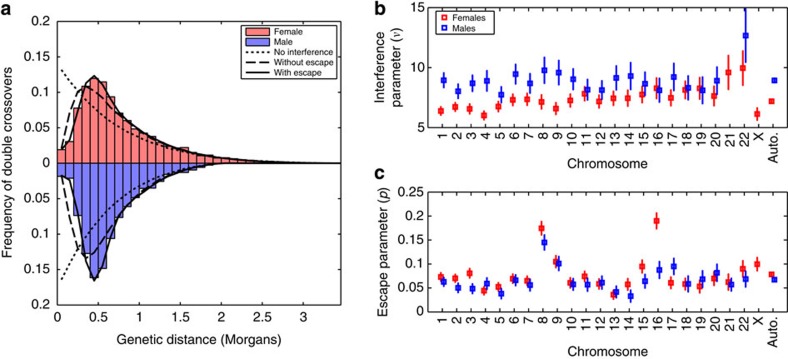
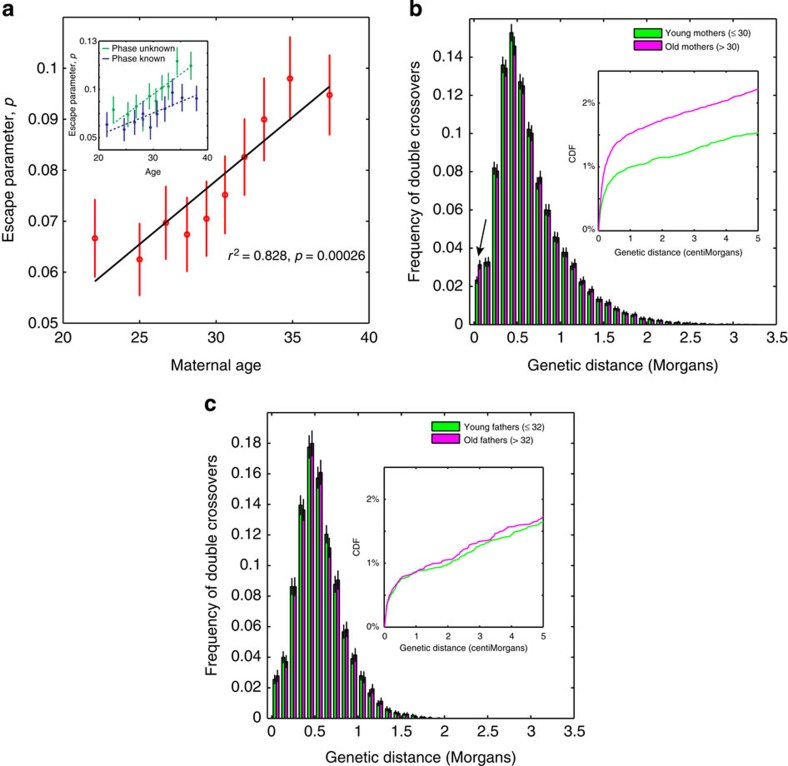
Recombination plays a fundamental role in meiosis, ensuring the proper segregation of chromosomes and contributing to genetic diversity by generating novel combinations of alleles. Here, we use data derived from direct-to-consumer genetic testing to investigate patterns of recombination in over 4,200 families. Our analysis reveals a number of sex differences in the distribution of recombination. We find the fraction of male events occurring within hotspots to be 4.6% higher than for females. We confirm that the recombination rate increases with maternal age, while hotspot usage decreases, with no such effects observed in males. Finally, we show that the placement of female recombination events appears to become increasingly deregulated with maternal age, with an increasing fraction of events observed within closer proximity to each other than would be expected under simple models of crossover interference.
Conflict of interest statement
N.A.F. and D.H. are current employees, and N.E. is a former employee of 23andMe Inc., and have private equity interest. The remaining authors declare no competing financial interests.
Figures
References
-
- Abecasis G. R., Cherny S. S., Cookson W. O. & Cardon L. R. Merlin--rapid analysis of dense genetic maps using sparse gene flow trees. Nat. Genet. 30, 97–101 (2002). - PubMed
-
- Kong A. et al. Fine-scale recombination rate differences between sexes, populations and individuals. Nature 467, 1099–1103 (2010). - PubMed
-
- Kong A. et al. Common and low-frequency variants associated with genome-wide recombination rate. Nat. Genet. 46, 11–16 (2014). - PubMed
Publication types
MeSH terms
Grants and funding
LinkOut - more resources
Full Text Sources
Other Literature Sources
Medical
