


Pituitary adenoma with paraganglioma/pheochromocytoma (3PAs) and succinate dehydrogenase defects in humans and mice
- PMID: 25695889
- PMCID: PMC4422891
- DOI: 10.1210/jc.2014-4297
Pituitary adenoma with paraganglioma/pheochromocytoma (3PAs) and succinate dehydrogenase defects in humans and mice
Abstract
Context: Germline mutations in genes coding succinate dehydrogenase (SDH) subunits A, B, C, and D have been identified in familial paragangliomas (PGLs)/pheochromocytomas (PHEOs) and other tumors. We described a GH-secreting pituitary adenoma (PA) caused by SDHD mutation in a patient with familial PGLs. Additional patients with PAs and SDHx defects have since been reported.
Design: We studied 168 patients with unselected sporadic PA and with the association of PAs, PGLs, and/or pheochromocytomas, a condition we named the 3P association (3PAs) for SDHx germline mutations. We also studied the pituitary gland and hormonal profile of Sdhb(+/-) mice and their wild-type littermates at different ages.
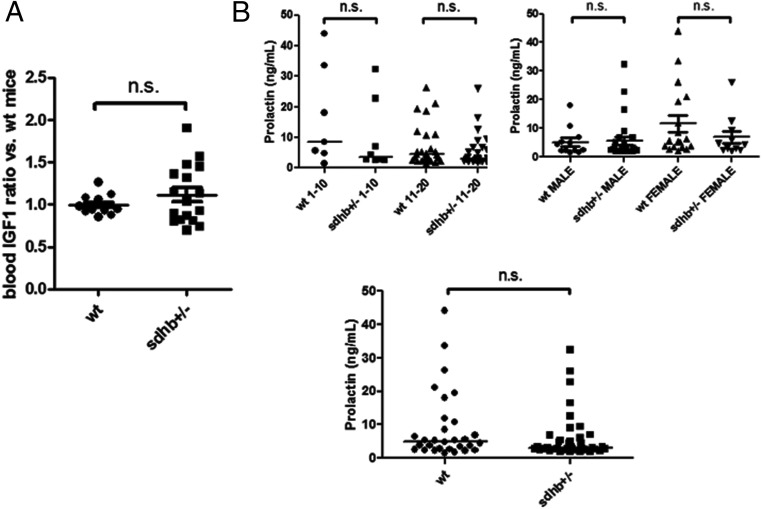
Results: No SDHx mutations were detected among sporadic PA, whereas three of four familial cases were positive for a mutation (75%). Most of the SDHx-deficient PAs were either prolactinomas or somatotropinomas. Pituitaries of Sdhb(+/-) mice older than 12 months had an increased number mainly of prolactin-secreting cells and several ultrastructural abnormalities such as intranuclear inclusions, altered chromatin nuclear pattern, and abnormal mitochondria. Igf-1 levels of mutant mice tended to be higher across age groups, whereas Prl and Gh levels varied according to age and sex.
Conclusion: The present study confirms the existence of a new association that we termed 3PAs. It is due mostly to germline SDHx defects, although sporadic cases of 3PAs without SDHx defects also exist. Using Sdhb(+/-) mice, we provide evidence that pituitary hyperplasia in SDHx-deficient cells may be the initial abnormality in the cascade of events leading to PA formation.
Figures


References
-
- Oyedotun KS, Lemire BD. The quaternary structure of the Saccharomyces cerevisiae succinate dehydrogenase. Homology modeling, cofactor docking, and molecular dynamics simulation studies. J Biol Chem. 2004;279:9424–9431. - PubMed
-
- Baysal BE, Ferrell RE, Willett-Brozick JE, et al. Mutations in SDHD, a mitochondrial complex II gene, in hereditary paraganglioma. Science. 2000;287:848–851. - PubMed
Publication types
MeSH terms
Substances
Grants and funding
LinkOut - more resources
Full Text Sources
Other Literature Sources
Medical
Molecular Biology Databases
Miscellaneous
