


Subcutaneous Injection Depth Does Not Affect the Pharmacokinetics or Glucodynamics of Insulin Lispro in Normal Weight or Healthy Obese Subjects
- PMID: 25697717
- PMCID: PMC4525656
- DOI: 10.1177/1932296815573865
Subcutaneous Injection Depth Does Not Affect the Pharmacokinetics or Glucodynamics of Insulin Lispro in Normal Weight or Healthy Obese Subjects
Abstract
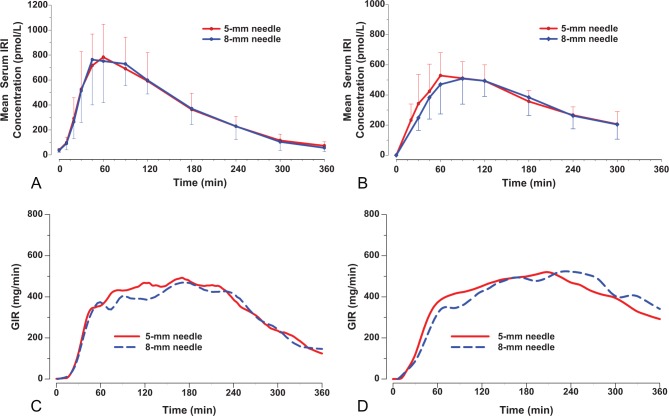
Background: An 8-mm needle length is commonly used for insulin injections; however, recent recommendations suggest shorter needles may help patients avoid intramuscular injections and reduce pain, while maintaining adequate glucose control. The goal of these analyses was to compare the pharmacokinetics (PK) and glucodynamics (GD) of insulin lispro after a 5-mm or an 8-mm injection depth administration in 2 populations: normal weight (study 1) or obese (study 2).
Methods: In both open-label, randomized, 2-period crossover euglycemic clamp studies, subjects received single 0.25 U/kg insulin lispro doses on 2 occasions (at 5-mm and 8-mm injection depths); samples for PK and GD analyses were collected up to 6 hours postdose. Noncompartmental PK parameters AUC0-tlast, AUC0-∞, Cmax and GD parameters Gtot, Rmax, tRmax were log-transformed prior to analysis using a mixed effects model.
Results: There were no apparent differences between PK profiles at the 5-mm or 8-mm injection depth in either study, demonstrated by the ratios of geometric means of AUC0-tlast, AUC0-∞, and Cmax being close to 1, with 90% confidence intervals (CI) within (0.80, 1.25). There were no apparent differences between GD profiles at either injection depth with the ratios of Gtot and Rmax near unity and 90% CIs that included 1. In both studies, the tRmax values were similar between injection depths, with a small median of pairwise differences and a 90% CI that included zero.
Conclusions: Injection depths in the 5-8 mm range did not affect the PK or GD of insulin lispro in normal weight or obese subjects.
Keywords: glucodynamics; injection depth; insulin lispro; pharmacokinetics.
© 2015 Diabetes Technology Society.
Conflict of interest statement
Figures
References
-
- McKay M, Compion G, Lytzen L. A comparison of insulin injection needles on patients’ perceptions of pain, handling, and acceptability: a randomized, open-label, crossover study in subjects with diabetes. Diabetes Technol Ther. 2009;11(3):195-201. - PubMed
-
- Strauss KA, Hannet I, McGonigle J, et al. Ultra-short (5 mm) insulin needles: trial results and clinical recommendations. Practical Diabetes Int. 1999;16:218-221.
-
- De Coninck C, Frid A, Gaspar R, et al. Results and analysis of the 2008-2009 Insulin Injection Technique Questionnaire survey. J Diabetes. 2010;2(3):168-179. - PubMed
-
- Thow JC, Home PD. Insulin injection technique: depth of injection is important. Brit Med J. 1990;301:3-4.
-
- Frid A, Hirsch L, Gaspar R, et al. New injection recommendations for patients with diabetes. Diabetes Metab. 2010;36(suppl 2):S3-S18. - PubMed
Publication types
MeSH terms
Substances
LinkOut - more resources
Full Text Sources
Other Literature Sources
Medical
