


Children's use of gesture in ambiguous pronoun interpretation
- PMID: 25698162
- PMCID: PMC4396442
- DOI: 10.1017/S0305000915000045
Children's use of gesture in ambiguous pronoun interpretation
Abstract
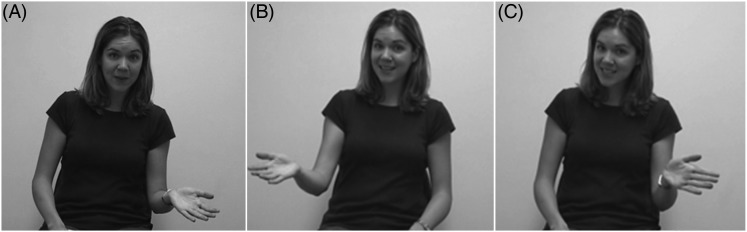
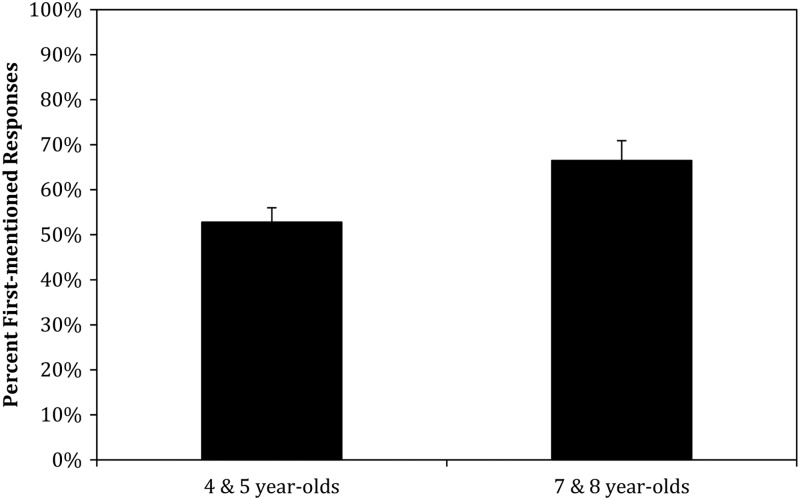
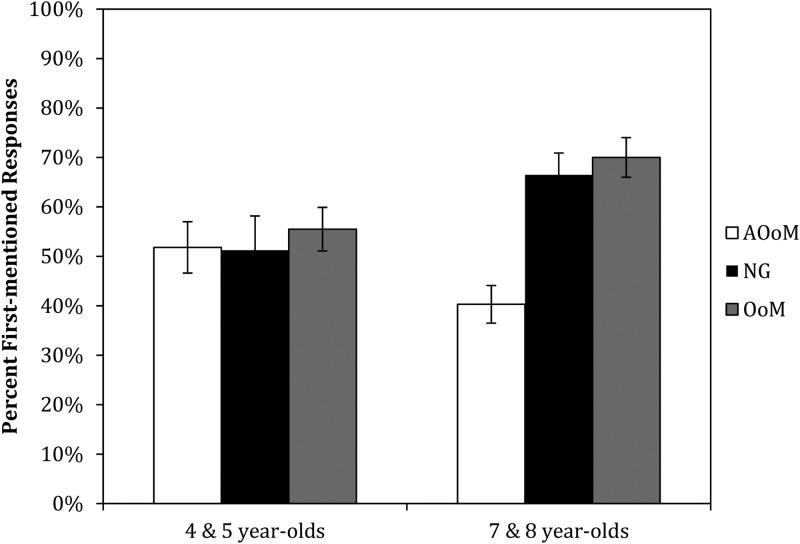
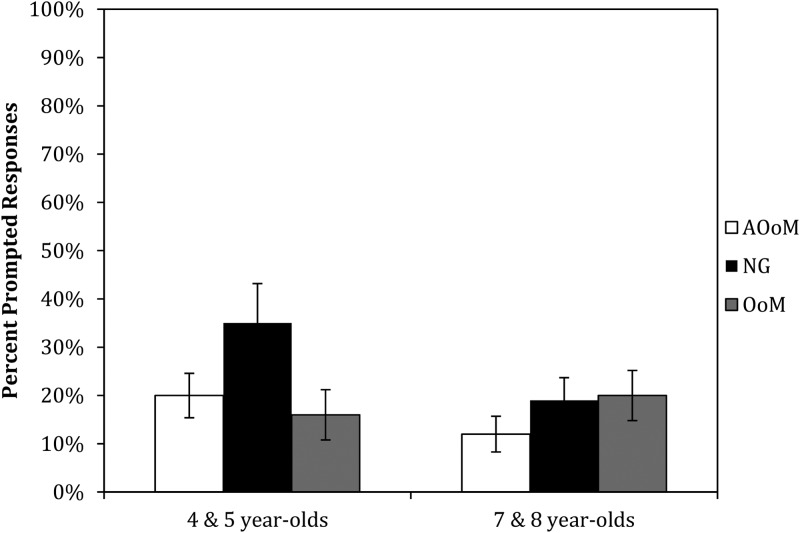
This study explores whether children can use gesture to inform their interpretation of ambiguous pronouns. Specifically, we ask whether four- to eight-year-old English-speaking children are sensitive to information contained in co-referential localizing gestures in video narrations. The data show that the older (7-8 years of age) but not younger (4-5 years) children integrate co-referential gestures into their interpretation of pronouns. This is the same age at which they show sensitivity to order-of-mention, the only other cue available in the stimuli. Interestingly, when children show sensitivity to the gestures, they are quite similar to adults, in that gestures consistent with order-of-mention increase first-mentioned responses as compared to stimuli with no gestures, but only slightly, while gestures inconsistent with order-of-mention have a larger effect on interpretation, decreasing first-mentioned responses and increasing second-mentioned responses.
Figures
References
-
- Alibali M. W. & Goldin-Meadow S. (1993). Gesture–speech mismatch and mechanisms of learning: what the hands reveal about a child's state of mind. Cognitive Psychology 25, 468–523. - PubMed
-
- Arnold J. E. (1998). Reference form and discourse patterns. Unpublished doctoral dissertation, Stanford University.
-
- Arnold J. E. (2001). The effect of thematic roles on pronoun use and frequency of reference continuation. Discourse Processes 31, 137–62.
-
- Arnold J. E. (2010). How speakers refer: the role of accessibility. Language and Linguistic Compass 4, 187–203.
-
- Arnold J. E., Brown-Schmidt S. & Trueswell J. (2007. a). Children's use of gender and order-of-mention during pronoun comprehension. Language and Cognitive Processes 22, 527–65.
Publication types
MeSH terms
Grants and funding
LinkOut - more resources
Full Text Sources
