


A meta-analysis on efficacy and safety: single-balloon vs. double-balloon enteroscopy
- PMID: 25698560
- PMCID: PMC4423464
- DOI: 10.1093/gastro/gov003
A meta-analysis on efficacy and safety: single-balloon vs. double-balloon enteroscopy
Abstract
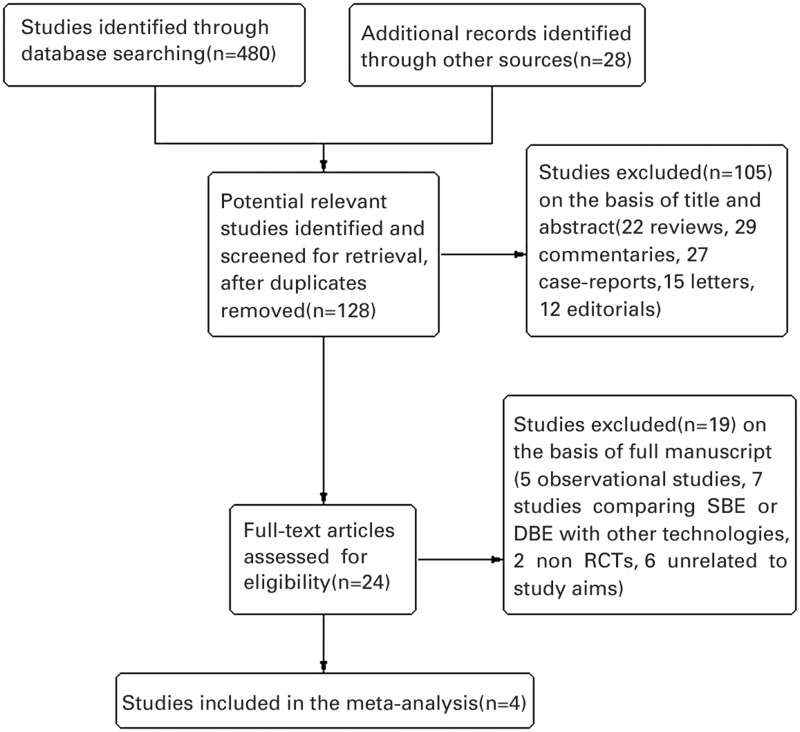
Background and aim: Double-balloon enteroscopy (DBE) and single-balloon enteroscopy (SBE) are new techniques capable of providing deep enteroscopy. Results of individual studies comparing these techniques have not been able to identify a superior strategy. Our aim was to systematically pool all available studies to compare the efficacy and safety of DBE with SBE for evaluation of the small bowel.
Methods: Databases were searched, including PubMed, Embase, and the Cochrane Central Register of Controlled Trials. The main outcome measures were complete small-bowel visualization, diagnostic yield, therapeutic yield, and complication rate. Statistical analysis was performed using Review Manager (RevMan version 5.2). Meta-analysis was performed using fixed-effect or random-effect methods, depending on the absence or presence of significant heterogeneity. We used the χ(2) and I(2) test to assess heterogeneity between trials. Results were expressed as risk ratios (RR) or mean differences with 95% confidence intervals (CI).
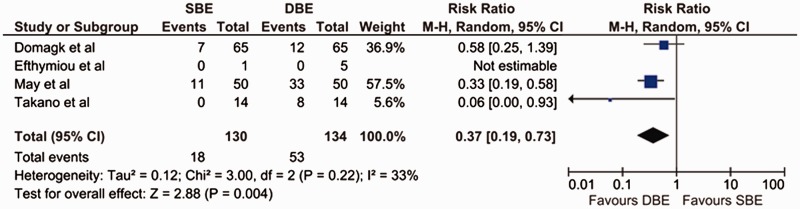
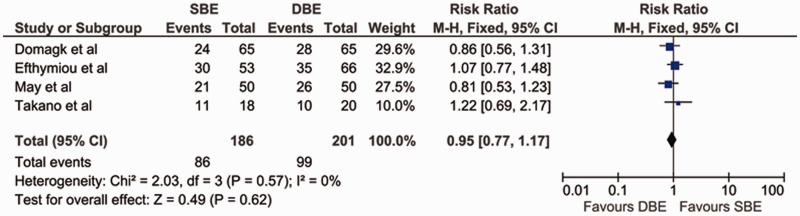
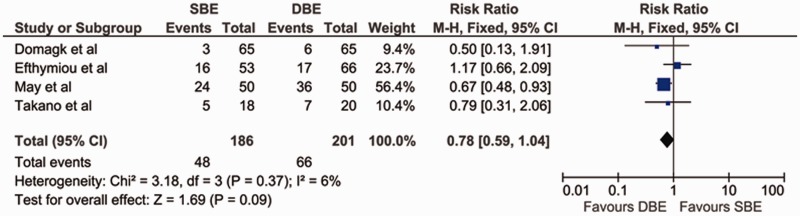
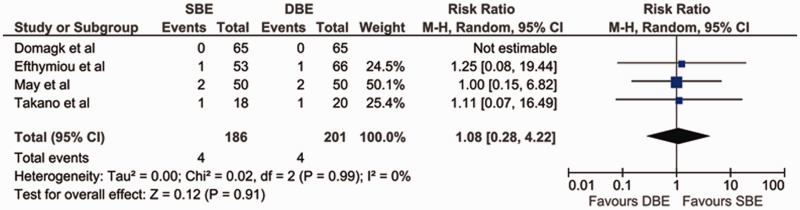
Results: Four prospective, randomized, controlled trials with a total of 375 patients were identified. DBE was superior to SBE for visualization of the entire small bowel [pooled RR = 0.37 (95% CI: 0.19-0.73; P = 0.004)]. DBE and SBE were similar in ability to provide diagnosis [pooled RR = 0.95 (95% CI: 0.77-1.17; P = 0.62)]. There was no significant difference between DBE and SBE in therapeutic yield [pooled RR = 0.78 (95% CI: 0.59-1.04; P = 0.09)] and complication rate [pooled RR = 1.08 (95% CI: 0.28-4.22); P = 0.91].
Conclusions: DBE was superior to SBE with regard to complete small bowel visualization. DBE was similar to SBE with regard to diagnostic yield, ability to provide treatment and complication rate, but these results should be interpreted with caution as they is based on very few studies and the overall quality of the evidence was rated as low to moderate, due to the small sample size.
Keywords: double-balloon enteroscopy; meta-analysis; outcomes; single-balloon enteroscopy; small bowel enteroscopy.
© The Author(s) 2015. Published by Oxford University Press and the Digestive Science Publishing Co. Limited.
Figures
References
-
- Yamamoto H, Sekine Y, Sato Y, et al. Total enteroscopy with a non-surgical steerable double-balloon method. Gastrointest Endosc 2001;53:216–20. - PubMed
-
- Ell C, May A, Nachbar L, et al. Push-and-pull enteroscopy in the small bowel using the double-balloon technique: results of a prospective European multicenter study. Endoscopy 2005;37:613–16. - PubMed
-
- Maaser C, Schmedt A, Bokemeyer M, et al. Long-term efficacy and safety of double balloon enteroscopy: prospective and retrospective data from a single-center study. Scand J Gastroenterol 2010;45:992–9. - PubMed
-
- May A, Nachbar L, Ell C. Double-balloon enteroscopy (push-and-pull enteroscopy) of the small bowel: feasibility and diagnostic and therapeutic yield in patients with suspected small bowel disease. Gastrointest Endosc 2005;62:62–70. - PubMed
-
- Hartmann D, Eickhoff A, Tamm R, et al. Balloon-assisted enteroscopy using a single-balloon technique. Endoscopy 2007;39 Suppl 1:E276. - PubMed
Publication types
LinkOut - more resources
Full Text Sources
Other Literature Sources
