. 2015 Feb 19;57(4):595-606.
doi: 10.1016/j.molcel.2015.01.022.

Top3-Rmi1 dissolve Rad51-mediated D loops by a topoisomerase-based mechanism

Affiliations

Top3-Rmi1 dissolve Rad51-mediated D loops by a topoisomerase-based mechanism

Clare L Fasching et al. Mol Cell. .

Abstract

The displacement loop (D loop) is a DNA strand invasion product formed during homologous recombination. Disruption of nascent D loops prevents recombination, and during synthesis-dependent strand annealing (SDSA), disruption of D loops extended by DNA polymerase ensures a non-crossover outcome. The proteins implicated in D loop disruption are DNA motor proteins/helicases that act by moving DNA junctions. Here we report that D loops can also be disrupted by DNA topoisomerase 3 (Top3), and this disruption depends on Top3's catalytic activity. Yeast Top3 specifically disrupts D loops mediated by yeast Rad51/Rad54; protein-free D loops or D loop mediated by bacterial RecA protein or human RAD51/RAD54 resist dissolution. Also, the human Topoisomerase IIIa-RMI1-RMI2 complex is capable of dissolving D loops. Consistent with genetic data, we suggest that the extreme growth defect and hyper-recombination phenotype of Top3-deficient yeast cells is partially a result of unprocessed D loops.


Figures

Figure 1
Figure 1. Sgs1 disrupts protein-free but not Rad51-mediated D-loops
A, Reaction scheme for deproteinized purified D-loops. B, Purified protein-free D-loops (~1 nM) containing a 5’-end labeled 95-mer were incubated with 0.5 nM Sgs1 or Sgs1hd (Sgs1-K706A), or reaction buffer for 10 min and the reaction products resolved on agarose gels. C, Quantitation of D-loops. Shown are means ± standard deviations of three independent experiments. D, Scheme for Rad51/Rad54-mediated D-loop reaction. E, Representative gel of products from reactions containing 20 nM 5’-end labeled 95-mer, 0.67 µM Rad51 (1 Rad51: 3 nts), 100 nM RPA, 112 nM Rad54, 20 nM supercoiled plasmid DNA, and Sgs1 (0, 1, 5, 10, 20, 50, 100 nM). F, Quantitation of D-loops. Shown are means ± standard deviations of three independent experiments.
Figure 2
Figure 2. Topoisomerase activity is necessary and sufficient for dissolution of Rad51–Rad54 reconstituted D-loops by Sgs1-Top3-Rmi1
A, Reaction scheme and proteins. B, D-loop dissolution by Sgs1, Sgs1-Top3-Rmi1 (STR), Sgs1-K706A-Top3-Rmi1 (DTR), Top3-Rmi1 (TR) (0, 2, 5, 10, 20, 50 nM). C, Quantitation of D-loops. Shown are normalized means ± standard deviations of three independent experiments. The absolute values corresponding to maximal D-loop levels are Sgs1: 14%, DTR: 12%, STR: 11%, and TR: 18%. The Sgs1 data were taken from Figure 1. D, D-loop dissolution by Top3 and Top3cd (Top3-Y356F) (0, 5, 10, 20, 50 nM). E, Quantitation of D-loops. Shown are normalized means ± standard deviations of three independent experiments. The absolute values corresponding to maximal D-loop levels are Top3: 22%, Top3cd: 19%.
Figure 3
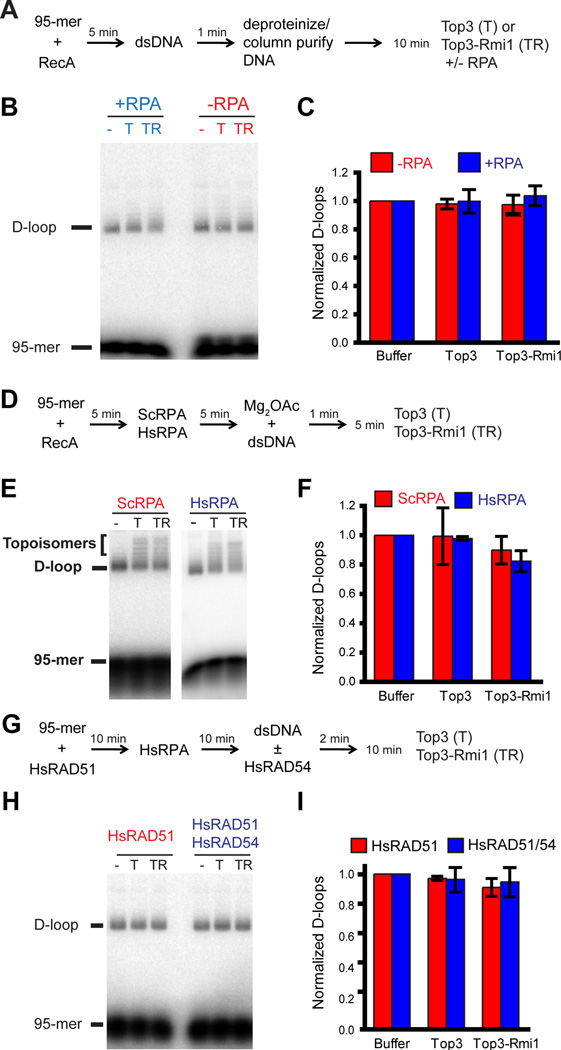
Figure 3. Top3-mediated D-loop dissolution is highly specific
Top3 does not dissolve protein-free D-loops. A, Reaction scheme for deproteinized D-loops. B, Deproteinized D-loops (~1 nM) were incubated with 0.5 nM Top3 (T) or Top3-Rmi1 (TR) in the presence or absence of 100 nM RPA. C, Quantitation of D-loops. Shown are normalized means ± standard deviations of three independent experiments. The absolute values corresponding to maximal D-loop levels were buffer 11.9%, Top3 12.6%, and Top3-Rmi1 12%. Top3 does not dissolve RecA-mediated D-loops. D, Reaction scheme for RecA-mediated D-loops. E, RecA D-loop reactions were incubated with 0.5 nM Top3 (T) or Top3-Rmi1 (TR) in the presence or absence of 100 nM yeast RPA (ScRPA) or human RPA (HsRPA). F, Quantitation of D-loops. Shown are normalized means ± standard deviations of three independent experiments. The absolute values corresponding to maximal D-loop levels were buffer (ScRPA 5.8%, HsRPA 7.4%), Top3 (ScRPA 5.5%, HSRPA 6%), and Top3-Rmi1 (ScRPA 5.1%, HsRPA 5.7%). Top3 does not dissolve human RAD51-mediated D-loops. G, Reaction scheme for human RAD51- or RAD51/RAD54-mediated D-loops. H, RAD51 D-loop reactions were incubated with 2 nM Top3 (T) or Top3-Rmi1 (TR) in the presence or absence of 100 nM human RPA (HsRPA). I, Quantitation of D-loops. Shown are normalized means ± standard deviations of three independent experiments. The absolute values corresponding to maximal D-loop levels were buffer (RAD51 7.8%, RAD51/RAD54 7.5%), Top3 (RAD51 7.6%, RAD51/RAD54 7.2%, and Top3-Rmi1 (RAD51 7.1%, RAD51/RAD54 7.1%).
Figure 4
Figure 4. Rmi1 stimulates D-loop dissolution by Top3
A, Reaction scheme for Rmi1-stimulated reactions. B, D-loop dissolution by Top3 or Top3-Rmi1 (0, 2, 5, 10, 20 nM). C, Quantitation of D-loops. Shown are normalized means ± standard deviations of three independent experiments. The absolute values corresponding to maximal D-loop levels are Top3: 21.1%, Top3-Rmi1: 18.7%. D, Reaction scheme with tailed 95-mer. E, D-loop dissolution time course by 2 nM Top3-Rmi1. F, Quantitation of D-loops. Shown are means ± standard deviations of three independent experiments.
Figure 5
Figure 5. Human TOPOIIIα-RMI1–RMI2 dissolves D-loops
A, Reaction scheme for human RAD51/RAD54-mediated D-loops. B, Quantitation of D-loops. The absolute values corresponding to maximal D-loop levels were TR 8 % and TRR 8 %. C, Reaction scheme for yeast Rad51/Rad54-mediated D-loops. D, Quantitation of D-loops. The absolute values corresponding to maximal D-loop levels were TR 12 % and TRR14 %. E, Reaction scheme for deproteinized D-loops. Deproteinized D-loops (~1 nM) were incubated with TR and TRR. F, Quantitation of D-loops. The absolute values corresponding to starting D-loop levels were TR 39 % and TRR 37 %. Shown are normalized means ± standard deviations of three independent experiments.
Figure 6
Figure 6
Different D-loops species during HR-mediated DSB and gap repair. D-loops are a collection of different recombination joint molecules with different DNA junction architecture (3’-end, length, gap invasion) and different HR proteins bound to the individual DNA intermediates. D-loops can form during DSB repair (left) or replication fork-associated gap repair (right) and include nascent D-loops (before extension by DNA polymerase: 3’-end not incorporated or ± branch migration), where proteins involved in strand invasion (e.g. Rad51, Rad51 paralogs, Rad54, RPA, Rad52?, others?) are likely still bound to at least parts of the D-loop (top) and extended D-loops (bottom), where instead or in addition to HR proteins replication proteins (PCNA, RFC, DNA polymerase, RPA) will be present in the D-loop.

Comment in

  • TOPping off meiosis.
    Haber JE. Haber JE. Mol Cell. 2015 Feb 19;57(4):577-581. doi: 10.1016/j.molcel.2015.02.004. Mol Cell. 2015. PMID: 25699706 Free PMC article.

References

    1. Bachrati CZ, Borts RH, Hickson ID. Mobile D-loops are a preferred substrate for the Bloom's syndrome helicase. Nucleic Acids Res. 2006;34:2269–2279. - PMC - PubMed
    1. Bailis AM, Arthur L, Rothstein R. Genome Rearrangement in top3 Mutants of Saccharomyces cerevisiae Requires a Functional RAD1 Excision Repair Gene. Mol Cell Biol. 1992;12:4988–4993. - PMC - PubMed
    1. Barber LJ, Youds JL, Ward JD, McIlwraith MJ, O'Neil NJ, Petalcorin MIR, Martin JS, Collis SJ, Cantor SB, Auclair M, et al. RTEL1 maintains genomic stability by suppressing homologous recombination. Cell. 2008;135:261–271. - PMC - PubMed
    1. Bernstein KA, Gangloff S, Rothstein R. The RecQ DNA Helicases in DNA Repair. Annu Rev Genet. 2010;44:393–417. - PMC - PubMed
    1. Bernstein KA, Shor E, Sunjevaric I, Fumasoni M, Burgess RC, Foiani M, Branzei D, Rothstein R. Sgs1 function in the repair of DNA replication intermediates is separable from its role in homologous recombinational repair. EMBO J. 2009;28:915–925. - PMC - PubMed

Publication types

MeSH terms