


Exploration of chronic kidney disease prevalence estimates using new measures of kidney function in the health survey for England
- PMID: 25700182
- PMCID: PMC4336286
- DOI: 10.1371/journal.pone.0118676
Exploration of chronic kidney disease prevalence estimates using new measures of kidney function in the health survey for England
Abstract
Background: Chronic kidney disease (CKD) diagnosis relies on glomerular filtration rate (eGFR) estimation, traditionally using the creatinine-based Modification of Diet in Renal Disease (MDRD) equation. The Chronic Kidney Disease Epidemiology Collaboration (CKDEPI) equation performs better in estimating eGFR and predicting mortality and CKD progression risk. Cystatin C is an alternative glomerular filtration marker less influenced by muscle mass. CKD risk stratification is improved by combining creatinine eGFR with cystatin C and urinary albumin to creatinine ratio (uACR). We aimed to identify the impact of introducing CKDEPI and cystatin C on the estimated prevalence and risk stratification of CKD in England and to describe prevalence and associations of cystatin C.
Methods and findings: Cross sectional study of 5799 people in the nationally representative 2009 and 2010 Health Surveys for England.
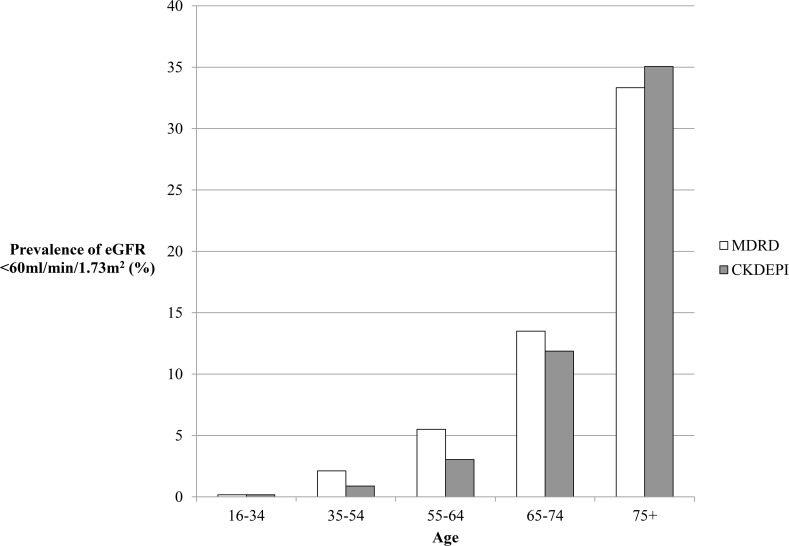
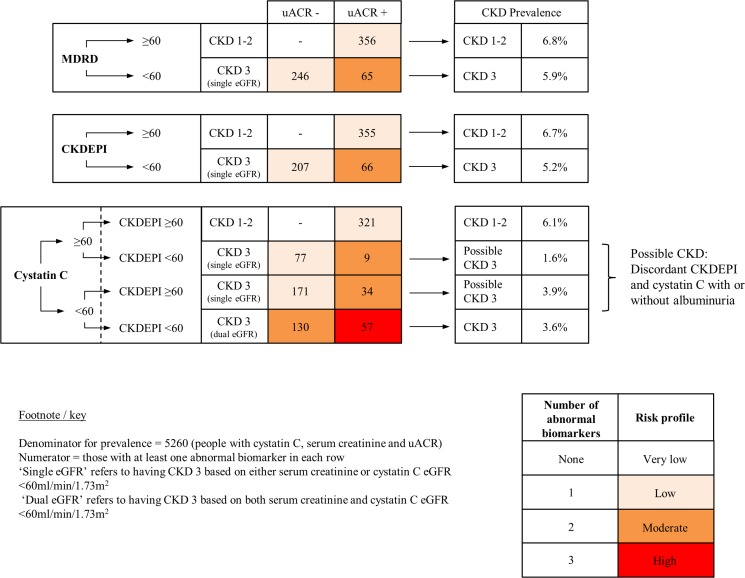
Primary outcome measures: prevalence of MDRD, CKDEPI and cystatin C-defined eGFR<60 ml/min/1.73 m(2); prevalence of CKD biomarker combinations (creatinine, cystatin C, uACR). Using CKDEPI instead of MDRD reduced the prevalence of eGFR<60 ml/min/1.73 m(2) from 6.0% (95% CI 5.4-6.6%) to 5.2% (4.7-5.8%) equivalent to around 340,000 fewer individuals in England. Those reclassified as not having CKD evidenced a lower risk profile. Prevalence of cystatin C eGFR<60 ml/min/1.73 m(2) was 7.7% and independently associated with age, lack of qualifications, being an ex-smoker, BMI, hypertension, and albuminuria. Measuring cystatin C in the 3.9% people with CKDEPI-defined eGFR<60 ml/min/1.73 m(2) without albuminuria (CKD Category G3a A1) reclassified about a third into a lower risk group with one of three biomarkers and two thirds into a group with two of three. Measuring cystatin C in the 6.7% people with CKDEPI eGFR >60 ml/min/1.73 m(2) with albuminuria (CKD Category G1-2) reclassified almost a tenth into a higher risk group.
Limitations: Cross sectional study, single eGFR measure, no measured ('true') GFR.
Conclusions: Introducing the CKDEPI equation and targeted cystatin C measurement reduces estimated CKD prevalence and improves risk stratification.
Conflict of interest statement
Figures
References
-
- National Kidney Foundation. K/DOQI clinical practice guidelines for chronic kidney disease: evaluation, classification and stratification. Executive summary. Am J Kidney Dis.2002;39: S17–31 - PubMed
-
- Levey AS, Coresh J, Greene T, Stevens LA, Zhang YL, Hendriksen S, et al. Using standardized serum creatinine values in the modification of diet in renal disease study equation for estimating glomerular filtration rate. Ann Intern Med. 2006;145: 247–254. - PubMed
-
- KDIGO 2012. Clinical Practice Guideline for the Evaluation and Management of Chronic Kidney Disease. Kidney Int Suppl 3: 150. - PubMed
-
- NICE clinical guideline 73: Chronic kidney disease; early identification and management of chronic kidney disease in adults in primary and secondary care London: National Institute for Health and Clinical Excellence, 2008.
-
- The National Service Framework for Renal Services. Part Two: Chronic Kidney Disease, Acute Renal Failure and End of Life Care. Department of Health; London, 2005. Available: https://www.gov.uk/government/uploads/system/uploads/attachment_data/fil... Accessed June 6th 2014.
Publication types
MeSH terms
Substances
LinkOut - more resources
Full Text Sources
Other Literature Sources
Medical
Research Materials
Miscellaneous
