


Can we identify patients with high risk of osteoarthritis progression who will respond to treatment? A focus on epidemiology and phenotype of osteoarthritis
- PMID: 25701074
- PMCID: PMC4366553
- DOI: 10.1007/s40266-015-0243-3
Can we identify patients with high risk of osteoarthritis progression who will respond to treatment? A focus on epidemiology and phenotype of osteoarthritis
Erratum in
-
Erratum to: Can We Identify Patients with High Risk of Osteoarthritis Progression Who Will Respond to Treatment? A Focus on Epidemiology and Phenotype of Osteoarthritis.Drugs Aging. 2017 May;34(5):411. doi: 10.1007/s40266-017-0456-8. Drugs Aging. 2017. PMID: 28349414 Free PMC article. No abstract available.
Abstract
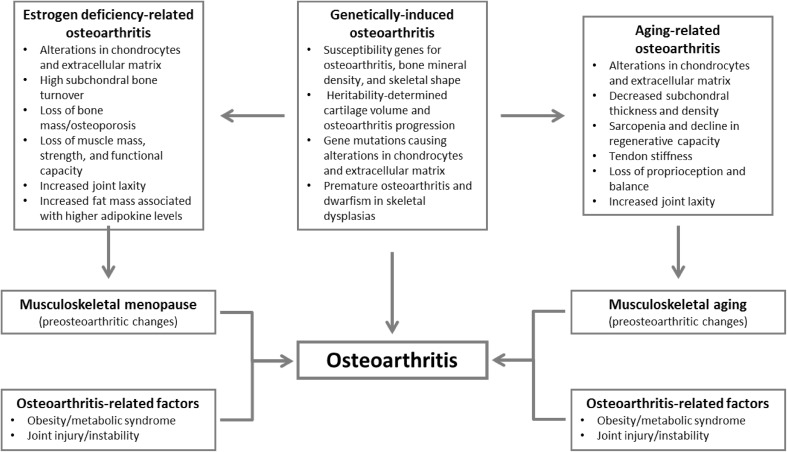
Osteoarthritis is a syndrome affecting a variety of patient profiles. A European Society for Clinical and Economic Aspects of Osteoporosis and Osteoarthritis and the European Union Geriatric Medicine Society working meeting explored the possibility of identifying different patient profiles in osteoarthritis. The risk factors for the development of osteoarthritis include systemic factors (e.g., age, sex, obesity, genetics, race, and bone density) and local biomechanical factors (e.g., obesity, sport, joint injury, and muscle weakness); most also predict disease progression, particularly joint injury, malalignment, and synovitis/effusion. The characterization of patient profiles should help to better orientate research, facilitate trial design, and define which patients are the most likely to benefit from treatment. There are a number of profile candidates. Generalized, polyarticular osteoarthritis and local, monoarticular osteoarthritis appear to be two different profiles; the former is a feature of osteoarthritis co-morbid with inflammation or the metabolic syndrome, while the latter is more typical of post-trauma osteoarthritis, especially in cases with severe malalignment. Other biomechanical factors may also define profiles, such as joint malalignment, loss of meniscal function, and ligament injury. Early- and late-stage osteoarthritis appear as separate profiles, notably in terms of treatment response. Finally, there is evidence that there are two separate profiles related to lesions in the subchondral bone, which may determine benefit from bone-active treatments. Decisions on appropriate therapy should be made considering clinical presentation, underlying pathophysiology, and stage of disease. Identification of patient profiles may lead to more personalized healthcare, with more targeted treatment for osteoarthritis.
Figures
References
Publication types
MeSH terms
Grants and funding
LinkOut - more resources
Full Text Sources
Other Literature Sources
Medical
