


Age at Autism Spectrum Disorder (ASD) Diagnosis by Race, Ethnicity, and Primary Household Language Among Children with Special Health Care Needs, United States, 2009-2010
- PMID: 25701197
- PMCID: PMC4500845
- DOI: 10.1007/s10995-015-1683-4
Age at Autism Spectrum Disorder (ASD) Diagnosis by Race, Ethnicity, and Primary Household Language Among Children with Special Health Care Needs, United States, 2009-2010
Abstract
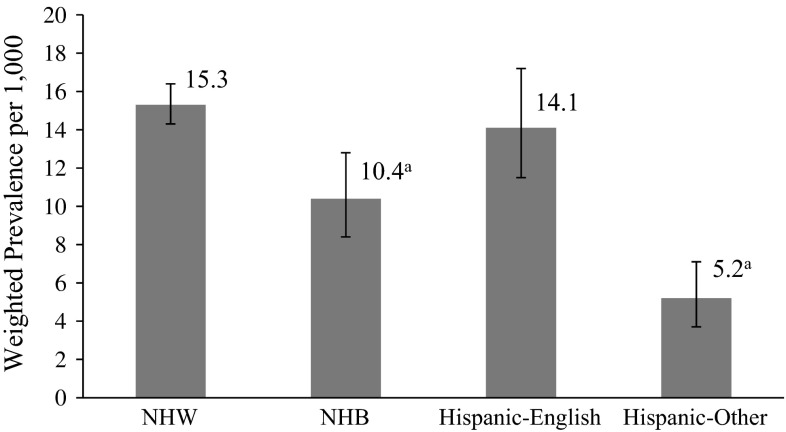
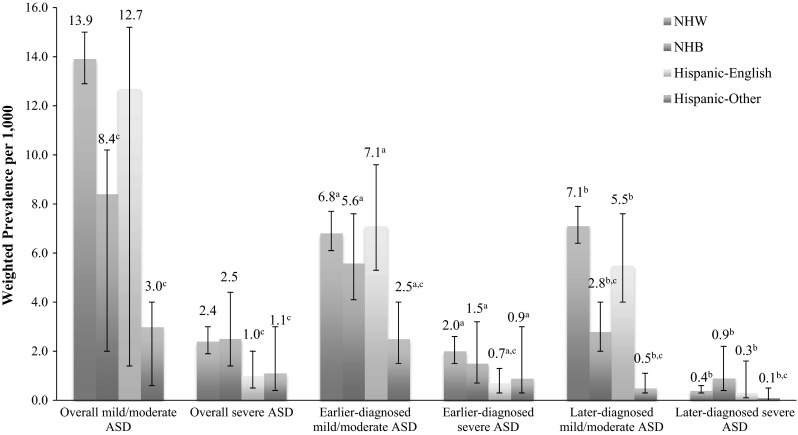
We examined prevalence of diagnosed autism spectrum disorder (ASD) and age at diagnosis according to child's race/ethnicity and primary household language. From the 2009-2010 National Survey of Children with Special Health Care Needs, we identified 2729 3-17-year-old US children whose parent reported a current ASD diagnosis. We compared ASD prevalence, mean diagnosis age, and percentage with later diagnoses (≥5 years) across racial/ethnic/primary household language groups: non-Hispanic-white, any language (NHW); non-Hispanic-black, any language (NHB); Hispanic-any-race, English (Hispanic-English); and Hispanic-any-race, other language (Hispanic-Other). We assessed findings by parent-reported ASD severity level and adjusted for family sociodemographics. ASD prevalence estimates were 15.3 (NHW), 10.4 (NHB), 14.1 (Hispanic-English), and 5.2 (Hispanic-Other) per 1000 children. Mean diagnosis age was comparable across racial/ethnic/language groups for 3-4-year-olds. For 5-17-year-olds, diagnosis age varied by race/ethnicity/language and also by ASD severity. In this group, NHW children with mild/moderate ASD had a significantly higher proportion (50.8 %) of later diagnoses than NHB (33.5 %) or Hispanic-Other children (18.0 %). However, NHW children with severe ASD had a comparable or lower (albeit non-significant) proportion (16.4 %) of later diagnoses than NHB (37.8 %), Hispanic-English (30.8 %), and Hispanic-Other children (12.0 %). While NHW children have comparable ASD prevalence and diagnosis age distributions as Hispanic-English children, they have both higher prevalence and proportion of later diagnoses than NHB and Hispanic-Other children. The diagnosis age findings were limited to mild/moderate cases only. Thus, the prevalence disparity might be primarily driven by under-representation (potentially under-identification) of older children with mild/moderate ASD in the two minority groups.
Figures
References
-
- American Psychiatric Association . Diagnostic and statistical manual of mental disorders, 4th edition, text revision (DSM-IV-TR) Washington, DC: American Psychiatric Publishing; 2000.
MeSH terms
Grants and funding
LinkOut - more resources
Full Text Sources
Other Literature Sources
Medical
