


Autonomic dysfunction syndromes after acute brain injury
- PMID: 25701906
- PMCID: PMC8101086
- DOI: 10.1016/B978-0-444-63521-1.00034-0
Autonomic dysfunction syndromes after acute brain injury
Abstract
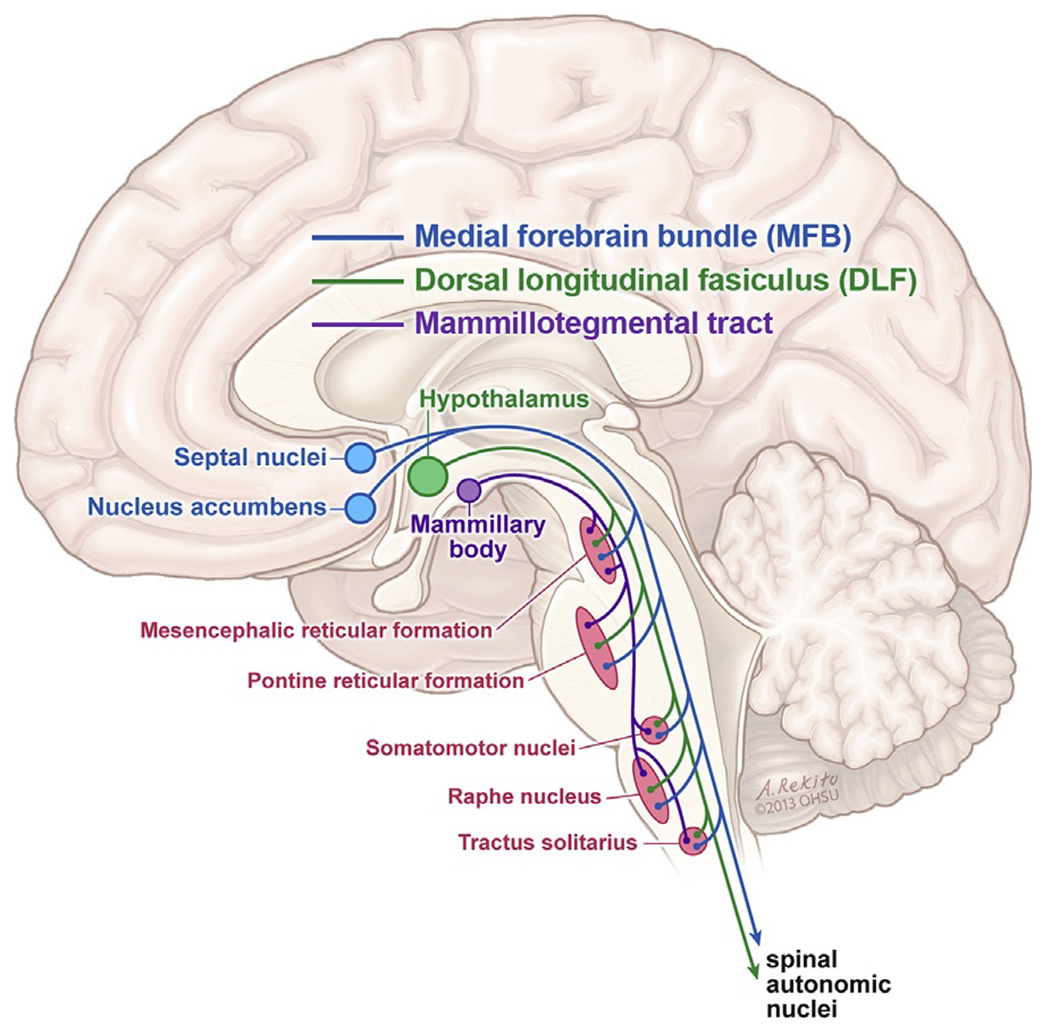
The central autonomic nervous system (CAN) is a multifaceted, richly connected neural network incorporating the hypothalamus, its descending tracts through the brainstem, the insular cortex and down into the spinal cord. All levels of the CAN are susceptible to injury following traumatic brain injury (TBI), whether from focal or diffuse injury. Focal injuries would be expected to produce localized damage to CAN control centers, whereas the effects of diffuse injuries are presumed to be more diverse and/or widely distributed. As the combination of focal and diffuse injury following TBI can vary widely from one individual to the next, the impact of focal injuries is best understood with reference to the focal ischemic stroke literature. Subarachnoid hemorrhage (SAH), a common complication following TBI, also has predictable effects on autonomic control that can be understood with reference to spontaneous SAH literature. Finally, paroxysmal sympathetic hyperactivity (PSH), a syndrome incorporating episodes of heightened sympathetic drive and motor overactivity following minor stimulation, is discussed as an example of what happens when central inhibitory control of spinal cord autonomics is impaired.
Keywords: central autonomic network; hyperadrenergic crisis; paroxysmal sympathetic hyperactivity; stroke; subarachnoid hemorrhage; traumatic brain injury.
© 2015 Elsevier B.V. All rights reserved.
Figures
References
-
- Anderson VL, Ahmed G, Duraski SA et al. (2004). Alternative treatment in the management of combined hyperadrenergia and spasticity in the adult with a severe traumatic brain injury: case report. Arch Phys Med Rahabil 85: e15.
-
- Badjatia N (2009). Hyperthermia and fever control in brain injury. Crit Care Med 37: S250–S257. - PubMed
-
- Badjatia N, Fernandez L, Schmidt JM et al. (2010). Impact of induced normothermia on outcome after subarachnoid hemorrhage. Neurosurg 66: 696–701. - PubMed
-
- Baguley IJ (2008a). The excitatory:inhibitory model (EIR model): an integrative explanation of acute autonomic overactivity syndromes. Med Hypotheses 70: 26–35. - PubMed
-
- Baguley IJ (2008b). Autonomic complications following central nervous system injury. Sem Neurol 28: 716–725. - PubMed
Publication types
MeSH terms
Grants and funding
LinkOut - more resources
Full Text Sources
Medical
Research Materials
