


Usual intake of added sugars and lipid profiles among the U.S. adolescents: National Health and Nutrition Examination Survey, 2005-2010
- PMID: 25703323
- PMCID: PMC4494648
- DOI: 10.1016/j.jadohealth.2014.12.001
Usual intake of added sugars and lipid profiles among the U.S. adolescents: National Health and Nutrition Examination Survey, 2005-2010
Abstract
Purpose: Although studies suggest that higher consumption of added sugars is associated with cardiovascular risk factors in adolescents, none have adjusted for measurement errors or examined its association with the risk of dyslipidemia.
Methods: We analyzed data of 4,047 adolescents aged 12-19 years from the 2005-2010 National Health and Nutrition Examination Survey, a nationally representative, cross-sectional survey. We estimated the usual percentage of calories (%kcal) from added sugars using up to two 24-hour dietary recalls and the National Cancer Institute method to account for measurement error.
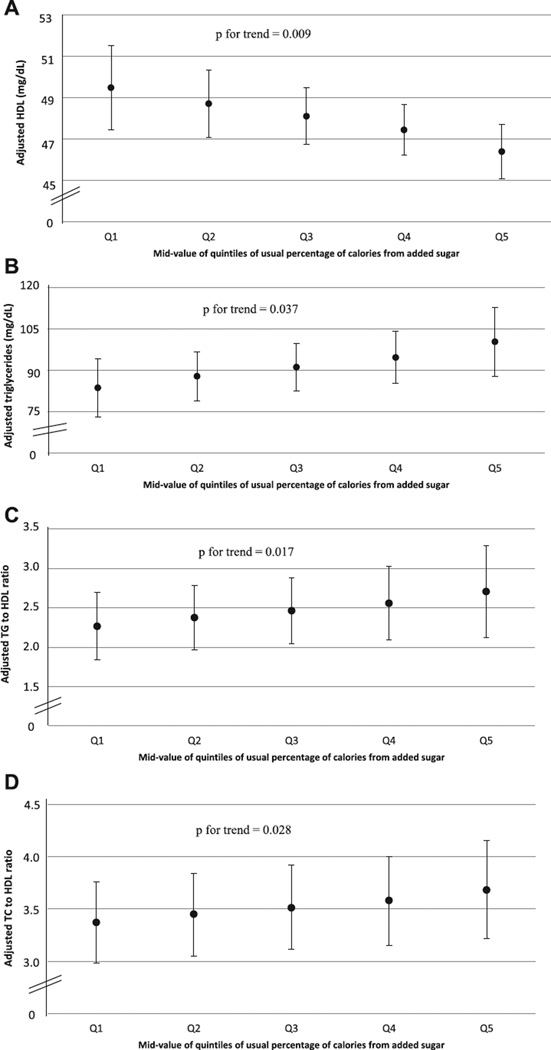
Results: The average usual %kcal from added sugars was 16.0%. Most adolescents (88.0%) had usual intake of ≥10% of total energy, and 5.5% had usual intake of ≥25% of total energy. After adjustment for potential confounders, usual %kcal from added sugars was inversely associated with high-density lipoprotein (HDL) and positively associated with triglycerides (TGs), TG-to-HDL ratio, and total cholesterol (TC) to HDL ratio. Comparing the lowest and highest quintiles of intake, HDLs were 49.5 (95% confidence interval [CI], 47.4-51.6) and 46.4 mg/dL (95% CI, 45.2-47.6; p = .009), TGs were 85.6 (95% CI, 75.5-95.6) and 101.2 mg/dL (95% CI, 88.7-113.8; p = .037), TG to HDL ratios were 2.28 (95% CI, 1.84-2.70) and 2.73 (95% CI, 2.11-3.32; p = .017), and TC to HDL ratios were 3.41 (95% CI, 3.03-3.79) and 3.70 (95% CI, 3.24-4.15; p = .028), respectively. Comparing the highest and lowest quintiles of intake, adjusted odds ratio of dyslipidemia was 1.41 (95% CI, 1.01-1.95). The patterns were consistent across sex, race/ethnicity, and body mass index subgroups. No association was found for TC, low-density lipoprotein, and non-HDL cholesterol.
Conclusions: Most U.S. adolescents consumed more added sugars than recommended for heart health. Usual intake of added sugars was significantly associated with several measures of lipid profiles.
Keywords: Added sugars; Dyslipidemia; Lipid profiles; Usual percentage of calories.
Published by Elsevier Inc.
Conflict of interest statement
Figures
References
-
- Expert Panel on Integrated Guidelines for Cardiovascular Health and Risk Reduction in Children and Adolescents National Heart, Lung, and Blood Institute. Expert panel on integrated guidelines for cardiovascular health and risk reduction in children and adolescents: Summary report. Pediatrics. 2011 Dec;128(Suppl 5):S213–S256. - PMC - PubMed
-
- Lauer RM, Clarke WR. Use of cholesterol measurements in childhood for the prediction of adult hypercholesterolemia. The Muscatine Study. JAMA. 1990;264:3034–3038. - PubMed
-
- Webber LS, Srinivasan SR, Wattigney WA, et al. Tracking of serum lipids and lipoproteins from childhood to adulthood. The Bogalusa Heart Study. Am J Epidemiol. 1991;133:884–899. - PubMed
-
- A preliminary report from the Pathobiological Determinants of Atherosclerosis in Youth (PDAY) Research Group. Relationship of atherosclerosis in young men to serum lipoprotein cholesterol concentrations and smoking. JAMA. 1990;264:3018–3024. - PubMed
MeSH terms
Substances
Grants and funding
LinkOut - more resources
Full Text Sources
Other Literature Sources
Miscellaneous
