


Exercise-based rehabilitation after hospital discharge for survivors of critical illness with intensive care unit-acquired weakness: A pilot feasibility trial
- PMID: 25703957
- PMCID: PMC4416081
- DOI: 10.1016/j.jcrc.2015.02.002
Exercise-based rehabilitation after hospital discharge for survivors of critical illness with intensive care unit-acquired weakness: A pilot feasibility trial
Abstract
Purpose: The aim of this study was to investigate feasibility of exercise-based rehabilitation delivered after hospital discharge in patients with intensive care unit-acquired weakness (ICU-AW).
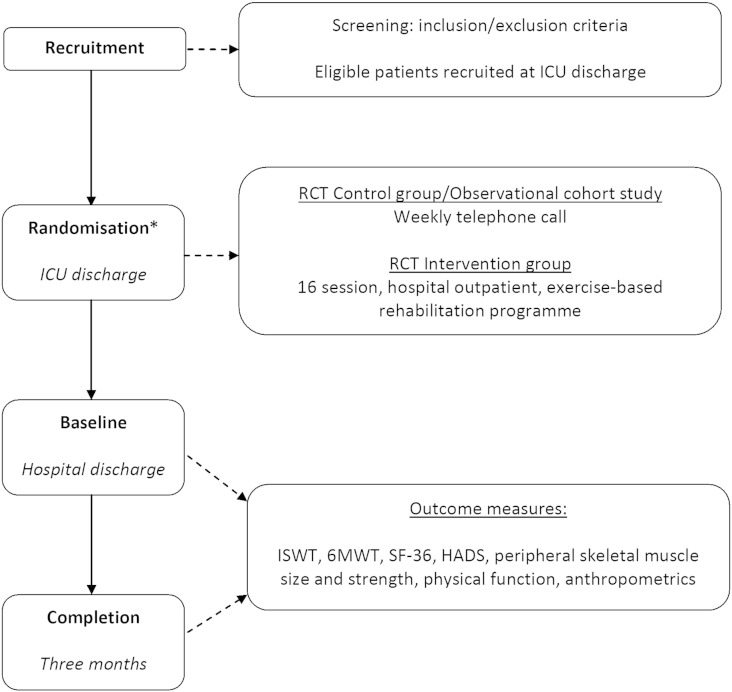
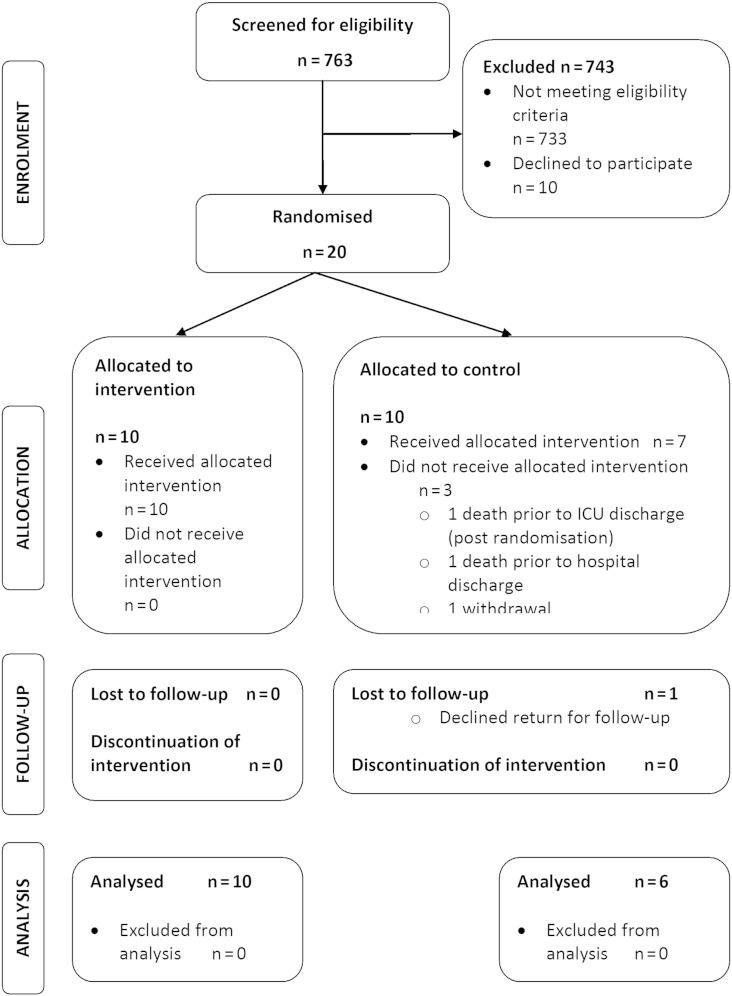
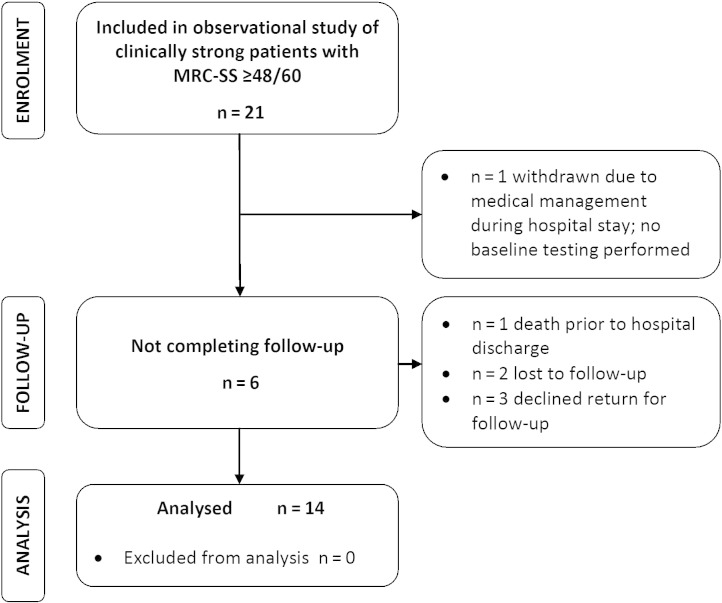
Materials and methods: Twenty adult patients, mechanically ventilated for more than 48 hours, with ICU-AW diagnosis at ICU discharge were included in a pilot feasibility randomized controlled trial receiving a 16-session exercise-based rehabilitation program. Twenty-one patients without ICU-AW participated in a nested observational cohort study. Feasibility, clinical, and patient-centered outcomes were measured at hospital discharge and at 3 months.
Results: Intervention feasibility was demonstrated by high adherence and patient acceptability, and absence of adverse events, but this must be offset by the low proportion of enrolment for those screened. The study was underpowered to detect effectiveness of the intervention. The use of manual muscle testing for the diagnosis of ICU-AW lacked robustness as an eligibility criterion and lacked discrimination for identifying rehabilitation requirements. Process evaluation of the trial identified methodological factors, categorized by "population," "intervention," "control group," and "outcome."
Conclusions: Important data detailing the design, conduct, and implementation of a multicenter randomized controlled trial of exercise-based rehabilitation for survivors of critical illness after hospital discharge have been reported.
Registration: Clinical Trials Identifier NCT00976807.
Keywords: Critical illness; Exercise rehabilitation; Hospital discharge; Intensive care unit–acquired weakness.
Copyright © 2015 The Authors. Published by Elsevier Inc. All rights reserved.
Figures
References
-
- Puthucheary Z.A., Rawal J., McPhail M., Connolly B., Ratnayake G., Chan P. Acute skeletal muscle wasting in critical illness. JAMA. 2013;310:1591–1600. - PubMed
-
- Needham D.M., Davidson J., Cohen H., Hopkins R.O., Weinert C., Wunsch H. Improving long-term outcomes after discharge from intensive care unit: report from a stakeholders' conference. Crit Care Med. 2012;40:502–509. - PubMed
-
- Bailey P., Thomsen G.E., Spuhler V.J., Blair R., Jewkes J., Bezdjian L. Early activity is feasible and safe in respiratory failure patients. Crit Care Med. 2007;35:139–145. - PubMed
-
- Burtin C., Clerckx B., Robbeets C., Ferdinande P., Langer D., Troosters T. Early exercise in critically ill patients enhances short-term functional recovery. Crit Care Med. 2009;37:2499–2505. - PubMed
-
- Morris P.E., Goad A., Thompson C., Taylor K., Harry B., Passmore L. Early intensive care unit mobility therapy in the treatment of acute respiratory failure. Crit Care Med. 2008;36:2238–2243. - PubMed
Publication types
MeSH terms
Associated data
Grants and funding
LinkOut - more resources
Full Text Sources
Other Literature Sources
Medical
