


Adipose stem cell microbeads as production sources for chondrogenic growth factors
- PMID: 25705097
- PMCID: PMC4329461
- DOI: 10.46582/jsrm.1002007
Adipose stem cell microbeads as production sources for chondrogenic growth factors
Abstract
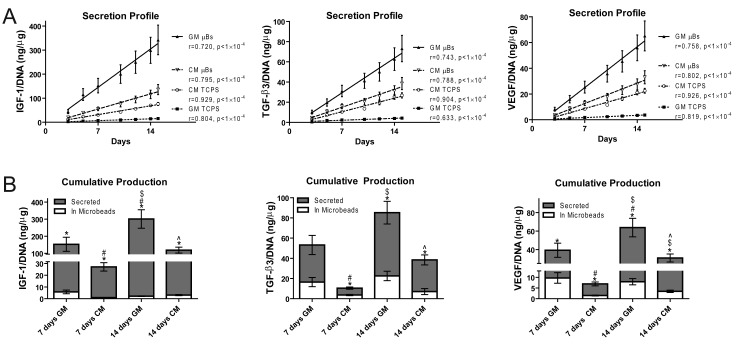
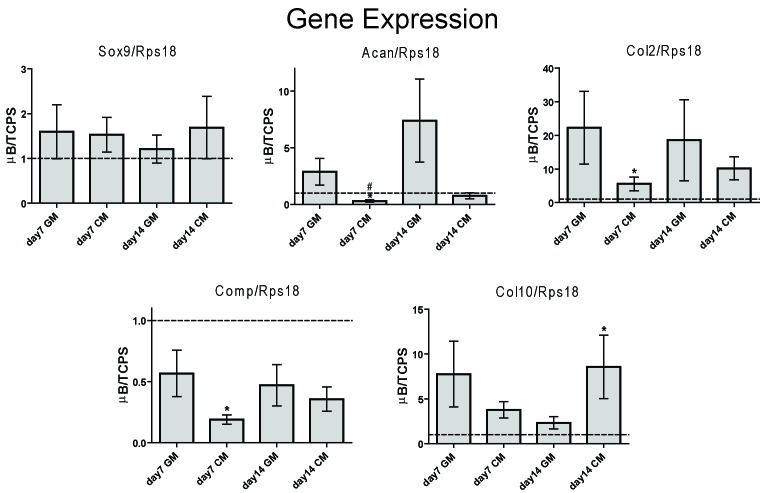
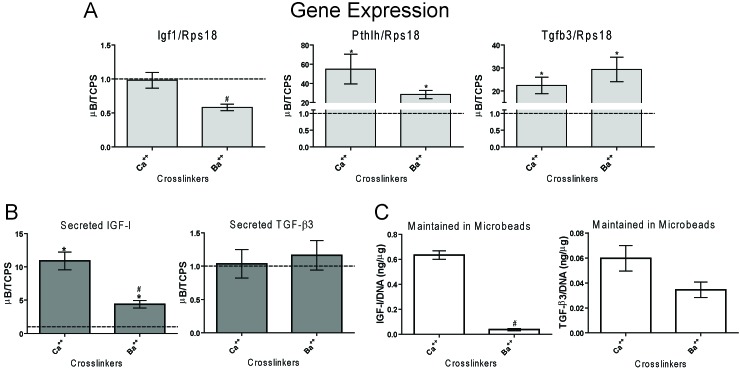
Microencapsulating stem cells in injectable microbeads can enhance delivery and localization, but their ability to act as growth factor production sources is still unknown. To address this concern, growth factor mRNA levels and production from alginate microbeads with encapsulated human adipose stem cells (ASC microbeads) cultured in both growth and chondrogenic media (GM and CM) were measured over a two week period. Human ASCs in microbeads were either commercially purchased (Lonza) or isolated from six human donors and compared to human ASCs on tissue culture polystyrene (TCPS). The effects of crosslinking and alginate compositions on growth factor mRNA levels and production were also determined. Secretion profiles of IGF-I, TGF-β3 and VEGF-A from commercial human ASC microbeads were linear and at a significantly higher rate than TCPS cultures over two weeks. For human ASCs derived from different donors, microencapsulation increased pthlh and both IGF-I and TGF-β3 secretion. CM decreased fgf2 and VEGF-A secretion from ASC microbeads derived from the same donor population. Crosslinking microbeads in BaCl2 instead of CaCl2 did not eliminate microencapsulation's beneficial effects, but did decrease IGF-I production. Increasing the guluronate content of the alginate microbead increased IGF-I retention. Decreasing alginate molecular weight eliminated the effects microencapsulation had on increasing IGF-I secretion. This study demonstrated that microencapsulation can enhance chondrogenic growth factor production and that chondrogenic medium treatment can decrease angiogenic growth factor production from ASCs, making these cells a potential source for paracrine factors that can stimulate cartilage regeneration.
Keywords: Adipose stem cells; Alginate; Cartilage; Growth factor delivery; Microencapsulation.
Figures




References
-
- Gimble J, Guilak F.Adipose-derived adult stem cells: isolation, characterization and differentiation potential. Cytotherapy 2003; 5(5):362-9. - PubMed
-
- Moyer HR, Kinney RC, Singh KA, Williams JK, Schwartz Z, Boyan BD.Alginate microencapsulation technology for the percutaneous delivery of adipose-derived stem cells. Ann Plast Surg 2010; 65(5):497-503. - PubMed
-
- Takahashi T, Ogasawara T, Kishimoto J, Liu G, Asato H, Nakatsuka T, Uchinuma E, Nakamura K, Kawaguchi H, Chung UI, Takato T, Hoshi K.Synergistic effects of FGF-2 with insulin or IGF-I on the proliferation of human auricular chondrocytes. Cell Transplant 2005; 14(9):683-93. - PubMed
-
- Liu Z, Lavine KJ, Hung IH, Ornitz DM.FGF18 is required for early chondrocyte proliferation, hypertrophy and vascular invasion of the growth plate. Dev Biol 2007; 302(1):80-91. - PubMed
-
- Hanada K, Solchaga LA, Caplan AI, Hering TM, Goldberg VM, Yoo JU, Johnstone B.BMP-2 induction and TGF-beta 1 modulation of rat periosteal cell chondrogenesis. J Cell Biochem 2001; 81 (2):284-94. - PubMed
LinkOut - more resources
Full Text Sources
Miscellaneous