


Evaluation of attitude to, knowledge of and barriers toward research among medical science students
- PMID: 25705121
- PMCID: PMC4336721
- DOI: 10.1186/s12930-015-0019-2
Evaluation of attitude to, knowledge of and barriers toward research among medical science students
Abstract
Background: Plans to increase the role of students in health research require data on students' knowledge and views of research. The aim of the study was to evaluate these factors toward research among medical science students.
Methods: Undergraduate and postgraduate students of three medicine, dentistry and pharmacy schools in Shiraz were enrolled in a cross-sectional descriptive study using questionnaires to provide details of the parameters of attitude to, knowledge of and barriers toward research for each individual. All data was coded for each of the parameters. Data analyses were performed by one-way ANOVA/Tukey and Student's t, Pearson's correlation and Chi-squared tests.
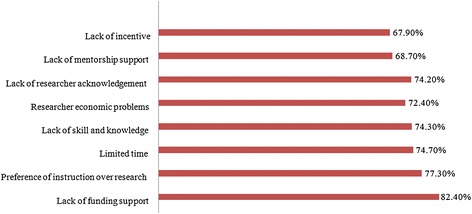
Results: A total of 384 questionnaires were returned complete. Mean student scores for attitude, knowledge and barriers were 68.97 ± 12.56, 70.99 ± 20.97 and 75.27 ± 15.38, respectively. On the knowledge parameter, 77.8% of students' scores fell above the middle of the possible attainable score, but 90% of attitude scores came in at below the middle of the possible attainable score. Undergraduate students (70.27 ± 12.00) showed a more positive attitude to research than postgraduate students (65.57 ± 13.06) (p = 0.001). Female students (72.97 ± 20.54) had greater knowledge than males (67.09 ± 21.56) (p = 0.010). Many barriers were highlighted by students such as lack of funding support and lack of time for research.
Conclusions: Students showed favorable knowledge of research, but their attitude to the field was inadequate. More attention must be placed on these parameters in the curriculum to improve student interest in health research. The impact of barrier factors on research demonstrates that there is a need for greater availability of information in order to solve the problems and change strategies for research.
Keywords: Approach; Awareness; Investigate; Medical students; Research.
Figures
References
-
- Vujaklija A, Hren D, Sambunjak D, Vodopivec I, Ivanis A, Marusić A, et al. Can teaching research methodology influence students’ attitude toward science? Cohort study and nonrandomized trial in a single medical school. J Investig Med. 2010;58(2):282–6. - PubMed
-
- Sridevi KV. Attitude of M. Ed. Students towards Research. Available at http://www.aiaer.net/ejournal/vol20108/14.htm
LinkOut - more resources
Full Text Sources
Other Literature Sources
