Review
. 2015 Feb 6:6:13.
doi: 10.3389/fendo.2015.00013. eCollection 2015.

Insulin, aging, and the brain: mechanisms and implications

Affiliations
Review

Insulin, aging, and the brain: mechanisms and implications

Abimbola A Akintola et al. Front Endocrinol (Lausanne). .

Abstract

There is now an impressive body of literature implicating insulin and insulin signaling in successful aging and longevity. New information from in vivo and in vitro studies concerning insulin and insulin receptors has extended our understanding of the physiological role of insulin in the brain. However, the relevance of these to aging and longevity remains to be elucidated. Here, we review advances in our understanding of the physiological role of insulin in the brain, how insulin gets into the brain, and its relevance to aging and longevity. Furthermore, we examine possible future therapeutic applications and implications of insulin in the context of available models of delayed and accelerated aging.

Keywords: accelerated aging; brain; delayed aging; inflammation; insulin; insulin receptors; longevity.


Figures
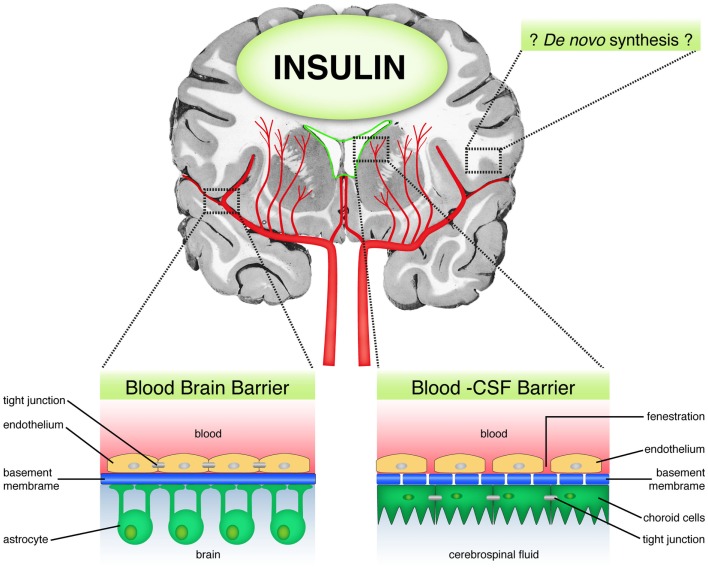
Figure 1
Figure 1
Sources of brain insulin. Schematic diagram showing the possible sources of brain insulin. First, peripheral insulin can access the brain through the blood brain barrier (BBB) via a selective, carrier-mediated transport system. Second, insulin may diffuse through the blood–CSF barrier in circumventricular regions, which are lacking in BBB. Third, there is some limited evidence suggesting the possibility of de novo insulin synthesis in the brain.
Figure 2
Figure 2
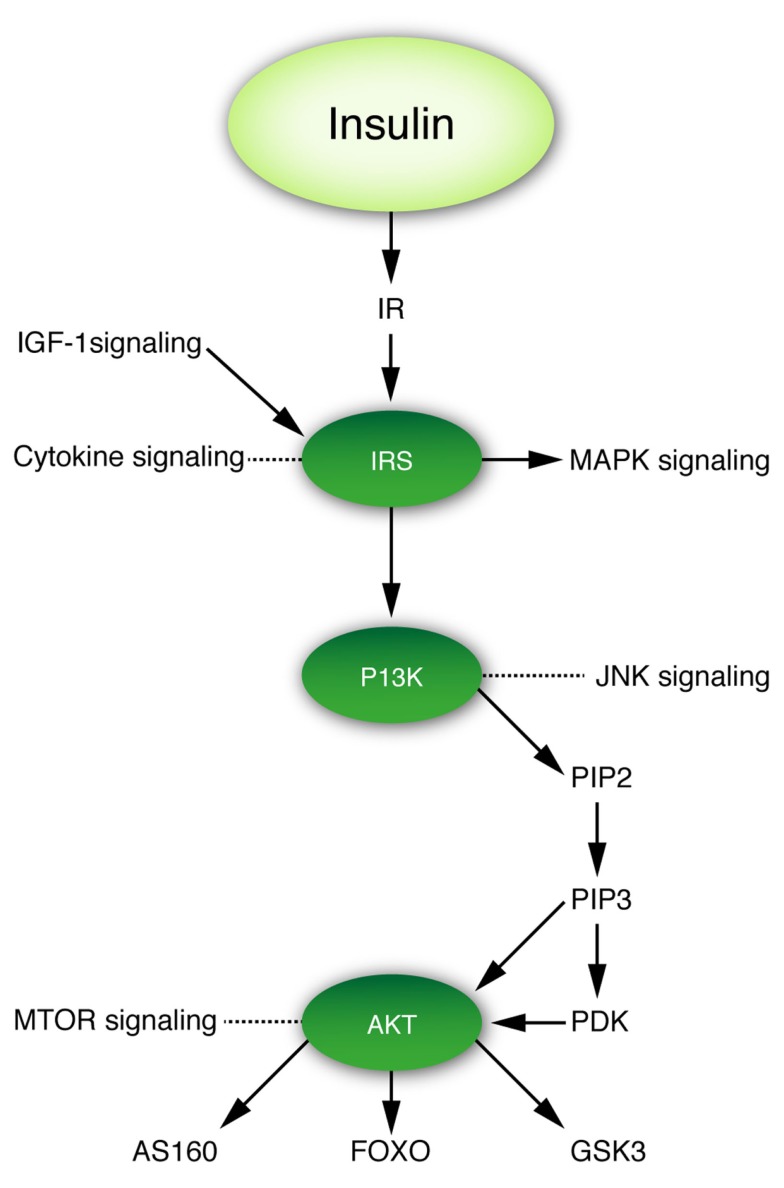
Insulin–IRS–P13K–AKT signaling cascade and its crosstalk with other signaling pathways. Figure denotes three critical nodes in insulin signaling that are important for the interaction of insulin signaling with other pathways relevant to this review.
Figure 3
Figure 3
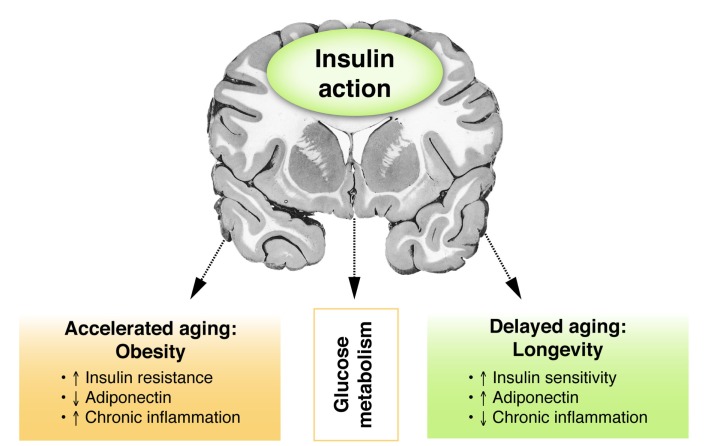
Insulin and the brain: models of accelerated and delayed aging. Figure showing the putative relationship between central insulin action and glucose metabolism in models of accelerated or delayed aging. Obesity as a model for accelerated aging is associated with peripheral insulin resistance, decreased adiponectin levels, and enhanced chronic inflammation. Opposite features are observed in healthy longevity as a model of delayed aging.
Figure 4
Figure 4
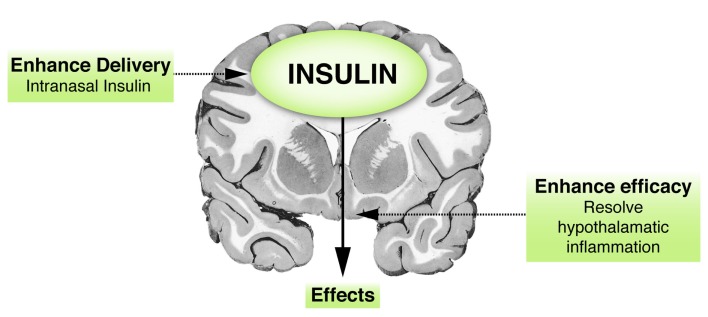
Insulin and the brain: therapeutic implications. Hypothetical figure presenting two possibilities of enhancing brain insulin action. First, a way of increasing insulin concentrations in the brain is via enhanced delivery, such as delivery via the intranasal route, which has been shown to have some beneficial effects. Second, insulin action could probably also be augmented by enhancing its efficacy, for example, via resolution of brain (hypothalamic) inflammation.

References

    1. Holzenberger M, Dupont J, Ducos B, Leneuve P, Geloen A, Even PC, et al. IGF-1 receptor regulates lifespan and resistance to oxidative stress in mice. Nature (2003) 421(6919):182–7. 10.1038/nature01298 - DOI - PubMed
    1. Iser WB, Gami MS, Wolkow CA. Insulin signaling in Caenorhabditis elegans regulates both endocrine-like and cell-autonomous outputs. Dev Biol (2007) 303(2):434–47. 10.1016/j.ydbio.2006.04.467 - DOI - PMC - PubMed
    1. Bartke A, Chandrashekar V, Dominici F, Turyn D, Kinney B, Steger R, et al. Insulin-like growth factor 1 (IGF-1) and aging: controversies and new insights. Biogerontology (2003) 4(1):1–8. 10.1023/A:1022448532248 - DOI - PubMed
    1. Bluher M, Kahn BB, Kahn CR. Extended longevity in mice lacking the insulin receptor in adipose tissue. Science (2003) 299(5606):572–4. 10.1126/science.1078223 - DOI - PubMed
    1. Fulop T, Larbi A, Douziech N. Insulin receptor and ageing. Pathol Biol (2003) 51(10):574–80. 10.1016/j.patbio.2003.09.007 - DOI - PubMed

LinkOut - more resources