Case Reports
doi: 10.5090/kjtcs.2015.48.1.70.
Epub 2015 Feb 5.
Extra-anatomic Aortic Bypass for the Management of Mid-Aortic Syndrome Caused by Takayasu arteritis
Affiliations
- PMID: 25705603
- PMCID: PMC4333854
- DOI: 10.5090/kjtcs.2015.48.1.70
Item in Clipboard
Case Reports
Extra-anatomic Aortic Bypass for the Management of Mid-Aortic Syndrome Caused by Takayasu arteritis
Korean J Thorac Cardiovasc Surg.
2015 Feb.
Abstract
Lower limb ischemia caused by multiple stenosis of the thoracoabdominal aorta is one of the rare clinical manifestations of Takayasu arteritis. The optimal management of such mid-aortic syndrome related with Takayasu arteritis has not been established to date. Here we report a case of extra-anatomic aortic bypass through minimally invasive techniques to treat lower limb ischemia caused by Takayasu arteritis.
Keywords: Aorta; Bypass surgery; Takayasu arteritis.
Figures

Preoperative computed tomography angiography. (A) The ascending aorta, aortic arch and supra aortic arteries are relatively well preserved in anterior view. (B) Multifocal luminal narrowing of the descending thoracic and abdominal aorta are shown in posterior view. (C) Axillo- femoral bypass surgery was untaken to relieve ischemic symptoms of the legs.

(A) An operative photograph showing an incision of upper hemi- sternotomy and mini-laparotomy. The ascending aorta-to-infrarenal abdominal aorta bypassing with the use of a Gelweave graft was performed. (B) The graft was anastomosed proximally to the ascending aorta and (C) distally to the infrarenal abdominal aorta.
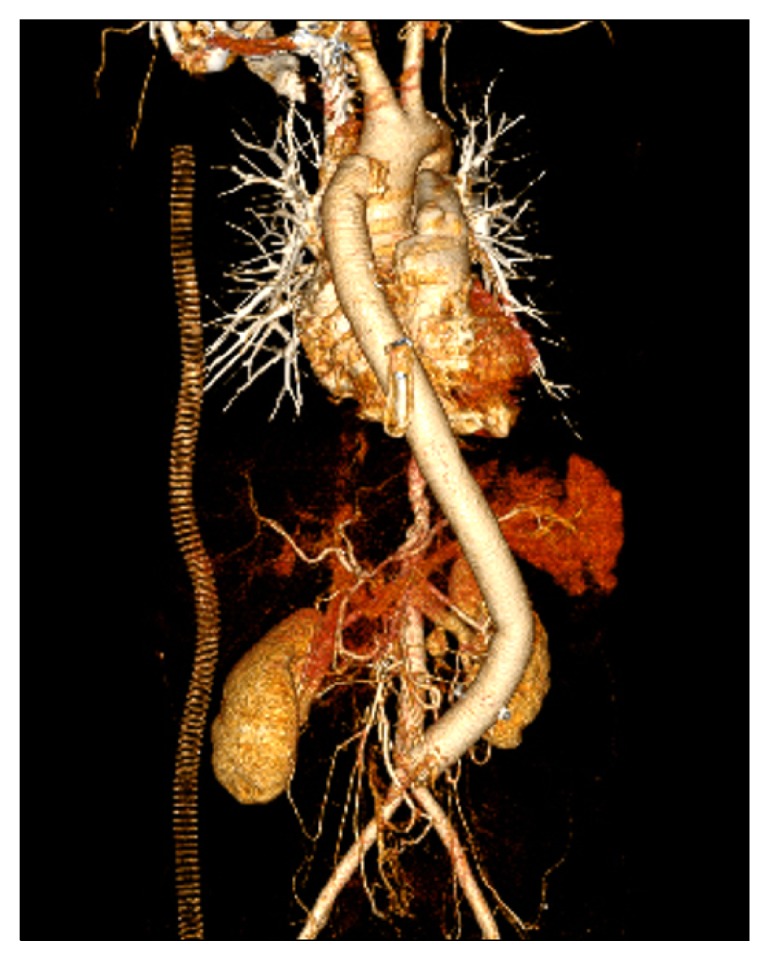
Follow-up computed tomography showing a widely patent bypass graft without any structural abnormality.
References
-
- Saxena A, Kothari SS, Sharma S, Juneja R, Srivastava S. Percutaneous transluminal angioplasty of the aorta in children with nonspecific aortoarteritis: acute and follow-up results with special emphasis on left ventricular function. Catheter Cardiovasc Interv. 2000;49:419–24. doi: 10.1002/(SICI)1522-726X(200004)49:4<419::AID-CCD15>3.0.CO;2-I. - DOI - PubMed
Publication types
LinkOut - more resources
Full Text Sources
Other Literature Sources