


Accuracy and reproducibility of adipose tissue measurements in young infants by whole body magnetic resonance imaging
- PMID: 25706876
- PMCID: PMC4338239
- DOI: 10.1371/journal.pone.0117127
Accuracy and reproducibility of adipose tissue measurements in young infants by whole body magnetic resonance imaging
Abstract
Purpose: MR might be well suited to obtain reproducible and accurate measures of fat tissues in infants. This study evaluates MR-measurements of adipose tissue in young infants in vitro and in vivo.
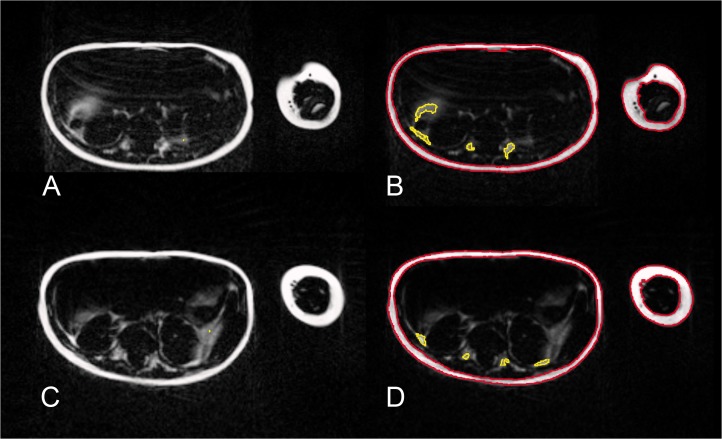
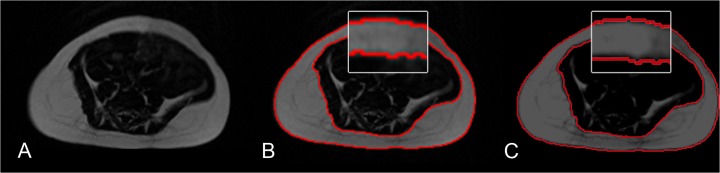
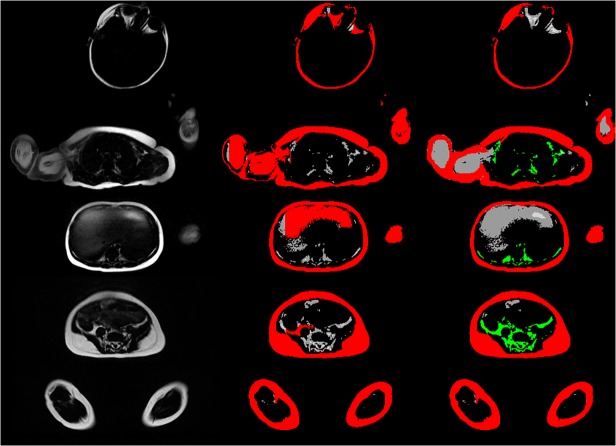
Material and methods: MR images of ten phantoms simulating subcutaneous fat of an infant's torso were obtained using a 1.5T MR scanner with and without simulated breathing. Scans consisted of a cartesian water-suppression turbo spin echo (wsTSE) sequence, and a PROPELLER wsTSE sequence. Fat volume was quantified directly and by MR imaging using k-means clustering and threshold-based segmentation procedures to calculate accuracy in vitro. Whole body MR was obtained in sleeping young infants (average age 67±30 days). This study was approved by the local review board. All parents gave written informed consent. To obtain reproducibility in vivo, cartesian and PROPELLER wsTSE sequences were repeated in seven and four young infants, respectively. Overall, 21 repetitions were performed for the cartesian sequence and 13 repetitions for the PROPELLER sequence.
Results: In vitro accuracy errors depended on the chosen segmentation procedure, ranging from 5.4% to 76%, while the sequence showed no significant influence. Artificial breathing increased the minimal accuracy error to 9.1%. In vivo reproducibility errors for total fat volume of the sleeping infants ranged from 2.6% to 3.4%. Neither segmentation nor sequence significantly influenced reproducibility.
Conclusion: With both cartesian and PROPELLER sequences an accurate and reproducible measure of body fat was achieved. Adequate segmentation was mandatory for high accuracy.
Conflict of interest statement
Figures

References
-
- Kramer MS, Morin I, Yang H, Platt RW, Usher R, et al. (2002) Why are babies getting bigger? Temporal trends in fetal growth and its determinants. J Pediatr 141: 538–542. - PubMed
-
- Odlind V, Haglund B, Pakkanen M, Otterblad Olausson P (2003) Deliveries, mothers and newborn infants in Sweden, 1973–2000. Trends in obstetrics as reported to the Swedish Medical Birth Register. Acta Obstet Gynecol Scand 82: 516–528. - PubMed
-
- Rogers I (2003) The influence of birthweight and intrauterine environment on adiposity and fat distribution in later life. Int J Obes Relat Metab Disord 27: 755–777. - PubMed
-
- Rugholm S, Baker JL, Olsen LW, Schack-Nielsen L, Bua J, et al. (2005) Stability of the association between birth weight and childhood overweight during the development of the obesity epidemic. Obes Res 13: 2187–2194. - PubMed
-
- Kurth BM, Schaffrath Rosario A (2007) [The prevalence of overweight and obese children and adolescents living in Germany. Results of the German Health Interview and Examination Survey for Children and Adolescents (KiGGS)]. Bundesgesundheitsblatt Gesundheitsforschung Gesundheitsschutz 50: 736–743. - PubMed
Publication types
MeSH terms
LinkOut - more resources
Full Text Sources
Other Literature Sources
Medical
