


Differing evolutionary histories of the ACTN3*R577X polymorphism among the major human geographic groups
- PMID: 25706920
- PMCID: PMC4338210
- DOI: 10.1371/journal.pone.0115449
Differing evolutionary histories of the ACTN3*R577X polymorphism among the major human geographic groups
Abstract
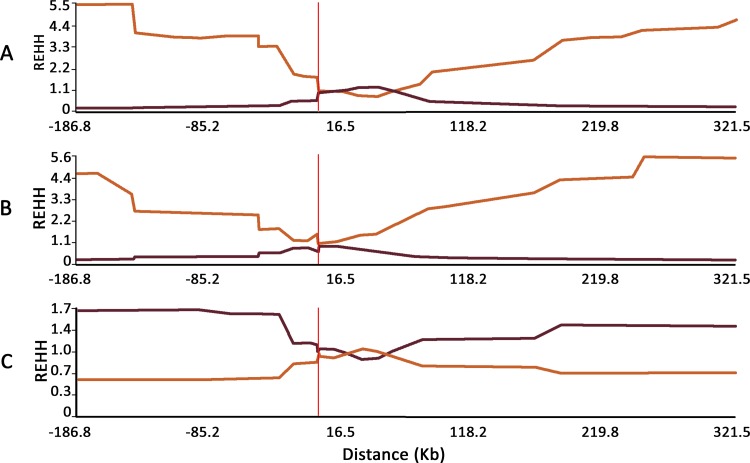
It has been proposed that the functional ACTN3*R577X polymorphism might have evolved due to selection in Eurasian human populations. To test this possibility we surveyed all available population-based data for this polymorphism and performed a comprehensive evolutionary analysis of its genetic diversity, in order to assess the action of adaptive and random mechanisms on its variation across human geographical distribution. The derived 577X allele increases in frequency with distance from Africa, reaching the highest frequencies on the American continent. Positive selection, detected by an extended haplotype homozygosisty test, was consistent only with the Eurasian data, but simulations with neutral models could not fully explain the results found in the American continent. It is possible that particularities of Native American population structure could be responsible for the observed allele frequencies, which would have resulted from a complex interaction between selective and random factors.
Conflict of interest statement
Figures

References
-
- Mills M, Yang N, Weinberger R,Vander Woude DL, Beggs AH, et al. (2001) Differential expression of the actin-binding proteins, alpha-actinin-2 and -3, in different species: implications for the evolution of functional redundancy. Hum Mol Genet 10: 1335–1346. - PubMed
-
- North KN, Yang N, Wattanasirichaigoon D, Mills M, Easteal S, et al. (1999) A common nonsense mutation results in alpha-actinin-3 deficiency in the general population. Nat Genet 21: 353–354. - PubMed
-
- MacArthur DG, Seto JT, Raftery JM, Quinlan KG, Huttley GA, et al. (2007) Loss of ACTN3 gene function alters mouse muscle metabolism and shows evidence of positive selection in humans. Nat Genet 39: 1261–1265. - PubMed
Publication types
MeSH terms
Substances
LinkOut - more resources
Full Text Sources
Other Literature Sources
